

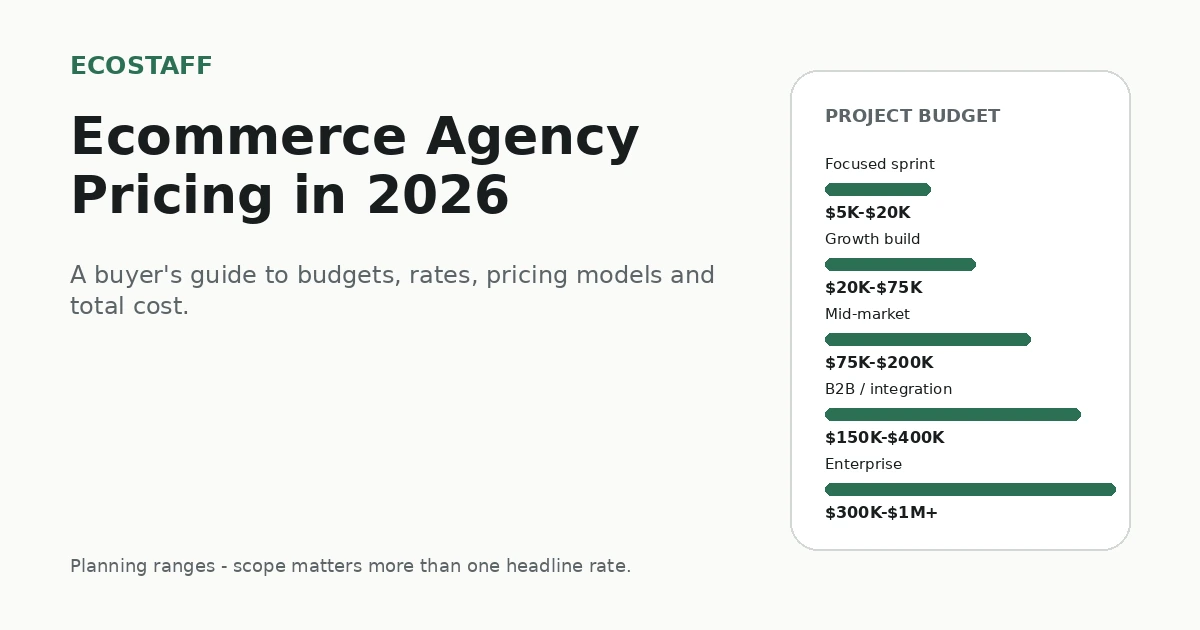
Quick answer: In 2026, an ecommerce agency engagement can range from roughly $5,000-$20,000 for a focused sprint to $300,000-$1 million or more for a complex enterprise program. The useful number is not an industry-wide average. Budget is driven by scope, platform fit, integrations, data migration, team seniority, QA, launch risk and post-launch ownership. For buyers, the best comparison is total cost for the required outcome – not the lowest hourly rate.
Ecommerce agency pricing is difficult to compare because two proposals with the same headline price can contain very different amounts of work. One may include discovery, UX, data migration, integration testing, SEO migration, launch support and a senior delivery team. Another may cover only design and development, leaving the buyer to discover missing work later.
This guide gives buyers a practical way to budget an ecommerce project in 2026, understand common pricing models, separate platform fees from agency fees, identify hidden costs and compare proposals on the same basis. If you are still deciding what type of partner you need, start with Ecostaff’s guide on how to choose an ecommerce agency.
How much does an ecommerce agency cost in 2026?
There is no single reliable market average for an ecommerce agency project because the term can describe anything from a two-week conversion audit to a multi-country replatforming program. A better starting point is to budget by project class.
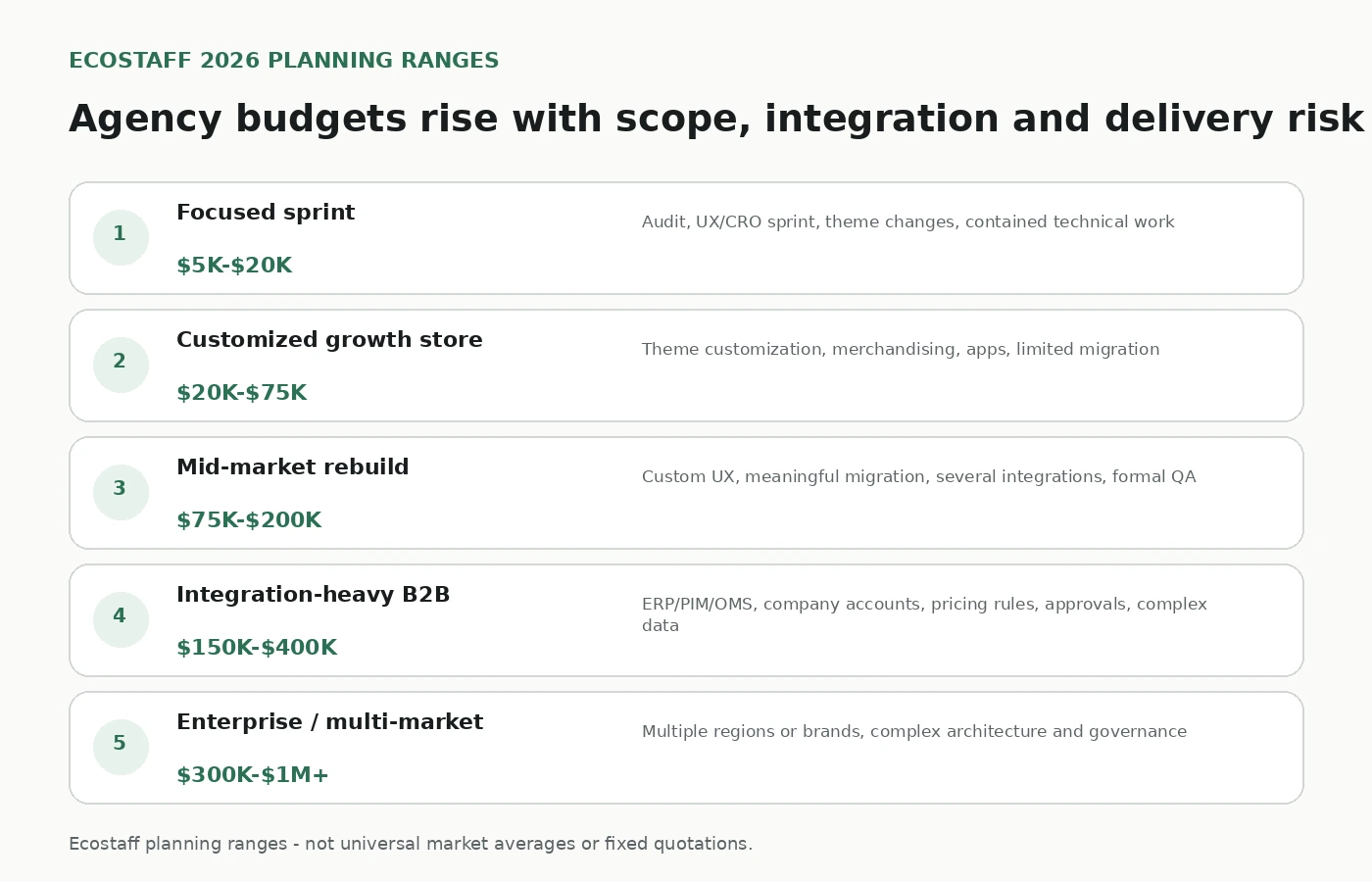
| Project class | Typical scope | Ecostaff planning range | Typical risk level |
|---|---|---|---|
| Focused sprint | Audit, CRO/UX sprint, theme work, contained technical change | $5,000-$20,000 | Low to moderate |
| Customized growth store | Theme customization, merchandising, apps, limited migration or integration | $20,000-$75,000 | Moderate |
| Mid-market rebuild or replatform | Custom UX, meaningful migration, several integrations, formal QA | $75,000-$200,000 | Moderate to high |
| Integration-heavy B2B | ERP/PIM/OMS, company accounts, price rules, approvals, complex data | $150,000-$400,000 | High |
| Enterprise / multi-market / composable | Multiple regions or brands, large integrations, complex architecture and governance | $300,000-$1,000,000+ | Very high |
Important: these are Ecostaff planning ranges, not universal market averages and not quotations. They intentionally overlap because complexity matters more than company size. A high-revenue DTC brand with a clean SaaS setup can be easier to deliver than a smaller manufacturer with customer-specific pricing, ERP-controlled inventory, RFQ workflows and several legal entities.
Why published price benchmarks can look contradictory
Current public sources illustrate why a single headline number can mislead. Shopify’s September 2026 ecommerce development guide says most reviewed custom ecommerce projects in its cited benchmark cost under $10,000 and lists many agency rates around $24-$49 per hour. That can be a useful reference for smaller or more standardized work, but it does not describe every mid-market or enterprise transformation.
At the other end, Elogic Commerce’s 2026 cost guide publishes its own planning ranges of roughly $80,000-$250,000 for a custom mid-market build, $125,000-$400,000 for integration-heavy B2B work and $400,000-$1 million or more for complex enterprise or composable programs. Those are agency-published planning ranges, not a neutral market average, but they show how quickly cost rises when integration and operational complexity enter the scope.
The lesson is not that one source is right and another is wrong. They are often describing different project classes. Before comparing numbers, normalize the scope.
What actually drives ecommerce agency pricing?
1. Scope and business requirements
Scope is the largest cost driver. A theme refresh is not the same project as a full replatform. Add B2B pricing, subscriptions, international storefronts, marketplaces, complex promotions, product configuration or custom checkout logic and the delivery effort changes materially.
The scope should be expressed as business capabilities, not only pages. “Build a product page” is weak scope. “Support configurable products with market-specific pricing, real-time stock, subscriptions and a customer-specific eligibility rule” is much closer to the work an agency must estimate.
2. Integrations
ERP, PIM, OMS, CRM, warehouse, tax, search, loyalty and payment integrations are frequently more expensive than the visible storefront work. The difficult part is rarely sending one API request. It is mapping data, deciding which system owns each field, handling failures, retries and duplicates, reconciling records, monitoring production and defining what happens when one system is unavailable.
A proposal that says “ERP integration included” without naming the data flows, frequency, ownership rules, error handling and testing assumptions is not yet a useful estimate.
3. Data migration
Product data, customers, orders, redirects, content, reviews, subscriptions, gift cards, B2B accounts and price lists may all require different migration logic. Dirty source data increases cost because the agency must spend time on normalization, mapping, validation and repeated migration rehearsals.
Buyers should ask for a data inventory before accepting a migration estimate. The number of records matters, but the number of data types, relationships and exceptions often matters more.
4. UX and design depth
A configured commercial theme is cheaper than a research-led custom experience. Cost rises when the scope includes customer research, information architecture, a design system, prototyping, accessibility work, component states, responsive behavior and usability validation.
The difference is important because two proposals may both say “UX/UI design” while one includes ten polished page mockups and the other includes a reusable component system that covers hundreds of real storefront states.
5. Platform and architecture
Platform choice affects the development model, hosting responsibility, extension ecosystem, checkout constraints, deployment process and specialists required. A managed SaaS build with standard requirements can be efficient. A headless or composable architecture can add frontend infrastructure, APIs, observability and more integration boundaries.
Use Ecostaff’s platform directory to compare providers by platform expertise.
6. Team seniority and operating model
A senior architect costs more per hour than a junior developer, but the cheapest hourly team is not automatically the cheapest project. Rework, weak discovery, slow decision-making, poor QA and integration mistakes can erase the saving.
Buyers should ask who will actually work on the account, how much time senior people will spend, and how responsibilities change after the sale. The team presented during the pitch is not always the team that delivers the work.
7. QA, launch and post-launch ownership
Testing is a budget line, not a final-day activity. Functional testing, integration testing, regression, performance checks, analytics validation, accessibility review, migration reconciliation and user acceptance can represent a meaningful share of the project. The same is true for launch planning, rollback, monitoring and hypercare.
If a proposal has no visible QA, migration rehearsal or launch stabilization budget, ask where that work is hiding.
Agency fee vs platform fee: do not mix them
One of the most common budgeting errors is treating the ecommerce platform subscription as if it were the total technology cost. Platform fees and implementation fees are different categories.
| Platform | Public 2026 pricing position | What the agency budget still needs to cover |
|---|---|---|
| Shopify Plus | Starts at $2,300/month on a 3-year term or $2,500/month on a 1-year term for standard setups | Discovery, design, theme/storefront work, migration, apps, integrations, QA and support |
| BigCommerce | Performance starts at $1,499/month billed annually; other plans have lower published prices | Implementation, theme/storefront customization, migration, integrations, third-party tools and support |
| WooCommerce | Core platform is free; total cost depends on hosting, extensions, payments and development | Architecture, hosting setup, custom development, plugins/extensions, security, QA and maintenance |
| Adobe Commerce | Adobe uses quote-based pricing rather than one universal public list price | Implementation, extensions, integrations, migration, environments, performance, upgrades and long-term ownership |
Current official sources confirm these different pricing structures: Shopify Plus pricing, BigCommerce pricing, WooCommerce pricing and Adobe Commerce pricing.
The practical implication is simple: a cheaper platform does not guarantee a cheaper implementation, and a higher platform subscription can sometimes reduce custom development or maintenance. Compare total cost of ownership, not one line item.
The four pricing models buyers will see most often
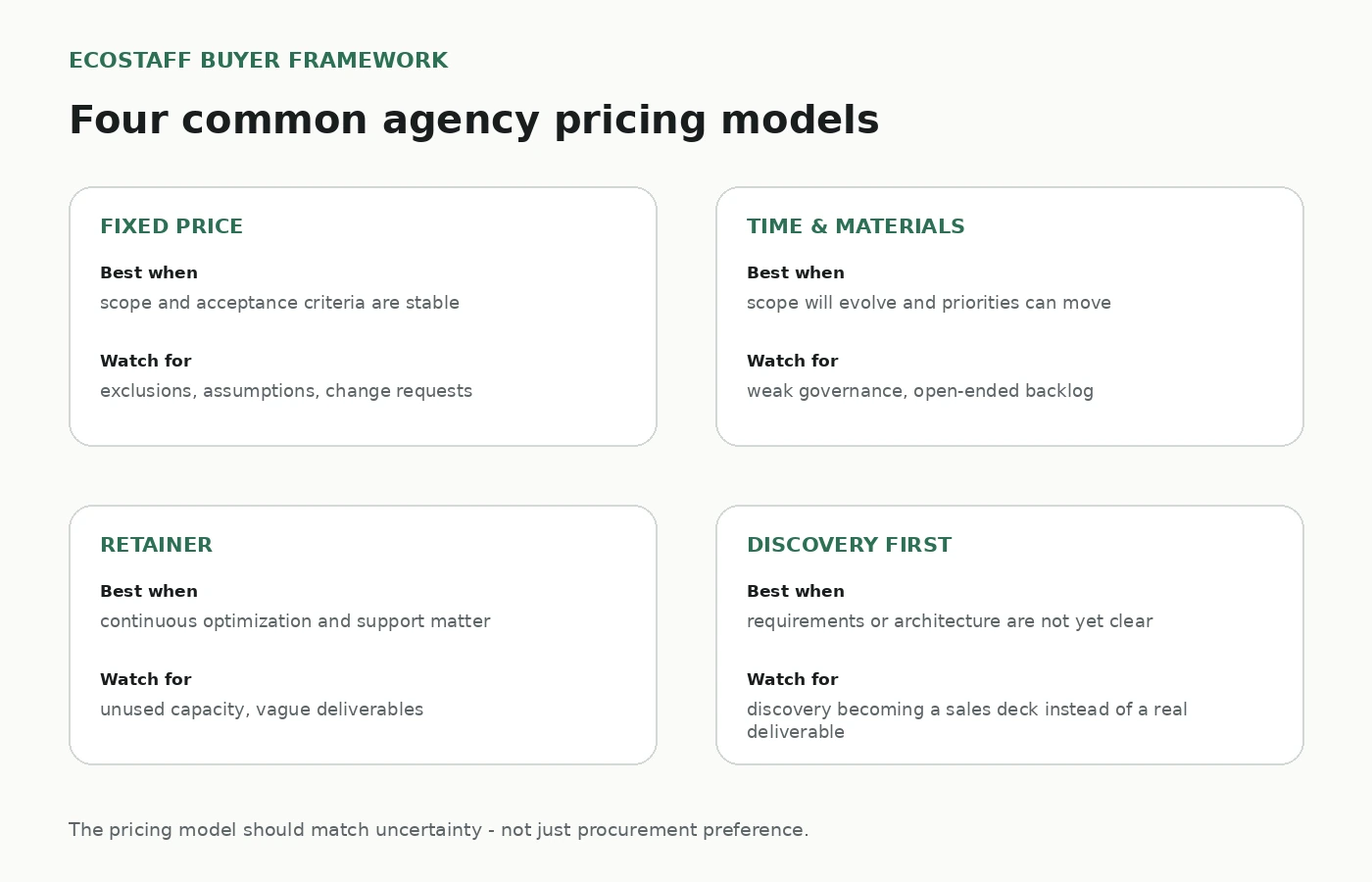
| Model | How it works | Works well when | Main buyer risk |
|---|---|---|---|
| Fixed price | Agency commits to defined scope and price | Requirements and acceptance criteria are stable | Important work may sit outside the fixed scope |
| Time and materials | Buyer pays for actual delivery time | Priorities or requirements are expected to change | Open-ended backlog without strong governance |
| Monthly retainer | Recurring capacity or services for a monthly fee | Optimization, support and continuous delivery are ongoing | Paying for capacity without clear outcomes |
| Discovery first | Paid discovery defines architecture, scope and estimate before build | Complexity or requirements are uncertain | Discovery becomes a sales exercise instead of a reusable deliverable |
Fixed price
Fixed price is useful when the buyer can describe exactly what is being delivered and how acceptance will be measured. It becomes fragile when the project contains unknown integrations, incomplete data or evolving business rules. In those situations, a low fixed price often means the agency has either added a large risk premium or left important assumptions outside the scope.
Time and materials
Time and materials gives both sides flexibility. It works best when the buyer has a strong product owner, prioritized backlog, transparent burn reporting and frequent checkpoints. The model is not a license for unlimited spending. Good governance should show what was delivered, what changed, what was learned and what the next increment is expected to cost.
Retainer
A retainer makes sense for continuous CRO, SEO, development, maintenance, lifecycle marketing or analytics. Compare retainers by named team, expected capacity, service levels, carry-over rules, meeting overhead, reporting and what happens when demand exceeds the included capacity.
Discovery first
For complex replatforming, B2B or integration work, paid discovery can reduce uncertainty before a large commitment. A useful discovery phase should leave the buyer with tangible outputs such as requirements, architecture decisions, data and integration maps, prioritized scope, risk register, delivery plan and a more defensible estimate.
How Ecostaff recommends building a realistic budget
Instead of starting with a target number and asking agencies to fit it, build a planning budget from the expected work.
Quick answer: Delivery effort x blended delivery rate + third-party costs + contingency = planning budget. The formula is intentionally simple. The quality of the assumptions behind each input matters more than mathematical precision.
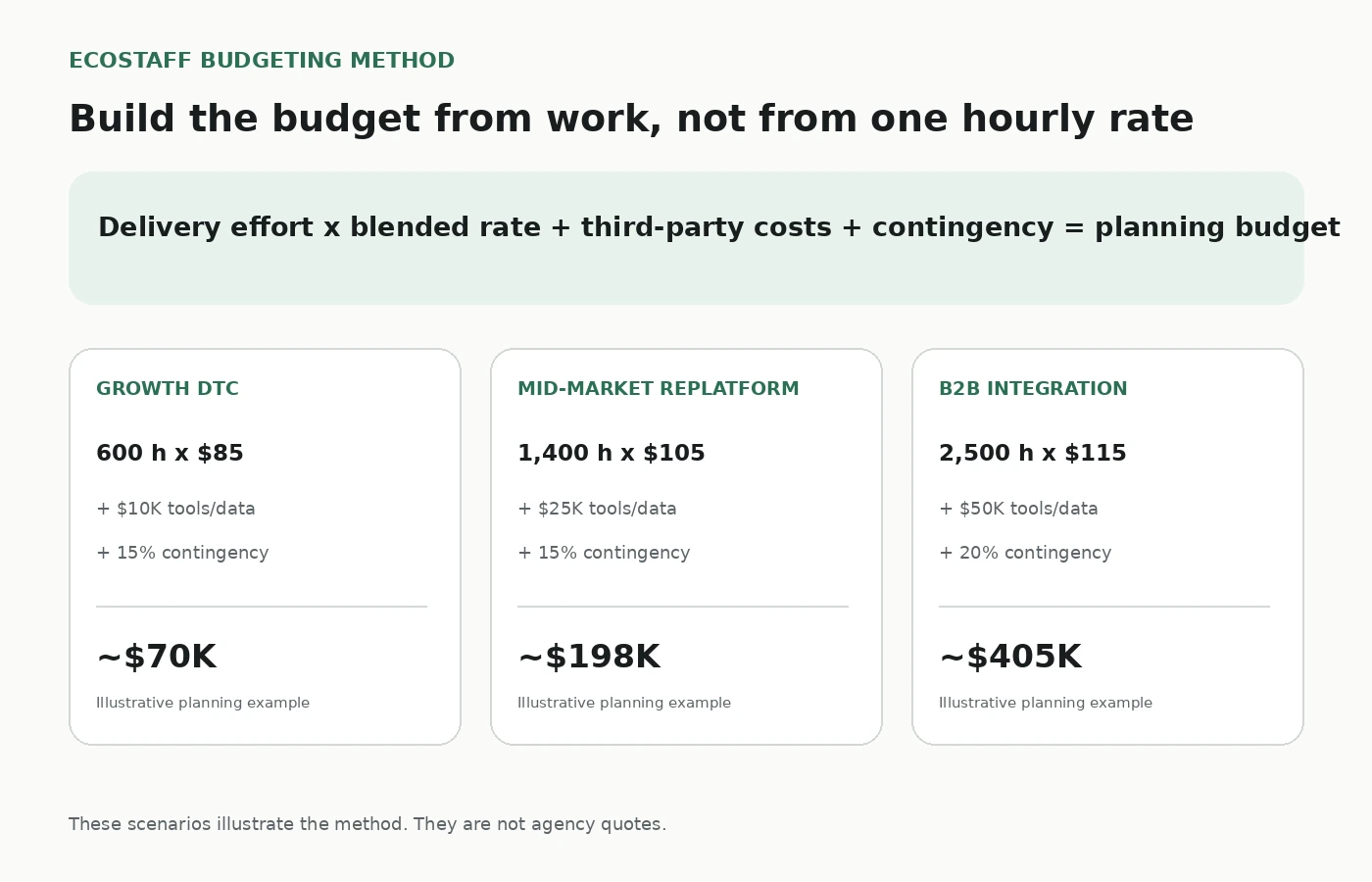
For example, 600 delivery hours at an illustrative blended rate of $85 per hour equals $51,000. Add $10,000 for tools, data or migration support and a 15% contingency and the planning budget becomes about $70,000. That is not a market quote – it is a transparent way to test whether a proposal is plausible.
The same logic can expose unrealistic pricing. If the work genuinely requires architecture, custom UX, two integrations, historical data migration, QA and launch support, a proposal that only funds a few hundred hours should trigger questions about what is missing.
A blended rate is often more useful than the rate of one developer because ecommerce projects use several roles. Discovery may need a strategist and architect, UX may need a designer and researcher, delivery may use frontend and backend specialists, and launch may need QA, analytics and project leadership.
What should be included in an ecommerce agency quote?
A useful proposal should let you understand what you are buying, what is excluded and how the agency reached the estimate. At minimum, ask for the following:
- Discovery and requirements: workshops, research, technical audit, requirements and architecture decisions.
- UX and design: research, wireframes, design system, page templates, responsive states and accessibility assumptions.
- Development: storefront, backend/custom logic, checkout work, theme or component development.
- Integrations: systems, data ownership, error handling, testing responsibilities and environments.
- Migration: exactly which data types are migrated and how many rehearsal runs are included.
- SEO migration: URL mapping, redirects, metadata, crawl checks and launch validation when applicable.
- Analytics: tracking plan, implementation, consent dependencies and QA.
- Quality assurance: functional, regression, integration, device/browser, performance and user acceptance support.
- Project management: governance, meetings, reporting, backlog management and change control.
- Launch: cutover plan, rollback approach, smoke tests, monitoring and hypercare.
- Post-launch support: warranty, support hours, service levels, maintenance and optimization options.
- Third-party costs: apps, plugins, hosting, middleware, search, analytics, testing tools and licenses.
A proposal does not need to price every task individually, but the buyer should be able to see whether each major workstream exists and what assumptions define it.
Hidden costs that frequently appear after the proposal
Content and product data preparation
Agencies often assume the buyer will deliver clean product data, photography, translations, copy and legal content on time. If that assumption is wrong, the project can stall or require additional content and data work.
For catalog-heavy businesses, product data cleanup can become a project of its own. Missing attributes, inconsistent variants, duplicate SKUs and unclear category rules can delay migration even when the new storefront is technically ready.
Internal team time
Your own people are part of total cost. Product owners, merchandisers, finance, operations, IT, legal and executives may need to attend workshops, make decisions, validate data and perform user acceptance testing. A cheap external proposal can still be expensive if it consumes excessive internal time.
Apps, extensions and middleware
Recurring licenses can materially change three-year cost. Search, subscriptions, loyalty, reviews, tax, fraud, personalization, integration middleware and experimentation tools should be listed separately from agency services.
Change requests
A fixed-price proposal with aggressive assumptions may create a stream of change requests later. Before signing, understand what counts as a change, who approves it, how it is estimated and whether there is a threshold for small adjustments.
Maintenance and continuous improvement
Launch is not the end of ownership. Budget for platform changes, app or extension updates, security, performance, conversion work, analytics, merchandising improvements and new business requirements.
Payment processing
Payment fees are usually not an agency fee, but they belong in TCO. Current platform pricing can also change the economics depending on the provider used. For example, BigCommerce changed its self-serve plan structure and payment-provider fee mechanics on June 1, 2026, which is documented on its official 2026 pricing update page.
A better way to compare two ecommerce agency proposals
Do not compare only the total at the bottom of the page. Normalize every proposal against the same work breakdown.
| Comparison area | Proposal A | Proposal B | What to verify |
|---|---|---|---|
| Discovery | Included / excluded | Included / excluded | Deliverables, workshops, architecture depth |
| Design | Pages or system? | Pages or system? | Research, components, responsive and accessibility states |
| Development | Hours / scope | Hours / scope | Custom logic, checkout, frontend/backend responsibilities |
| Integrations | Named systems | Named systems | Error handling, testing, monitoring, ownership |
| Migration | Data types | Data types | History, redirects, validation, rehearsal runs |
| QA | Coverage | Coverage | Regression, integration, performance, UAT support |
| Launch | Support window | Support window | Cutover, rollback, monitoring, hypercare |
| Post-launch | Warranty / retainer | Warranty / retainer | SLAs, included capacity, response times |
Ecostaff’s broader evaluation methodology is designed around the same principle: compare providers using consistent evidence and criteria rather than one marketing claim.
A useful procurement step is to create one normalized comparison sheet before discussing the final commercial decision. If Proposal A includes migration, QA and hypercare and Proposal B does not, the total prices are not comparable until the missing work is added back.
When the cheapest agency becomes the most expensive option
Low price is not automatically a red flag. A specialist may be genuinely efficient, a regional delivery model may lower cost, or the scope may be simpler than alternatives assume. The risk appears when the low price cannot be reconciled with the work required.
Warning signs include:
- The proposal has a total price but no work breakdown.
- Discovery is skipped even though requirements are uncertain.
- The sales team is senior but the delivery team is unnamed.
- Integrations are described as simple connections with no error-handling or reconciliation scope.
- Data migration is included without listing the data to be migrated.
- QA is a single line item with no coverage.
- SEO migration is absent from a replatforming project.
- Launch support ends immediately after deployment.
- Change-control rules are missing.
- The agency cannot explain which assumptions would move the estimate.
If you are shortlisting providers, compare companies in the Ecostaff company directory and use the services directory to narrow the list by the work you actually need.
How platform choice changes agency cost
Shopify and Shopify Plus
Shopify can reduce infrastructure and upgrade responsibility for standard use cases, but agency costs still vary widely. A theme-led implementation can be contained, while Shopify Plus B2B, multi-store, international, ERP, subscriptions, custom apps or headless storefronts can move the project into a much larger budget.
Shopify Plus itself currently starts at $2,300 per month on a three-year term or $2,500 per month on a one-year term for standard setups. That platform fee should not be confused with implementation.
WooCommerce
WooCommerce’s core software is free, but free software is not free ownership. Hosting, security, premium extensions, custom development and maintenance all matter.
WooCommerce’s own pricing page currently publishes sample merchant TCO breakdowns where initial development examples range from $60,000 to $200,000. These are examples from specific merchant profiles, not general market averages, but they illustrate how business complexity can dominate the license cost.
BigCommerce
BigCommerce is managed SaaS, but implementation cost still depends on storefront customization, data, integrations, B2B needs and third-party tools. Its 2026 pricing structure also uses GMV thresholds and different plan economics, so buyers should model platform cost and agency cost separately.
As of September 2026, BigCommerce’s Performance plan starts at $1,499 per month when billed annually. Lower self-serve tiers have published monthly and annual pricing.
Adobe Commerce
Adobe Commerce typically appears in more complex mid-market and enterprise environments. Adobe does not publish one universal dollar list price for Commerce, so license discussions are quote-based.
Implementation cost can be driven by B2B workflows, integrations, extensions, performance, multi-site requirements, upgrades and long-term application ownership. The absence of a public license price is another reason to request a full three-year cost model rather than focusing only on implementation.
How much contingency should you budget?
For a well-defined project with clean data and standard integrations, buyers may use a smaller contingency. For a legacy replatform, custom integration or B2B transformation, the risk allowance should be higher.
A practical planning range is often 10%-20% of the delivery budget, held transparently rather than hidden inside a vague fixed price. This is an Ecostaff budgeting guideline, not an industry rule.
Contingency should not become a free spending pool. Define which risks can use it, who approves the drawdown and how unused contingency is treated.
How to budget total cost of ownership, not just launch
A launch budget tells you what it costs to reach go-live. A total cost of ownership model asks what it costs to operate the commerce stack over several years.
For a three-year view, include:
- Initial agency implementation.
- Platform subscription or license.
- Hosting where it is separate.
- Apps, extensions and middleware.
- Payment processing.
- Agency support or internal engineering.
- Maintenance, upgrades and security.
- CRO, UX and analytics improvements.
- Monitoring and observability.
- Internal team time where it is material.
WooCommerce’s TCO calculator is one example of a platform-owned tool that explicitly separates platform, transactions, development and extensions. Even if you are not considering WooCommerce, the cost categories are a useful reminder that implementation is only one part of ownership.
Questions to ask an ecommerce agency about price
- What assumptions are built into this estimate?
- Which workstreams are explicitly excluded?
- Who is on the delivery team and what is the expected seniority mix?
- How many hours or delivery units sit behind the estimate?
- Which integrations are included and what does “integration complete” mean?
- What data will you migrate, validate and reconcile?
- What QA coverage is included?
- How do you handle scope changes and who approves them?
- What third-party licenses or tools are not included in your fee?
- What support is included after launch?
- What would most likely cause the budget to increase?
- If we had to reduce budget by 20%, what would you remove first and what risk would that create?
The last question is especially useful. A strong agency should be able to explain trade-offs instead of simply discounting the same scope.
A simple buyer example: why scope normalization matters
Imagine two agencies quote the same replatform.
Agency A: $95,000
- Discovery and architecture included.
- Custom UX system included.
- Product, customer and order migration included.
- ERP integration included with error handling.
- Redirect mapping and SEO launch checks included.
- Full regression QA included.
- Four weeks of hypercare included.
Agency B: $62,000
- Discovery is a free sales workshop.
- Design covers six page templates.
- Product migration only.
- ERP integration assumes the client supplies middleware.
- Redirects are the client’s responsibility.
- QA covers browser testing.
- Post-launch support is billed separately.
Agency B is not necessarily bad or overpriced. But it is not a $33,000 saving until the missing work is priced and the buyer decides who owns it.
This is the core pricing lesson: compare the complete delivery model, not the first number.
Ecostaff editorial methodology for these planning ranges
The planning bands in this article are an editorial framework created to help buyers scope conversations – not a survey average and not a promise of what a specific agency will charge.
We triangulated current public platform pricing, current platform-owned cost guidance, public agency research and scope-based delivery logic. Where a number comes from a specific vendor or agency, the source is identified. Where Ecostaff gives a range, it is labeled as an Ecostaff planning range.
This approach is deliberate. Google recommends content that provides original analysis and substantial value rather than scaled commodity summaries. Ecostaff’s editorial standard follows that principle and separates sourced facts from our own planning framework.
For more about how Ecostaff evaluates providers and evidence, see our methodology.
FAQ
How much does an ecommerce agency charge per hour?
There is no single dependable hourly rate. Public benchmarks vary by region, specialization and seniority. Shopify’s 2026 development guide, citing Clutch, lists many ecommerce agencies around $24-$49 per hour, while specialist senior consulting can be materially higher. Compare the hours, team and scope behind the rate, not the rate alone.
How much does a Shopify agency cost?
A focused theme or optimization engagement can be in the low five figures, while a custom Shopify Plus replatform with integrations, B2B, data migration or headless architecture can move well into six figures. The Shopify subscription is separate from the agency implementation fee.
How much does an ecommerce redesign cost?
A design-only engagement can be relatively contained, but a redesign often becomes a rebuild when it changes templates, data, checkout, apps or integrations. Define whether the project is visual redesign, UX redesign, theme rebuild or full replatform before comparing prices.
Is fixed price better than hourly pricing?
Fixed price works well when scope is stable. Time and materials works better when priorities or requirements will evolve. The best model is the one that matches uncertainty and gives both sides clear governance.
How much should I budget for ecommerce maintenance?
Maintenance depends on platform, custom code, integrations and release cadence. Budget separately for security, upgrades, bug fixing, performance, analytics, conversion work and new features rather than assuming the launch budget covers ongoing ownership.
What is usually excluded from an agency quote?
Common exclusions include platform subscriptions, apps or extensions, payment processing, content production, product data cleanup, translation, legal work, internal staff time and some third-party integration costs. Always request an exclusions list.
How do I know if an agency quote is too low?
Ask the agency to show the scope, assumptions, team and effort behind the number. If a complex project has no meaningful budget for discovery, integrations, migration, QA or launch support, the low price may simply mean the missing work will appear later.
Sources and further reading
- Shopify – Ecommerce Website Development: A Complete Guide (2026)
- Shopify – Shopify Plus pricing
- BigCommerce – Pricing and plan information
- BigCommerce – 2026 plan and pricing updates
- WooCommerce – Pricing
- WooCommerce – TCO calculator
- Adobe – Commerce pricing and packaging
- Elogic Commerce – Ecommerce Website Development Cost in 2026
- Google Search Central – Creating helpful, reliable, people-first content
- Google Search Central – 2026 guidance for generative AI search experiences
Pricing changes over time and can vary by country, contract, GMV, scope and provider. Verify current platform pricing and request project-specific quotes before making a purchasing decision.