

Choosing an eCommerce agency is not simply a matter of finding a company with an attractive portfolio or the right hourly rate.
The right partner depends on the problem you need to solve, your eCommerce platform, technical complexity, business model, growth stage, internal capabilities and the outcomes you expect the agency to influence.
A company that is excellent at Shopify theme development may be the wrong choice for an Adobe Commerce replatforming project. A strong paid media agency may not be qualified to lead a conversion optimization program. And a large full-service agency is not automatically a better fit than a specialized team.
Quick answer: how should you choose an eCommerce agency?
Choose an eCommerce agency based on fit and evidence, not reputation or price alone.
- Define your actual business objective.
- Match the agency’s specialization to the problem.
- Verify platform and technical expertise.
- Review relevant case studies and measurable results.
- Consider industry and business-model experience.
- Meet the team that will actually deliver the work.
- Examine the delivery process and project governance.
- Check measurement and analytics capabilities.
- Compare pricing, contract terms and total cost.
- Validate client evidence and trust signals.
For larger projects, shortlist three to five agencies, evaluate every candidate against the same criteria and speak to the people who will actually work on the project before making a final decision.
Why choosing an eCommerce agency is harder than it looks
The term “eCommerce agency” covers a very broad market. Some providers specialize in custom development, some in migrations, some in CRO or UX, and others in SEO, paid acquisition, retention, analytics or systems integration.
- custom eCommerce development;
- Shopify and Shopify Plus;
- Magento and Adobe Commerce;
- WooCommerce and BigCommerce;
- platform migrations;
- UX/UI and conversion rate optimization;
- SEO and performance optimization;
- paid acquisition and retention marketing;
- ERP, CRM and PIM integrations;
- analytics and ongoing eCommerce operations.
This creates a basic problem for buyers: two companies calling themselves eCommerce agencies may actually solve completely different problems.
That is why the first question should not be “Which is the best eCommerce agency?” It should be: “Which agency is the best fit for the specific problem we need to solve?”
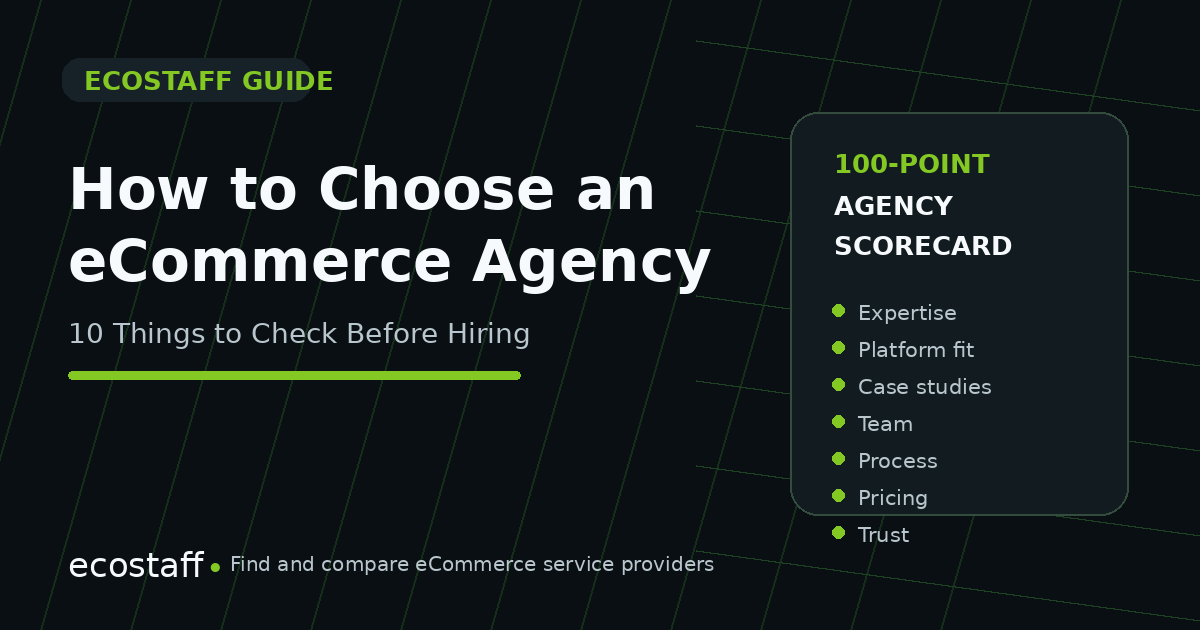
10 Things to Check Before Hiring an eCommerce Agency
1. Define the outcome before searching for an agency
Start with the problem, not the agency. A vague brief such as “We need a better eCommerce website” will usually produce vague proposals.
Instead, define what needs to change. For example:
- migrate from Magento to Shopify Plus without losing organic traffic;
- increase checkout conversion;
- reduce site performance problems;
- integrate the store with ERP and warehouse systems;
- redesign mobile product pages;
- improve organic revenue;
- build a B2B commerce portal;
- improve customer retention;
- launch into new markets;
- replace an existing development partner.
Then define how success will be measured. A migration project might be measured by launch stability, data accuracy, SEO preservation and downtime. A CRO project may focus on conversion rate, revenue per visitor or checkout completion. A retention engagement might focus on repeat purchase rate, customer lifetime value or revenue generated from email and SMS.
Ask before contacting an agency: What business outcome should be different six or twelve months after this engagement?
2. Match the agency specialization to the problem
Do not assume that “full-service” means “best at everything.” Different problems require different capabilities. Ecostaff organizes providers by the work they actually perform; you can browse the current eCommerce services directory before building a shortlist.
| Your primary problem | Agency type to prioritize |
|---|---|
| New store or major rebuild | eCommerce development agency |
| Shopify implementation | Shopify-specialized agency |
| Complex Magento / Adobe Commerce project | Magento / Adobe Commerce specialist |
| Low conversion rate | CRO / UX specialist |
| Organic traffic and technical issues | eCommerce SEO specialist |
| ERP / PIM / CRM complexity | Integration-focused development agency |
| Customer retention | Email / retention specialist |
| Paid growth | eCommerce performance marketing agency |
| Several connected problems | Full-service eCommerce agency |
A specialist is often preferable when the problem is narrow and technically demanding. A broader agency may make more sense when several disciplines must work together under one delivery team.
3. Verify real platform expertise
Platform logos on an agency website are not enough. If your business depends on Shopify Plus, Adobe Commerce, WooCommerce, BigCommerce or another platform, determine how deep the agency’s experience actually goes. You can use Ecostaff’s platform directory as one starting point.
- How many projects have you delivered on this platform?
- How recently?
- What types of projects?
- Which integrations were involved?
- Can you show a comparable project?
- Who on the delivery team has platform-specific experience?
- Do you hold relevant platform certifications or partner status?
- Have you handled migrations to or from this platform?
The complexity matters. Building a basic Shopify storefront is very different from working with Shopify Plus, multiple markets, subscriptions, ERP integrations, headless architecture, B2B pricing, large catalogs or custom checkout requirements.
Platform familiarity is not the same as platform depth.
4. Evaluate case studies as evidence, not marketing
Client logos can establish credibility, but they do not prove that an agency can solve your problem. A useful case study should answer four questions.
Context
What type of company and eCommerce environment was involved?
Problem
What specific business or technical problem needed to be solved?
Work
What did the agency actually do?
Result
What changed after the work was completed, and over what timeframe?
Depending on the engagement, relevant outcomes might include conversion improvement, revenue impact, site speed, lower error rates, organic traffic, retention, reduced operational work, faster deployment, a successful migration or improved Core Web Vitals.
Be cautious when a case study provides a large percentage increase without explaining the baseline, timeframe or the agency’s contribution. The closer a case study is to your problem, platform and business model, the stronger the evidence.
5. Decide how much industry experience actually matters
Industry experience can reduce the learning curve. A fashion retailer, B2B manufacturer, beauty brand and automotive parts seller may all operate eCommerce websites, but their operational challenges can be very different. Ecostaff’s industry directory helps add this context to provider research.
- complex product compatibility;
- regulatory restrictions;
- subscriptions;
- internationalization;
- B2B pricing;
- large catalogs;
- marketplaces;
- high return rates;
- configurable products;
- unusual fulfillment workflows.
But industry experience should not become an automatic requirement. Sometimes expertise in the problem matters more than expertise in the industry.
6. Meet the team that will actually work on your account
One of the biggest differences between the sales process and the actual engagement can be the people involved. A senior strategist may lead the pitch while a different and much more junior team delivers the project.
- Who will be responsible for the account?
- Who is the project lead?
- Who will perform the actual work?
- What is their experience?
- Which roles are internal?
- Is any work outsourced?
- How many clients does the team manage simultaneously?
- What happens if a key team member leaves?
For technically important projects, request a conversation with the actual technical lead. For marketing engagements, meet the person who will own strategy and reporting. For CRO, speak to the person responsible for research and experimentation.
Evaluate the delivery team, not only the sales team.
7. Examine the agency’s delivery process
A good proposal explains not only what will be delivered but how the work will be controlled.
For development projects, look for clarity around discovery, requirements, architecture, design, backlog management, development environments, QA, testing, deployment, documentation, change requests and post-launch support.
For marketing or optimization engagements, look for a clear initial audit, prioritization process, experiment or campaign planning, implementation, measurement, reporting and learning cycles.
Ask what happens when requirements change, how delays are handled, who owns decisions, where documentation will live and who owns the code, accounts and data after the engagement ends.
8. Check how the agency measures success
A credible agency should be able to explain how its work connects to measurable outcomes. The metrics depend on the engagement.
Development
- release frequency;
- performance and uptime;
- defect rates;
- technical debt;
- page speed and Core Web Vitals.
CRO and UX
- conversion rate;
- add-to-cart rate;
- checkout completion;
- revenue per visitor;
- experiment win rate.
Acquisition
- customer acquisition cost;
- contribution margin;
- new customer revenue;
- marketing efficiency and profitability.
Retention
- repeat purchase rate;
- customer lifetime value;
- email and SMS revenue;
- churn and retention cohorts.
Avoid an agency that cannot clearly explain what it will measure, where the data comes from and how success will be evaluated.
9. Compare total value, not just hourly rates
The cheapest agency is not always the least expensive option. A low hourly rate can still result in a higher total cost if the team requires more hours, creates technical debt, produces poor documentation, misses deadlines or requires another agency to fix the project later.
| Pricing model | Usually works well for | Main risk |
|---|---|---|
| Fixed price | Well-defined projects | Change requests can become expensive |
| Time & materials | Complex or evolving projects | Requires budget control |
| Monthly retainer | Ongoing marketing, CRO or support | Value can become unclear without KPIs |
| Dedicated team | Long-term product development | Requires strong management and planning |
| Paid discovery | Complex projects with uncertain scope | Adds an upfront stage before delivery |
Also review the commercial details that are easy to overlook: payment schedule, minimum commitment, notice period, termination rights, intellectual property, code ownership, repository access, licenses, third-party costs, post-launch support and the change-request process.
The right question is not “Which agency has the lowest rate?” It is: “Which option gives us the best risk-adjusted value for the outcome we need?”
10. Validate trust before signing
Reviews are useful, but a star rating by itself provides very little information. Look for context around the service, project type, engagement size, recency, reviewer credibility and whether multiple reviews show a consistent pattern.
- What service did the agency provide?
- What type of business hired them?
- How large was the engagement?
- What went well?
- What went wrong?
- How recent is the review?
- Does the reviewer appear credible?
- Are there multiple reviews showing a consistent pattern?
For higher-value engagements, request client references and speak directly with one or two relevant customers when possible. Trust should be based on several signals, not one badge or rating. You can read more about how Ecostaff handles company information and trust signals in the Ecostaff methodology and ranking policy.
The Ecostaff 100-Point Agency Evaluation Framework
Rather than making the final decision based on impressions from sales calls, score every shortlisted agency using the same framework. Ecostaff recommends the following 100-point model as a practical starting point.
| Criterion | Weight |
|---|---|
| Business objective fit | 10 |
| Relevant service specialization | 12 |
| Platform / technical depth | 12 |
| Relevant proof and case studies | 15 |
| Industry / business-model fit | 7 |
| Team quality and seniority | 10 |
| Delivery process and governance | 10 |
| Measurement and analytics | 8 |
| Commercial fit and total cost | 8 |
| Reviews, references and trust | 8 |
| Total | 100 |
Give each agency a rating of 1 to 5 for every criterion, then calculate: weighted score = (rating ÷ 5) × criterion weight.
- 80–100: strong candidate;
- 65–79: potential fit, but investigate weaknesses;
- below 65: significant fit or risk concerns.
The score should support judgment rather than replace it. A critical technical weakness, security concern or trust problem can still disqualify an agency even if its total score looks good.

10 red flags when hiring an eCommerce agency
- They propose a solution before understanding the problem.
- Their portfolio contains logos but no useful project context.
- They guarantee specific revenue, rankings or ROAS without understanding your baseline.
- You cannot meet the people who will actually deliver the work.
- They recommend the same technology for almost every project.
- Reporting and success metrics are vague.
- Ownership of code, data or accounts is unclear.
- Subcontracting is hidden or poorly explained.
- The contract makes it unnecessarily difficult to leave.
- Communication is poor while they are still trying to win your business.
One red flag may have an innocent explanation. Several together usually indicate higher delivery risk.

Questions to ask an eCommerce agency before hiring
About your problem
- Have you solved a problem similar to ours before?
- What would you need to understand before recommending a solution?
About proof
- Can you show a relevant case study and explain exactly what your team contributed?
- Which result from that project is most relevant to ours?
About the team
- Who will actually work on our account?
- Can we meet the project or technical lead before signing?
About delivery
- What happens during the first 30 days?
- How do you handle scope changes and unexpected problems?
About measurement
- Which KPIs would you use to evaluate this engagement?
- What data access would you need from us?
About risk
What do you think is the biggest risk in our project?
This is one of the most revealing questions you can ask. An experienced agency usually identifies uncertainty; an inexperienced sales process often promises that everything will be easy.
About the relationship
Why might your agency not be the right fit for us? Good providers know where their capabilities end.
Should you hire a specialist or a full-service eCommerce agency?
Neither is automatically better. Choose a specialist when the problem is clearly defined, deep expertise matters, you already have capable partners or an internal team, or the engagement requires unusual technical knowledge.
Choose a full-service agency when several disciplines are tightly connected, you want fewer vendors, strategy and execution need to be coordinated, or your internal team cannot manage multiple specialist providers.
For example, a checkout optimization problem may benefit from a dedicated CRO specialist. A complete international replatforming involving UX, development, SEO, data migration and integrations may require a broader team.

How many eCommerce agencies should you compare?
For most meaningful engagements, three to five serious candidates is enough. Too few limits your ability to compare approaches. Too many usually creates unnecessary evaluation work and encourages superficial decisions.
Use the same brief and evaluation framework for every finalist. This makes differences in thinking, expertise, process, pricing and risk much easier to see.
How to use Ecostaff when researching eCommerce agencies
1. Start with the service
Identify the actual problem you need to solve and browse providers by service.
2. Check platform expertise
If the platform matters, narrow your research using the Ecostaff platform directory.
3. Add business context
Consider industry experience, company information, case studies and available project evidence.
4. Evaluate trust signals
Review approved client feedback and other available profile information before creating your shortlist. Ecostaff’s methodology explains how company information and trust signals are handled.
Final checklist before hiring an eCommerce agency
- Do we know exactly what outcome we need?
- Does this agency specialize in the relevant service?
- Can it demonstrate real platform expertise?
- Have we seen evidence from comparable projects?
- Do we know who will actually work with us?
- Is the delivery process clear?
- Do we understand how success will be measured?
- Are pricing and additional costs transparent?
- Is ownership of code, accounts and data clear?
- Have we checked reviews or references?
- Do we understand the exit terms?
- Would we still select this agency if we removed its brand name from the proposal?
That final question is useful because it forces the decision back toward evidence and fit.
Frequently asked questions
What should I look for when choosing an eCommerce agency?
Prioritize relevant specialization, platform expertise, evidence from similar projects, the actual delivery team, project process, measurement capabilities, commercial terms and credible client evidence. Do not choose primarily by company size, portfolio design or hourly rate.
How do I know if an eCommerce agency is good?
A good agency should be able to explain the problem it is solving, demonstrate comparable work, introduce the team responsible for delivery, explain its process and measurement approach and discuss potential risks honestly.
Should I choose a Shopify-specialized agency?
If Shopify or Shopify Plus is central to the project, deep Shopify experience can reduce technical and implementation risk. Platform expertise should still be evaluated alongside service expertise: a Shopify developer is not automatically a CRO, SEO or retention specialist.
Should I hire a specialist or full-service agency?
Choose based on the scope. Specialists are often stronger for narrow, complex problems. Full-service agencies can be useful when development, UX, marketing, analytics and other disciplines must operate together.
How many agencies should I shortlist?
A shortlist of three to five qualified agencies is usually sufficient for a meaningful comparison without creating unnecessary procurement work.
Should I choose the cheapest eCommerce agency?
Usually not on price alone. Compare total scope, seniority, delivery risk, expected rework, post-launch support and total cost of ownership. The lowest hourly rate can still produce the highest final cost.
Are client reviews enough to choose an agency?
No. Reviews are one input. Combine them with relevant case studies, platform expertise, conversations with the delivery team, references and a structured evaluation process.
When does paid discovery make sense?
Paid discovery can be useful when a project has major technical unknowns, complex integrations, uncertain scope or significant migration risk. A short discovery engagement can be safer than forcing an agency to provide a fixed estimate before the problem is properly understood.
Conclusion
There is no universally “best” eCommerce agency. There is only a provider that is more or less suitable for a specific business, platform, problem and stage of growth.
The best selection process replaces reputation and sales presentation with structured evidence: define the outcome, match the specialization, verify the proof, meet the team, understand the process and compare risk-adjusted value.
Explore eCommerce service providers on Ecostaff and build a shortlist around the expertise your project actually requires.