


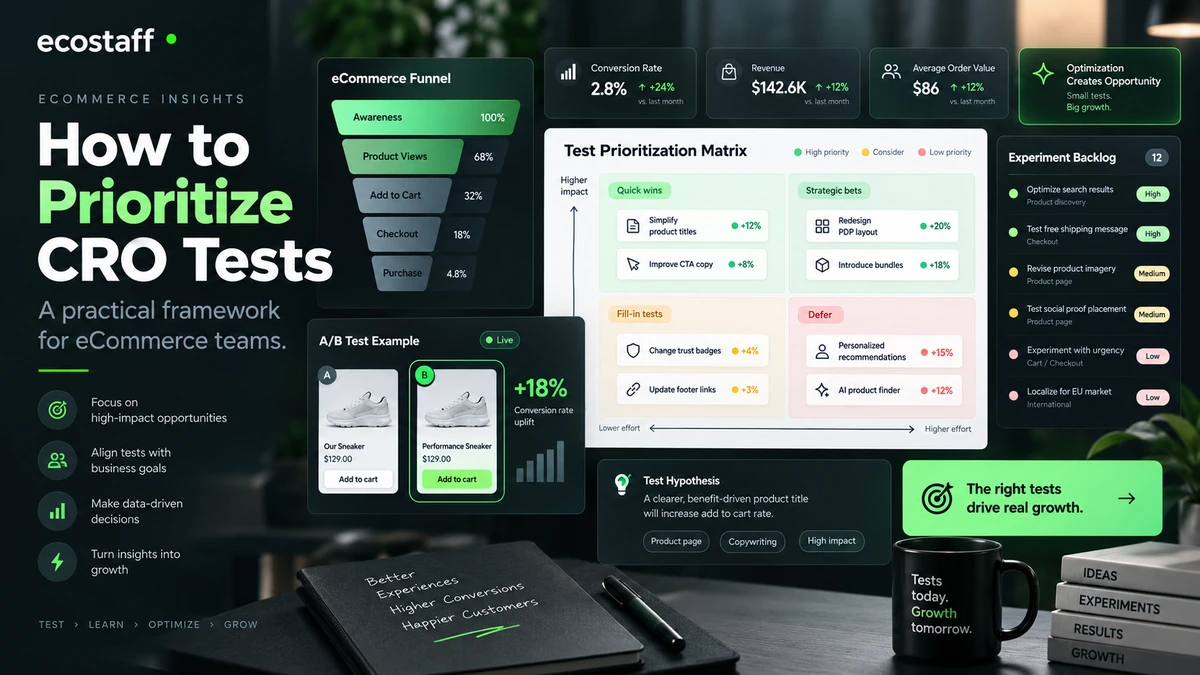
Quick answer: how should eCommerce teams prioritize CRO tests?
Prioritize experiments with the strongest combination of business impact, evidence, reach and decision value, then discount ideas for effort and operational risk. A large backlog is not a strategy. The team should first separate defects that should simply be fixed from uncertain ideas that genuinely need experimentation.
Ecostaff uses a 100-point editorial prioritization model: Potential Impact 25, Evidence Strength 20, Reach 15, Business Priority 15, Confidence 10, Effort Efficiency 10 and Risk/Reversibility 5. The score ranks ideas. It does not replace sample-size planning, metric design or statistical analysis.
CRO teams often have more ideas than traffic. Marketing wants new offers, design wants a cleaner product page, merchandising wants bundles, support wants clearer delivery messaging and leadership wants higher checkout conversion. Without a shared scoring method, the loudest stakeholder wins.
A useful prioritization system does two things: it focuses effort on problems with evidence, and it makes trade-offs visible. The score should never pretend to predict the exact conversion lift. It should improve the order in which the team learns.
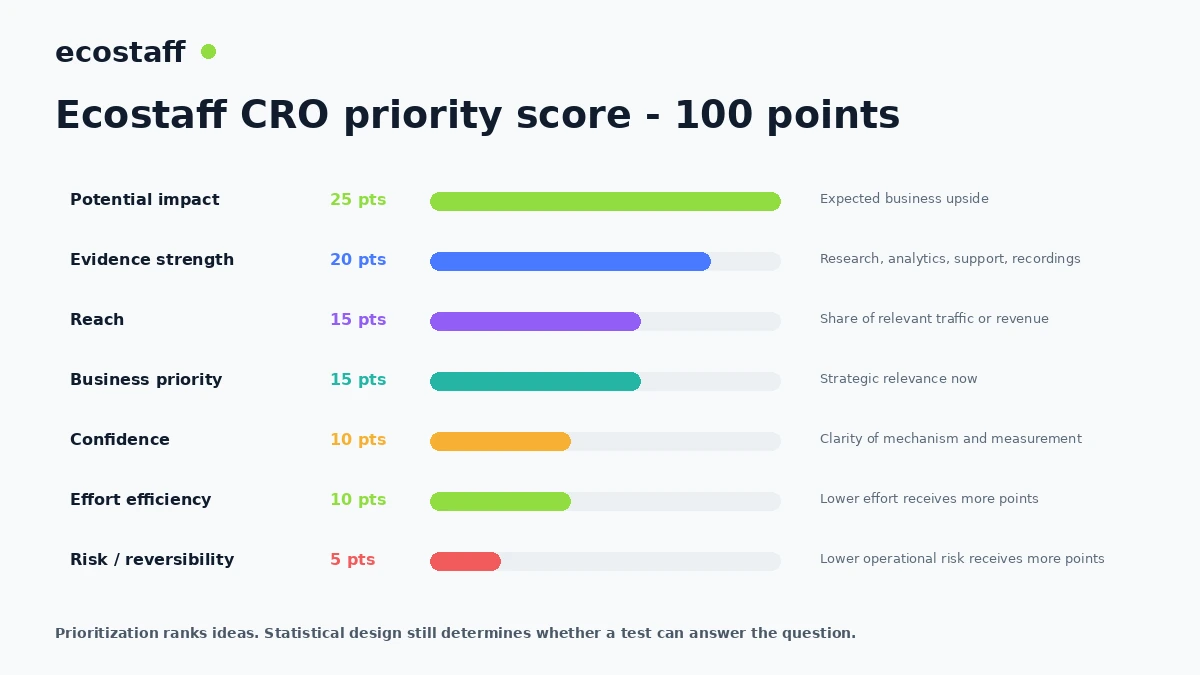
First decide whether the idea needs a test
Not every change belongs in an A/B test. A broken payment field, inaccessible control, legal error or obvious data-quality defect should generally be fixed and validated. Testing a defect against a working version wastes traffic and preserves a known problem for part of the audience.
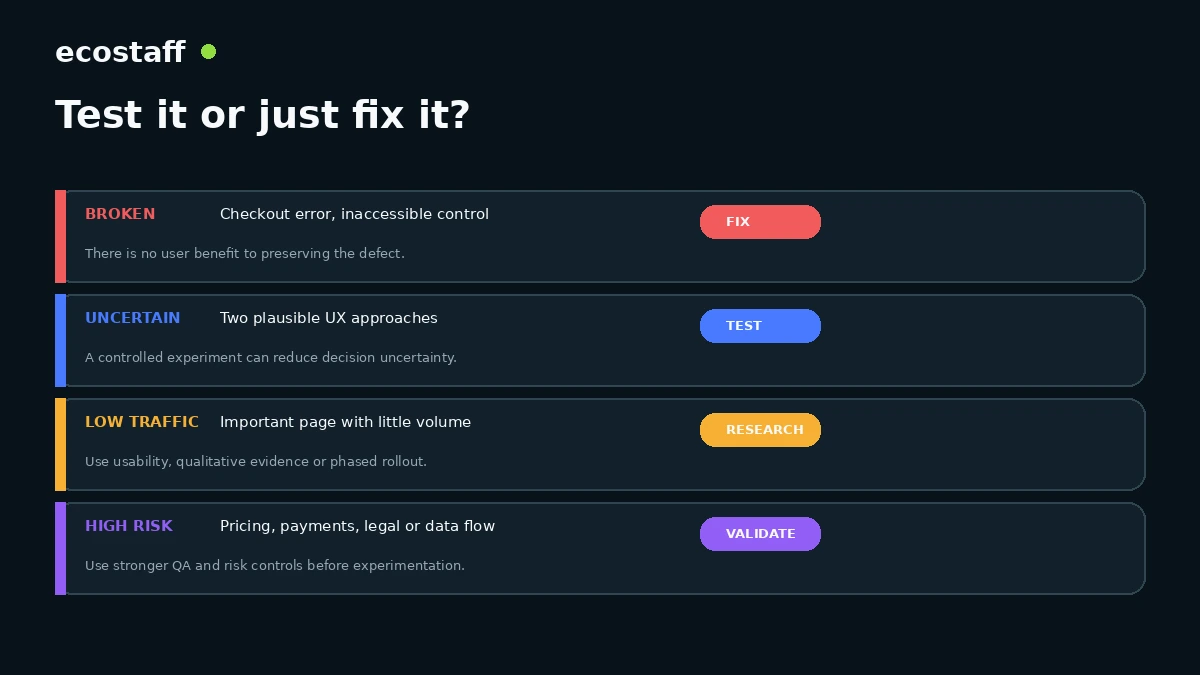
The Ecostaff 100-point prioritization model
| Factor | Weight | What earns a high score |
|---|---|---|
| Potential impact | 25 | The opportunity touches revenue, margin, conversion or a high-value journey. |
| Evidence strength | 20 | Multiple sources point to the same problem or mechanism. |
| Reach | 15 | A meaningful share of relevant users, sessions or revenue is exposed. |
| Business priority | 15 | The test supports an important commercial objective now. |
| Confidence | 10 | The hypothesis, mechanism and measurement are clear. |
| Effort efficiency | 10 | The idea is relatively inexpensive to design, build and QA. |
| Risk / reversibility | 5 | The test has low operational, legal, brand or technical risk. |
The 100-point framework explained
1. Potential impact: prioritize the business mechanism
A high-impact idea should change a meaningful customer decision or business constraint. Examples include product discovery, product understanding, trust, shipping clarity, payment choice, cart friction or checkout completion. Moving a decorative element may be easy, but ease alone does not make it important.
2. Evidence strength: start where the signal is strongest
Evidence can come from analytics, usability research, session recordings, customer support, surveys, search logs, review themes, returns and technical errors. The strongest opportunities usually appear in more than one source.
Baymard research repeatedly shows that major eCommerce sites still contain substantial usability issues on product pages, product lists and checkout. Use external research to identify likely problem areas, then validate whether the issue exists on your own store.
3. Reach: count the relevant audience, not total traffic
A checkout experiment should be scored against checkout traffic or revenue, not homepage sessions. A fit-guide test may have low site-wide reach but very high reach within a size-sensitive category. Define the exposed audience at the point where the change can influence behavior.
4. Business priority: include margin and strategy
Conversion rate is not the only objective. A merchandising test might improve gross margin, reduce returns, increase repeat purchase or shift demand toward strategic inventory. Explicit business priority prevents the team from optimizing only what is easiest to measure.
5. Confidence: can you explain why the change should work?
A good hypothesis names the user problem, the proposed change, the expected behavior and the business outcome. “Make the button green to increase conversion” is weak unless there is evidence that visibility or hierarchy is the actual problem.
Good hypothesis: Showing delivery cost and estimated arrival date near the Add to Cart area will reduce uncertainty for high-intent shoppers and increase add-to-cart rate because support logs and exit surveys show shipping questions on product pages.
6. Effort efficiency: include QA and analysis, not only design time
Estimate research, design, copy, engineering, analytics, QA and post-test implementation. Some apparently simple tests become expensive because they touch pricing, checkout, localization or multiple platforms.
7. Risk and reversibility: protect the business
High-revenue checkout changes, pricing, legal claims, inventory logic and payment flows deserve stricter controls. A reversible copy test is different from a change that can create incorrect orders. Scoring risk separately keeps attractive upside from hiding operational exposure.
Build the backlog around problems, not solutions
Store one problem statement with several possible interventions. For example, “users cannot confidently judge product size” may lead to in-scale imagery, dimension visualization, comparison objects or improved specification placement. If the team stores only the first solution idea, it stops exploring the problem.
Use the funnel to find leverage, not to dictate tests
A funnel highlights where volume drops, but drop-off alone does not prove a UX defect. Some users are not ready to buy, some products are poor fits and some sessions are informational. Combine funnel data with evidence about why users struggle.
Plan statistics before launch
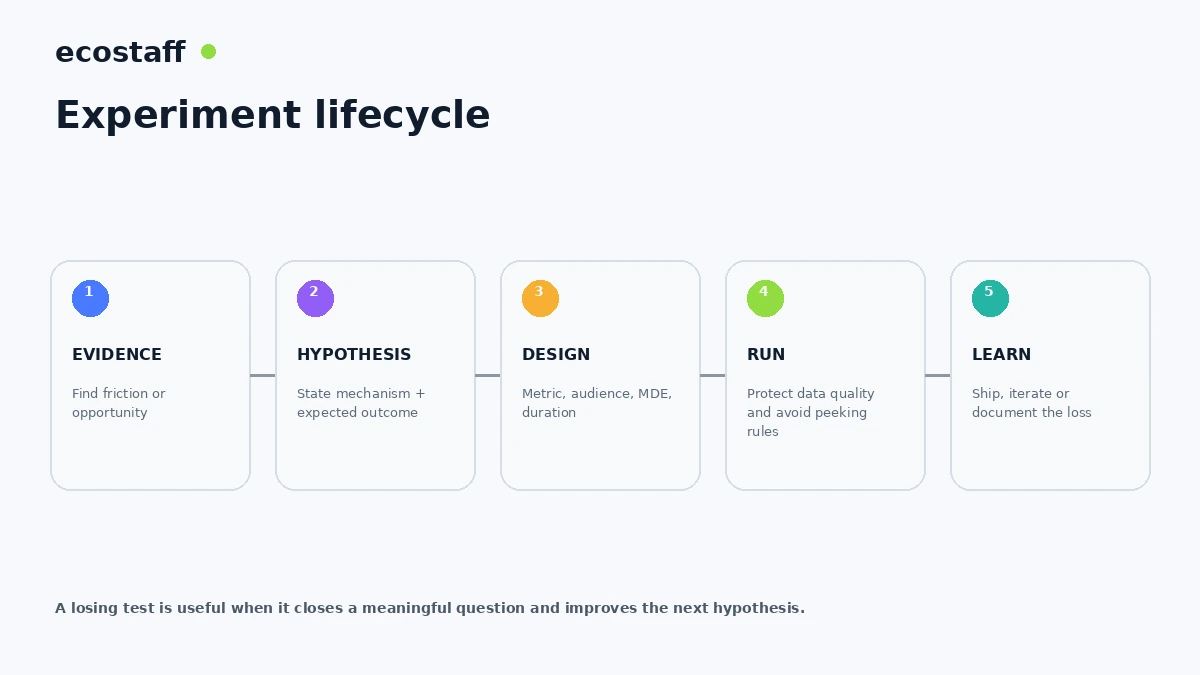
Before an A/B test, define the primary metric, guardrails, audience, minimum detectable effect and decision threshold. Small effects require more traffic. Teams should avoid repeatedly checking noisy early results and declaring a winner because the first few days look positive.
Experiment platforms use different statistical methods, so follow the methodology of the tool you actually use. The prioritization score tells you what to test first. The experiment design tells you whether the test can answer the question.
Example: prioritizing five eCommerce ideas
| Idea | Why it may rank high or low | Likely action |
|---|---|---|
| Improve product-size evidence | High evidence from returns/support and affects a major category | High-priority test or phased UX change |
| Rewrite footer navigation | Low reach at purchase decision and weak evidence | Defer |
| Clarify shipping near Add to Cart | High-intent reach with support evidence | High-priority test |
| Add another recommendation carousel | Unclear mechanism, app and performance cost | Research first |
| Fix broken wallet payment | Known defect with direct checkout impact | Fix and validate, do not A/B test |
A practical CRO operating rhythm
- Review evidence sources weekly or biweekly.
- Maintain problem statements and link evidence to each.
- Score candidate opportunities using the same rubric.
- Separate fixes, research tasks and experiments.
- Design the hypothesis and measurement before engineering starts.
- Run fewer tests with clearer questions.
- Document winners, losses and inconclusive results.
- Feed learnings back into the next backlog review.
When should an agency help?
Specialist CRO support is useful when the team lacks research capacity, experimentation analytics, front-end implementation or a disciplined operating process. Ask prospective partners how they generate hypotheses, how they size tests and what they do with losing results.
Use Ecostaff to compare eCommerce service providers, and apply the agency selection framework before outsourcing experimentation.
Frequently asked questions
Is the highest-scoring idea always the next test?
No. Dependencies, seasonality, campaign calendars and technical constraints can change the order. The score creates a default ranking and makes exceptions visible.
Should low-traffic stores A/B test?
Sometimes, but not every question is testable with available volume. Use usability research, customer interviews, before-and-after monitoring or phased rollouts when an experiment would take too long to detect a meaningful effect.
Can a losing test still be valuable?
Yes. A well-designed loss can eliminate a plausible idea, reveal segment differences or sharpen the mechanism for the next hypothesis.
Sources and further reading
- Baymard – Product Page UX research
- Baymard – Cart and Checkout UX research
- Baymard – Product Lists and Filtering UX research
Conclusion
CRO prioritization is not about finding the idea with the most exciting predicted lift. It is about sequencing learning where the combination of evidence, commercial value and decision clarity is strongest.
A shared framework reduces politics, protects scarce traffic and helps teams invest in experiments that can genuinely change the business.
