

Quick answer: what did October 2025 data reveal about holiday eCommerce?
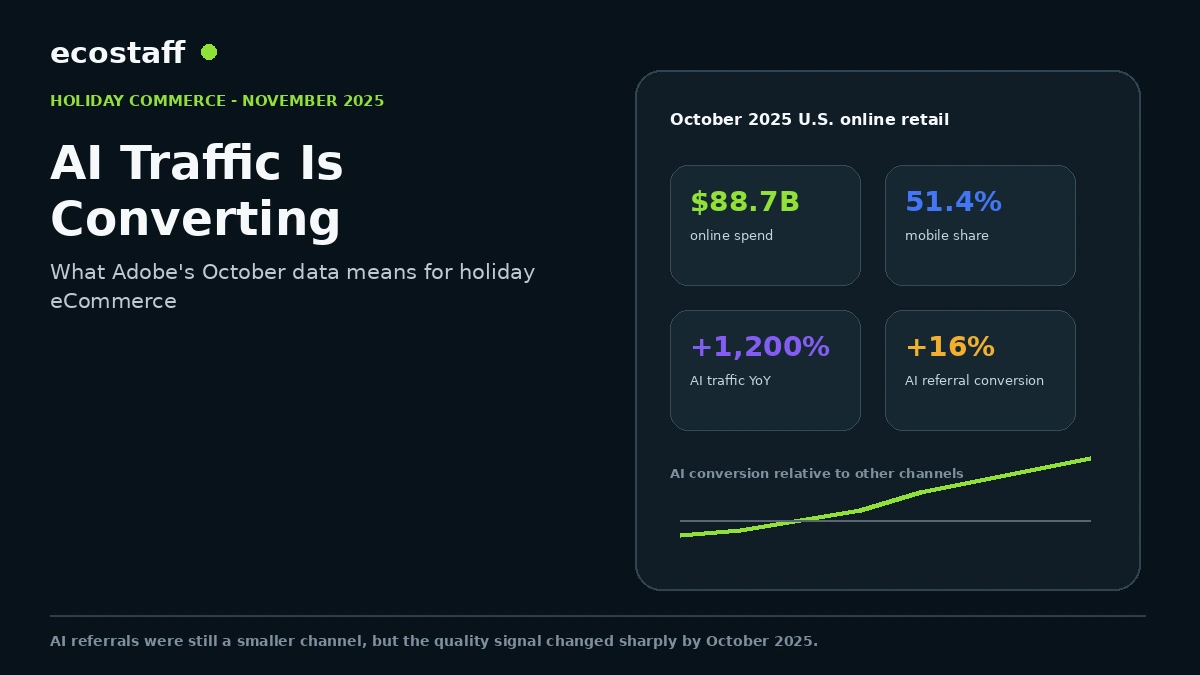
Adobe Digital Insights reported $88.7 billion in U.S. online spending during October 2025, up 8.2% year over year, with mobile accounting for 51.4% of spend. More importantly for channel strategy, Adobe reported that traffic from generative AI sources to U.S. retail sites increased 1,200% year over year in October and was 16% more likely to convert than non-AI traffic.
That does not mean AI had become a larger channel than paid search, email or organic search. Adobe explicitly described AI traffic as still modest in share. The useful signal was quality: after lagging earlier in 2025, AI referrals had begun arriving with stronger purchase intent and higher engagement.
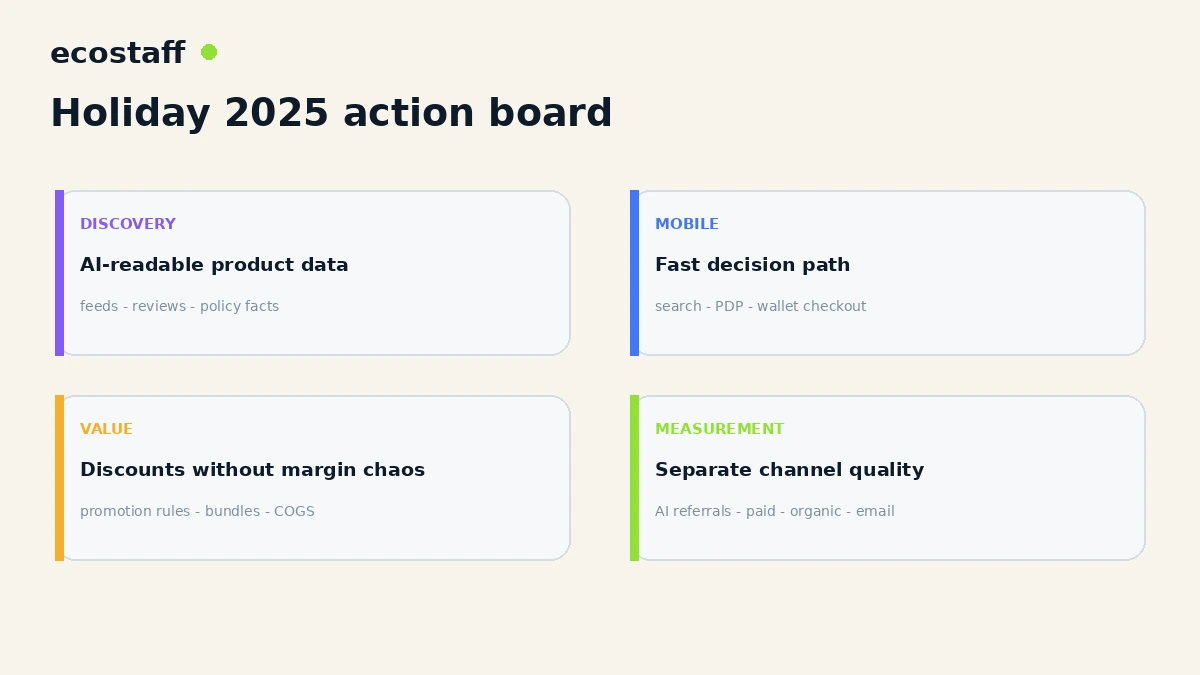
Holiday planning in 2025 was not only about bigger discounts. Consumer discovery was changing, mobile had become the majority of online spend and AI-assisted research was moving closer to purchase. Retailers therefore needed to align product data, mobile experience, promotion economics and measurement.
Adobe’s October actuals are useful because they cover direct commerce activity at large scale: more than one trillion visits to U.S. retail sites, 100 million SKUs and 18 product categories.
October 2025: the key numbers
| Metric | October 2025 | What it suggests |
|---|---|---|
| U.S. online spend | $88.7B | Digital demand entered holiday season with strong growth. |
| Year-over-year spend growth | +8.2% | Online retail remained resilient. |
| Mobile share of spend | 51.4% | Mobile was no longer a secondary checkout experience. |
| AI referral traffic growth | +1,200% YoY | AI discovery was scaling from a small base. |
| AI conversion likelihood | +16% vs non-AI | Referral quality had moved above other traffic in Adobe’s analysis. |
| AI revenue per visit | +8% | Higher conversion was creating commercial value per session. |
AI traffic changed from research-heavy to more purchase-ready
Earlier in 2025, Adobe reported that AI referrals converted below other channels. By September, conversion had moved above non-AI traffic, and in October the difference widened to 16%. This is strategically important because it suggests some shoppers were completing more research before clicking through.
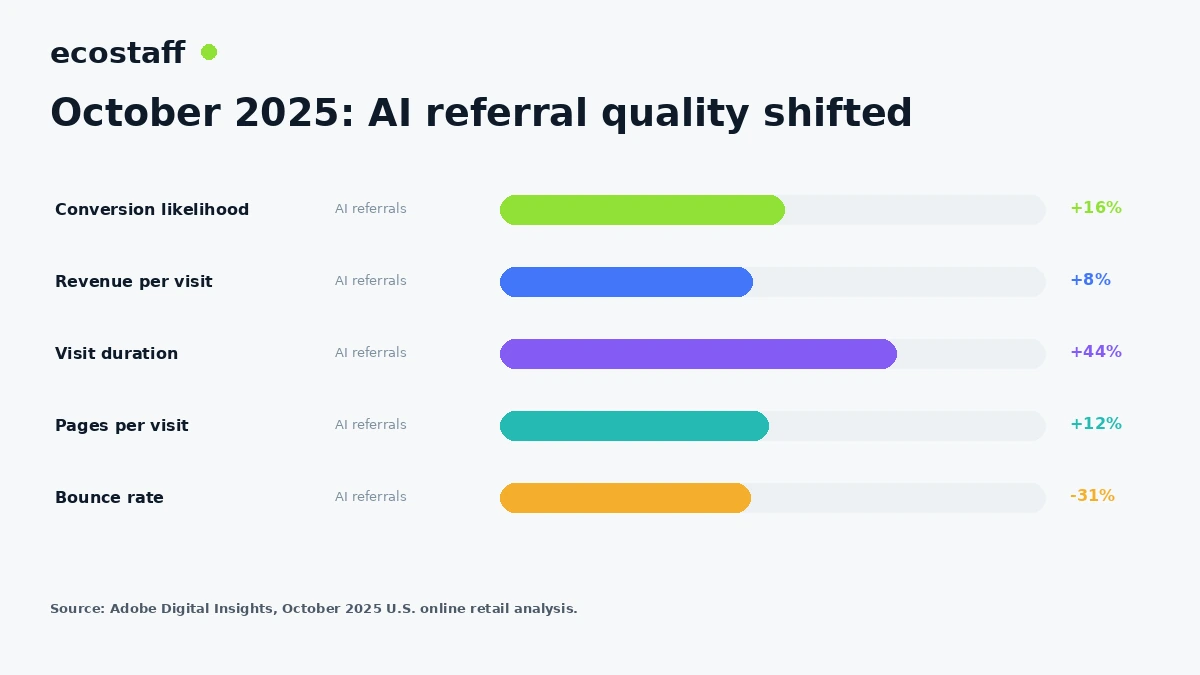
Adobe also reported that AI-referred shoppers were 13.6% more engaged, spent 44% longer on retail sites, viewed 12% more pages and had a 31% lower bounce rate. These metrics should not be treated as universal benchmarks for every merchant, but they show why AI referrals deserve their own analytics segment.
Mobile is the default holiday storefront
Mobile generated 51.4% of U.S. online spend in October. The implication is bigger than responsive design. Product discovery, search, account creation, promotions, wallets, checkout and customer support all need to work with one hand on a small screen.
- Keep filters usable without covering the entire viewport.
- Make variant selection clear and easy to change.
- Keep promotion messaging close to the affected product or cart state.
- Support digital wallets and accelerated payment where appropriate.
- Reduce unnecessary form fields.
- Keep returns, delivery and stock information near purchase decisions.
- Test real mid-range mobile devices, not only desktop emulation.
Holiday shoppers are value-sensitive, not price-only
Adobe’s October 6 holiday forecast expected U.S. online holiday spending to exceed $250 billion for November and December 2025, with Cyber Week representing 17.2% of the season’s spend. Strong discounts were expected, but aggressive discounting without cost controls can create revenue growth and profit disappointment at the same time.
Merchants should use product margin, stock depth and customer value to set promotional floors. WooCommerce stores gained native COGS in version 10.3, while other platforms can use ERP, PIM or analytics data to build similar controls.
AI discovery increases the value of product evidence
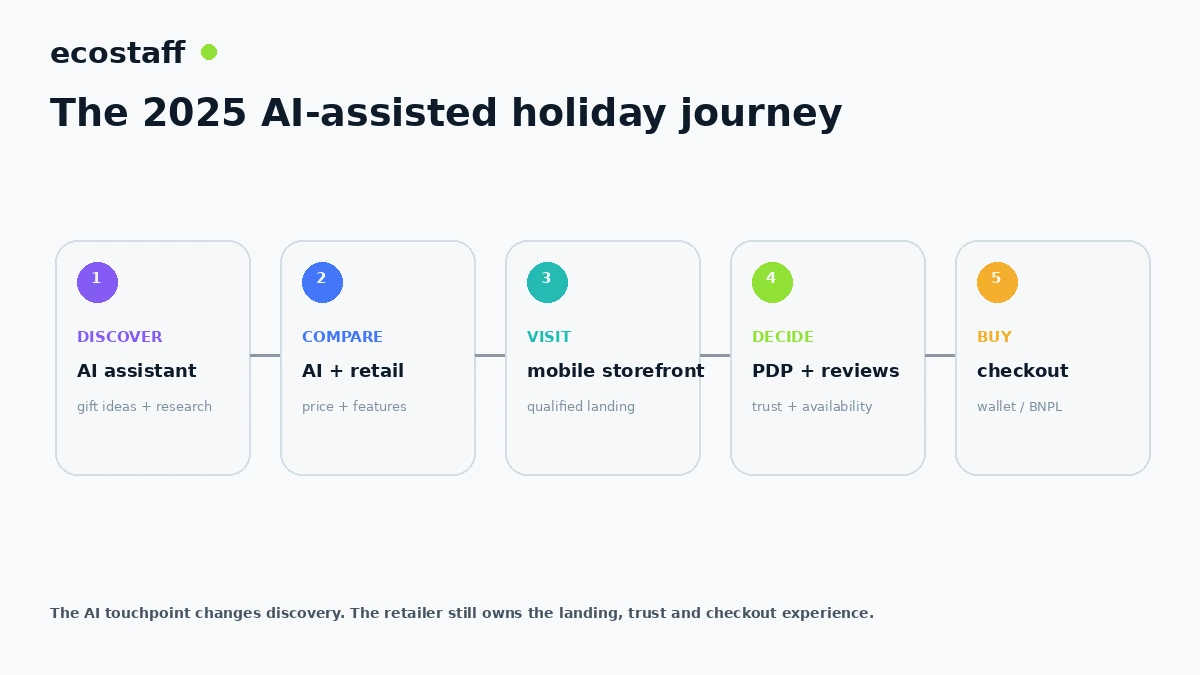
When a shopper arrives after using an AI assistant, the landing page needs to confirm the recommendation quickly. Product pages should make price, availability, specifications, delivery, reviews and return conditions easy to verify.
The Google AI Mode for eCommerce guide explains the product-data layer behind AI-assisted shopping in more detail.
Separate AI referrals in analytics
Do not combine every referral into a generic ‘referral’ bucket. Build a channel view that identifies known AI sources where your analytics system allows it, while acknowledging that browser and privacy changes can make attribution incomplete.
- Create a list of known AI referral domains and review analytics classification.
- Compare conversion, revenue per session and engagement by source.
- Look at the landing pages AI referrals use most.
- Separate branded and non-branded product discovery.
- Review whether AI-referred shoppers use site search differently.
- Track assisted conversions where your analytics model supports them.
- Annotate large shopping platform and AI-search launches.
Prepare promotions with margin and inventory together
A product with deep inventory and strong gross margin can support a different offer from a low-stock, low-margin bestseller. Create a promotion matrix that includes stock, cost, replenishment time and strategic role.
| Product situation | Promotion approach | Risk |
|---|---|---|
| High stock + strong margin | Aggressive acquisition offer | Operational capacity if demand spikes. |
| Low stock + high demand | Protect price or use smaller discount | Overselling and poor customer experience. |
| High margin accessory | Bundle with hero product | Bundle logic and inventory sync. |
| Old inventory | Clearance or targeted offer | Brand perception and return risk. |
| New launch | Value-add instead of deep discount | Need strong product education. |
Customer support is part of conversion
Holiday shoppers have questions about delivery, gifts, returns and exchanges. Slow support can cancel the value of strong marketing. Make cutoff dates, order tracking, return windows and contact options visible before the customer needs to ask.
A practical November readiness checklist
- Segment mobile conversion by key device classes.
- Validate top landing pages from AI, search, email and paid campaigns.
- Audit product facts, reviews and shipping promises.
- Create promotion floors using margin and inventory.
- Test every major payment method.
- Confirm holiday return and delivery policies.
- Monitor inventory sync for top SKUs.
- Set analytics segments for AI referrals.
- Create a daily revenue and checkout health board.
- Define escalation owners for payment, stock, fulfillment and tracking issues.
- Freeze non-critical checkout changes before peak days.
- Document results for the 2026 holiday plan.
Build a channel-quality view, not only a channel-volume report
AI referrals are a useful example of why traffic volume can mislead. A channel with a small share of sessions can still matter if visitors arrive later in the decision process, convert at a higher rate or create larger baskets. Build a measurement view that compares traffic quality and commercial outcome side by side.
| Metric | Why to include it | What it can reveal |
|---|---|---|
| Sessions / users | Channel scale | Whether growth is commercially material yet. |
| Engagement | Intent quality | Whether shoppers continue researching after landing. |
| Product-view depth | Discovery behavior | How many products are evaluated before purchase. |
| Add-to-cart rate | Commercial intent | Whether visits progress beyond browsing. |
| Checkout-start rate | Purchase readiness | Whether friction begins before or during checkout. |
| Conversion rate | Final efficiency | How frequently visits become orders. |
| Revenue per visit | Commercial value | Whether higher conversion also translates into stronger economics. |
Keep attribution limitations visible. Some AI assistants, browsers or privacy settings can obscure referral information, and a shopper may research in one environment and return directly later. Treat reported AI referral data as a measurable subset of influence, not a complete map of every AI-assisted purchase.
Turn holiday learnings into a reusable operating system
After peak week, hold a short cross-functional review while the evidence is still fresh. Record which promotions caused confusion, which products oversold, which payment methods failed, which referral sources surprised the team and where support demand concentrated. The output should become changes to the next year’s merchandising, inventory and technical plan – not just a retrospective slide deck.
Frequently asked questions
Was AI already a major traffic channel in October 2025?
Adobe described AI traffic as rising rapidly but still modest compared with channels such as paid search and email. The important change was growth and referral quality, not absolute share.
Did AI traffic really convert better?
In Adobe’s October 2025 U.S. retail data, AI-referred visits were 16% more likely to convert than non-AI traffic. Individual merchant results can differ.
Should retailers move budget from paid search to AI immediately?
Not from this data alone. AI referrals are not a direct replacement for paid media. Treat the channel as an emerging discovery source and measure incremental commercial value.
Why focus on mobile if AI shopping often starts on desktop?
By October 2025, mobile represented the majority of U.S. online spend. AI referral behavior was also becoming more mobile over time. The final conversion path still needs excellent mobile execution.
Sources and further reading
- Adobe Digital Insights – October 2025 U.S. online spending actuals
- Adobe Newsroom – 2025 U.S. holiday shopping forecast
- Adobe – 5 ways AI will change Black Friday 2025
- Adobe – Generative AI-powered shopping traffic report, August 2025
Conclusion
October 2025 showed two commerce shifts happening together: mobile had become the majority transaction surface, while AI referrals were moving from experimental research traffic toward stronger commercial intent.
The best holiday response was not to chase a new channel in isolation. It was to make product data, mobile UX, pricing economics and measurement work together so qualified discovery could turn into profitable orders.