

Quick answer: what changed for eCommerce when Google expanded AI Mode in May 2025?
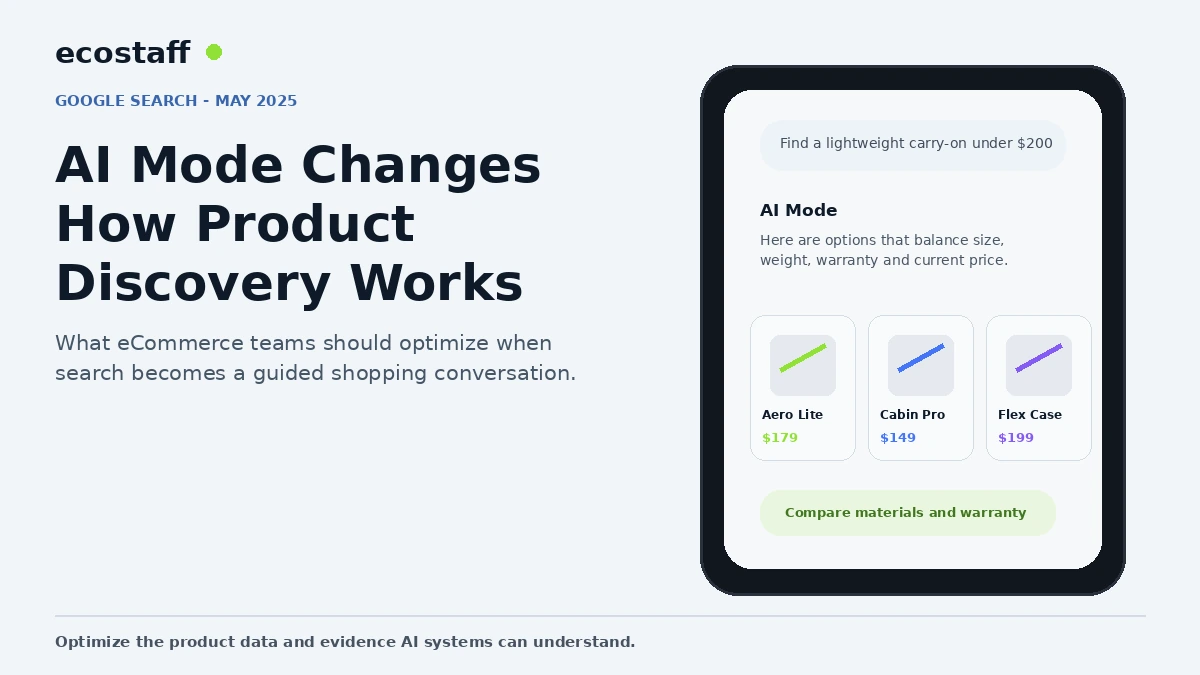
At Google I/O on May 20, 2025, Google expanded AI Mode in Search and introduced a more shopping-focused experience powered by Gemini and the Shopping Graph. Google described AI Mode as a place where shoppers can ask longer, more specific questions, compare products, see shoppable product information, use virtual try-on for apparel and eventually use agentic checkout workflows.
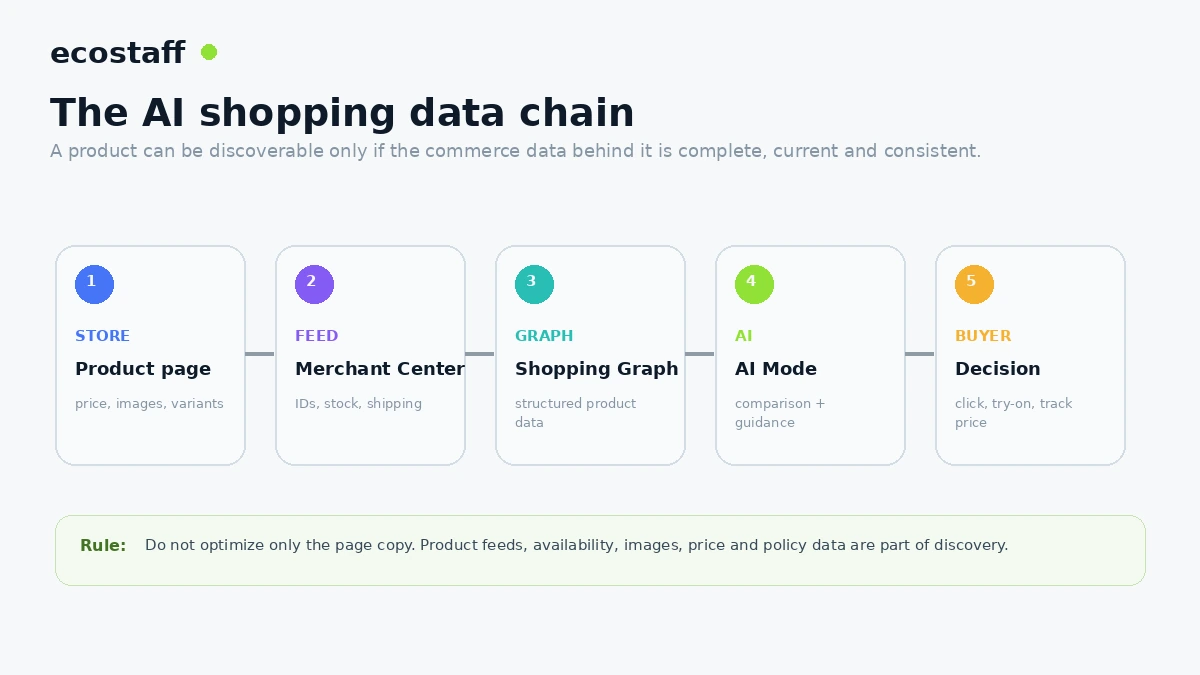
For eCommerce teams, this meant organic visibility could no longer be treated only as a ranking position problem. Product feeds, structured product data, real-time price and availability, strong images, policy information, brand answers and useful product-page evidence all became part of the discovery system.
AI Overviews had already changed the shape of Google Search in 2024. By May 2025, Google was moving beyond summarization toward a more interactive discovery model. AI Mode combined conversational search with product cards, Shopping Graph data, visual exploration and follow-up questions. That is particularly relevant to eCommerce because a buyer can express constraints in natural language instead of refining only through category filters.
This does not mean websites disappear. Google’s own announcement emphasized links to the web and product options. But the path to a click becomes more selective. Merchants need to make sure their product and brand information is understandable across both the web page and the commerce data systems that power Google’s shopping surfaces.
What Google announced at I/O 2025
Google announced that AI Mode would begin rolling out more broadly in the United States and that Gemini 2.5 would power AI Mode and AI Overviews in the U.S. The company also presented a new shopping experience that combined generative AI with the Shopping Graph.
- Conversational product discovery: shoppers can ask nuanced, multi-constraint questions.
- Shoppable product options: AI Mode can surface product cards with prices and other commercial information.
- Virtual try-on: users in the U.S. could experiment with apparel try-on using their own uploaded photo.
- Price tracking and agentic checkout: Google previewed workflows that can monitor price and help shoppers act when conditions are met.
- Follow-up search: the buyer can refine intent without starting a completely new query.
Why AI Mode changes ecommerce SEO
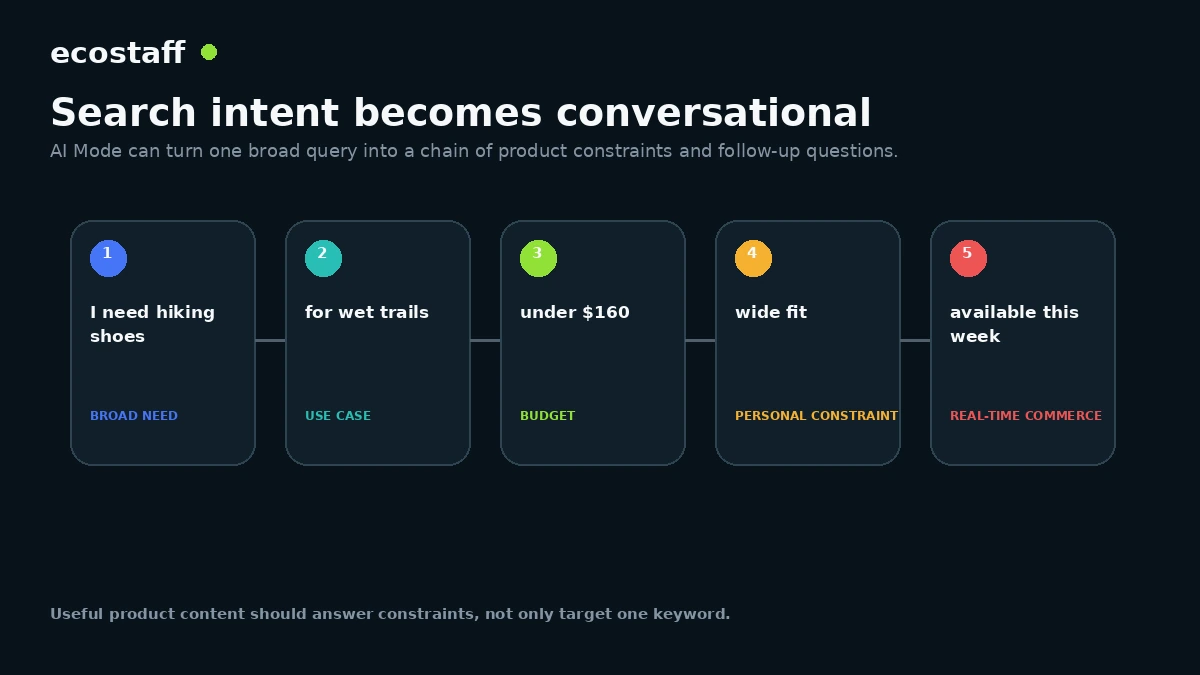
Traditional ecommerce SEO often maps one page to one keyword cluster. Conversational search is more fluid. A shopper can start broad, then specify material, use case, size, budget, delivery window, sustainability preferences or compatibility. The underlying product data needs to answer those constraints.
The product page becomes an evidence source
A product page should not only contain a product name, short description and generic specifications. Strong pages answer the questions that determine purchase fit: dimensions, compatibility, materials, warranty, returns, use limitations, shipping, stock, sizing, maintenance and real examples.
The product feed becomes part of organic discoverability
Merchant Center data can supply identifiers, current prices, availability, shipping and other product attributes. When page content and feed data disagree, the merchant creates ambiguity for both shoppers and systems. Feed quality should therefore be treated as an SEO and merchandising responsibility, not only as a paid-shopping task.
Brand and policy information matter
Google’s shopping systems increasingly answer questions about returns, shipping and product suitability. Merchants should make important policies easy to find, accurate and consistent across website, feeds and other connected data sources.
Five data layers to audit
| Layer | What to verify | Why it matters |
|---|---|---|
| Product page | Name, specs, variants, evidence, images, price context | Provides crawlable buyer information and page-level relevance. |
| Structured data | Product, Offer and relevant merchant markup | Helps machines understand commercial attributes. |
| Merchant Center | IDs, availability, shipping, images, price | Feeds product surfaces with current commerce data. |
| Brand / policy content | Returns, shipping, warranty, sizing, company information | Supports questions that influence purchase confidence. |
| Analytics | Search visits, product discovery, conversion paths | Shows whether visibility becomes useful commercial demand. |
How to write product content for conversational discovery
Do not respond by stuffing more question variants into the page. Instead, make the product information structurally complete. A useful product page should give a buyer enough evidence to evaluate fit without guessing.
- State the product’s main use case and important limitations.
- Use specific dimensions, materials, compatibility and model information.
- Explain variant differences instead of listing only names.
- Include real product imagery and, where possible, in-scale or use-context images.
- Make shipping, returns, warranty and availability easy to reach.
- Add FAQs when they answer recurring customer questions.
- Use reviews as evidence, but do not hide limitations or mixed feedback.
- Link to deeper comparisons and buying guides where the decision is complex.
Product imagery matters more in visual shopping
Google’s 2025 shopping announcements highlighted virtual try-on and visual product exploration. That reinforces a basic commerce principle: poor or inconsistent images limit both conversion and discovery. Merchants should audit image resolution, background consistency, variant mapping, alternate angles and whether images reflect the actual item sold.
AI Mode and Shopping Graph: what not to assume
AI Mode does not create a public optimization score for merchants. There is no official checklist that guarantees inclusion. Avoid vendors who claim they can force a brand into AI-generated shopping answers through one hidden schema field or an invented AI ranking factor.
The defensible strategy is the same one that supports strong commerce systems generally: accurate product data, clear pages, strong primary information, healthy technical accessibility and a measurement plan.
How to measure visibility when click patterns change
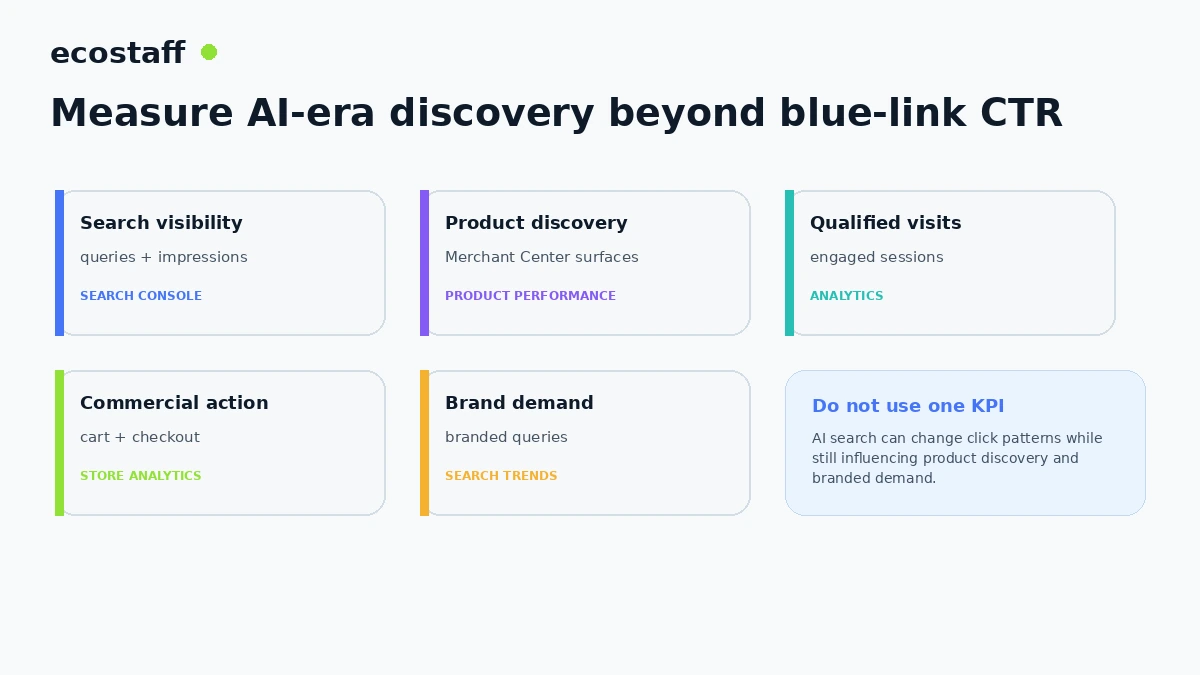
A single organic CTR metric is not enough to explain AI-assisted discovery. Teams should combine Search Console, Merchant Center product performance, analytics, conversion data and branded search trends. The goal is to understand whether search is creating qualified product discovery even if the exact click path changes.
- Track search impressions and query groups in Search Console.
- Monitor product-level visibility and issues in Merchant Center.
- Separate branded and non-branded demand.
- Watch landing-page engagement rather than sessions alone.
- Measure product views, cart additions and checkout starts from organic traffic.
- Monitor changes in brand searches and direct traffic after major search shifts.
- Annotate Search feature launches and measurement changes.
What agencies should be able to explain
An ecommerce SEO or feed-management agency should be able to connect technical search work to the merchant’s product-data architecture. Ask how they audit Merchant Center, structured data, variant logic, canonical URLs, image discovery, availability and category-page intent.
Ecostaff lists eCommerce service providers and platform specialists. For broader AI-era SEO context, see eCommerce SEO in 2025: What Changed After AI Overviews.
Practical AI shopping readiness checklist
- Audit product titles and unique identifiers.
- Confirm price and availability match across page and feed.
- Improve variant-specific information.
- Review primary and alternate product images.
- Add real decision-support information to product pages.
- Validate Product and Offer structured data.
- Review returns, shipping and warranty pages.
- Check Merchant Center diagnostics.
- Segment organic product landing pages in analytics.
- Monitor product discovery and branded demand together.
- Document who owns feed quality, page content and policy data.
- Re-test after catalog, theme or feed-app changes.
How to audit Merchant Center for AI-era product discovery
Merchant Center should be reviewed as a source of product truth. Start with diagnostics, disapprovals and mismatches, then compare the feed against what a shopper sees on the product page. A product that changes price frequently, has multiple regional feeds or uses complex variants deserves extra attention because inconsistent commerce data can create poor experiences even when the page itself is technically indexable.
Identifiers and variants
Use stable product identifiers where they exist and make sure variant relationships are intentional. Color, size, material and pack-size variants should not collapse into ambiguous titles or duplicate images. If the product page shows one variant while the feed references another, the buyer may reach the wrong option or see conflicting information.
Availability and shipping
Availability should reflect the real purchase state. Backorders, preorder products and region-specific stock need clear rules. Shipping data is equally important because delivery timing and cost are common shopping constraints. If the site can deliver next day but the feed says five days, the merchant loses an advantage before the buyer even visits.
Price consistency
Promotions, member pricing, currency conversion and bundle logic can make price consistency difficult. Audit whether the price shown in the feed, structured data and rendered page matches what an unauthenticated shopper can actually buy. A recurring mismatch is a data-governance problem, not simply a feed warning.
Create product information that survives aggregation
AI shopping systems often summarize several merchants at once. That makes generic descriptions particularly weak because they add little distinction. Merchants should develop structured, defensible information that can survive being extracted from the page and compared with alternatives.
| Information type | Weak version | Stronger version |
|---|---|---|
| Material | Premium fabric | 78% recycled nylon, 22% elastane, 220 gsm |
| Fit | Comfortable fit | Relaxed fit, 4 cm ease at chest, model wears size M |
| Compatibility | Works with most models | Compatible with Series 4-9, not compatible with Ultra housing |
| Warranty | Manufacturer warranty | 24-month warranty covering defects; battery excluded after 12 months |
| Delivery | Fast shipping | Same-day dispatch before 14:00; 1-2 business days in Poland |
Build an AI-search content layer around real customer questions
Support tickets, on-site search, reviews and sales chat reveal the constraints shoppers actually use. Mine these sources for recurring questions and turn them into product-page facts, category guidance and policy content. This creates a stronger information layer than inventing FAQ questions from keyword tools alone.
- Questions about fit, dimensions and compatibility.
- Delivery timing to specific countries or regions.
- Return conditions for opened or used items.
- Warranty coverage and exclusions.
- Bundle contents and what must be purchased separately.
- Replacement parts, accessories and maintenance.
- Comparison questions between two similar models.
How to brief an ecommerce team around AI search
Assign ownership by data type. Merchandising should own product truth, operations should own shipping and stock rules, content should own decision-support copy, development should own structured data and feed integration, and marketing should own measurement. Without ownership, AI-search optimization becomes another temporary SEO project that decays as the catalog changes.
Frequently asked questions
Does AI Mode replace Google Shopping?
No. Google’s 2025 announcements described AI Mode as using the Shopping Graph and surfacing shoppable options. Existing product and shopping infrastructure remains highly relevant.
Do I need a special AI Mode schema?
Google did not announce a special public AI Mode schema for merchants. Continue using supported product structured data, Merchant Center feeds and accurate page content.
Will AI Mode reduce organic clicks?
Click behavior can change by query type, but there is no single guaranteed effect for every merchant. Measure your own query groups, landing pages and commercial outcomes.
Should product descriptions be much longer now?
Not necessarily. Completeness and usefulness matter more than word count. Add the information a buyer needs to evaluate the product and remove filler.
Sources and further reading
- Google – AI in Search: Going beyond information to intelligence, May 20, 2025
- Google – Shop with AI Mode, use AI to buy and try clothes on yourself virtually
- Google – AI announcements from May 2025
- Google – AI Mode product cards and real-time shopping information, May 1, 2025
Conclusion
Google’s May 2025 AI shopping announcements made ecommerce discovery more conversational, visual and data-driven. The strongest response is not to chase an AI shortcut. It is to improve the product information systems that search, feeds and shoppers all depend on.
Treat the page, Merchant Center feed, structured data, images and policy content as one product-discovery system. That work remains valuable whether a shopper reaches the store through a traditional result, a product card or an AI-guided comparison.