

Quick answer: what changed for Shopify merchants in March 2026?
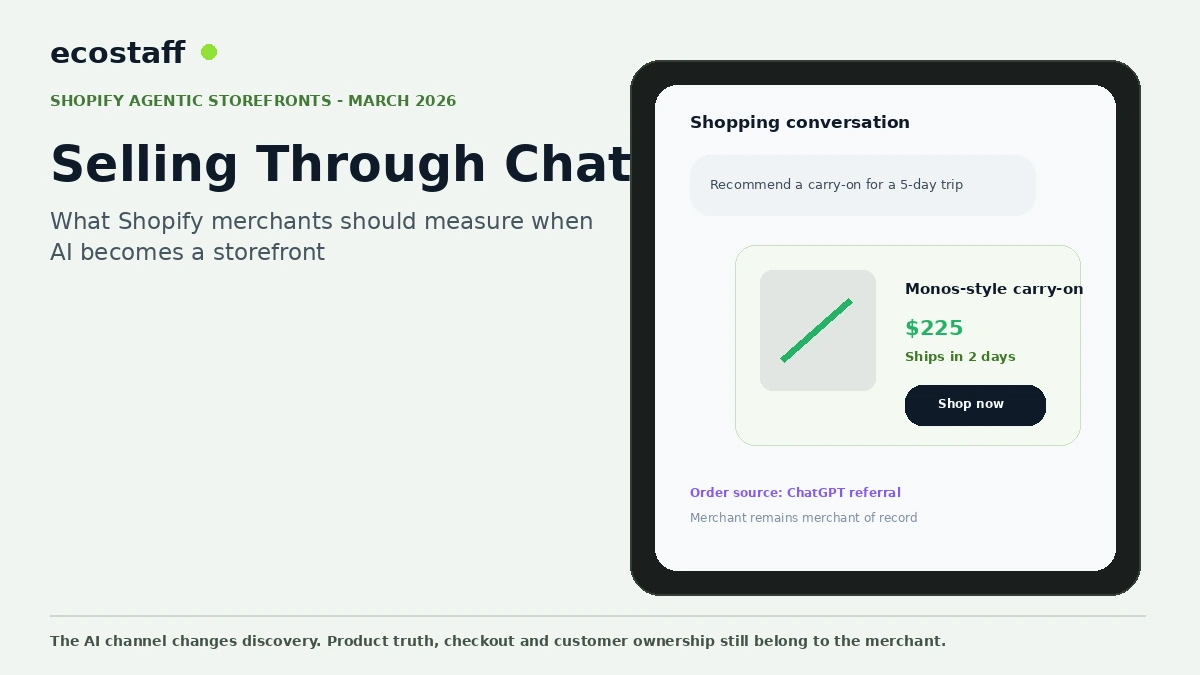
On March 24, 2026, Shopify said millions of merchants could begin selling to ChatGPT users through Agentic Storefronts. Shopify described product discovery through Shopify Catalog, checkout through an in-app browser on supported mobile experiences and direct merchant-store linking on desktop. Orders flow into Shopify admin with ChatGPT referral attribution, while the merchant remains the merchant of record and retains the customer relationship.
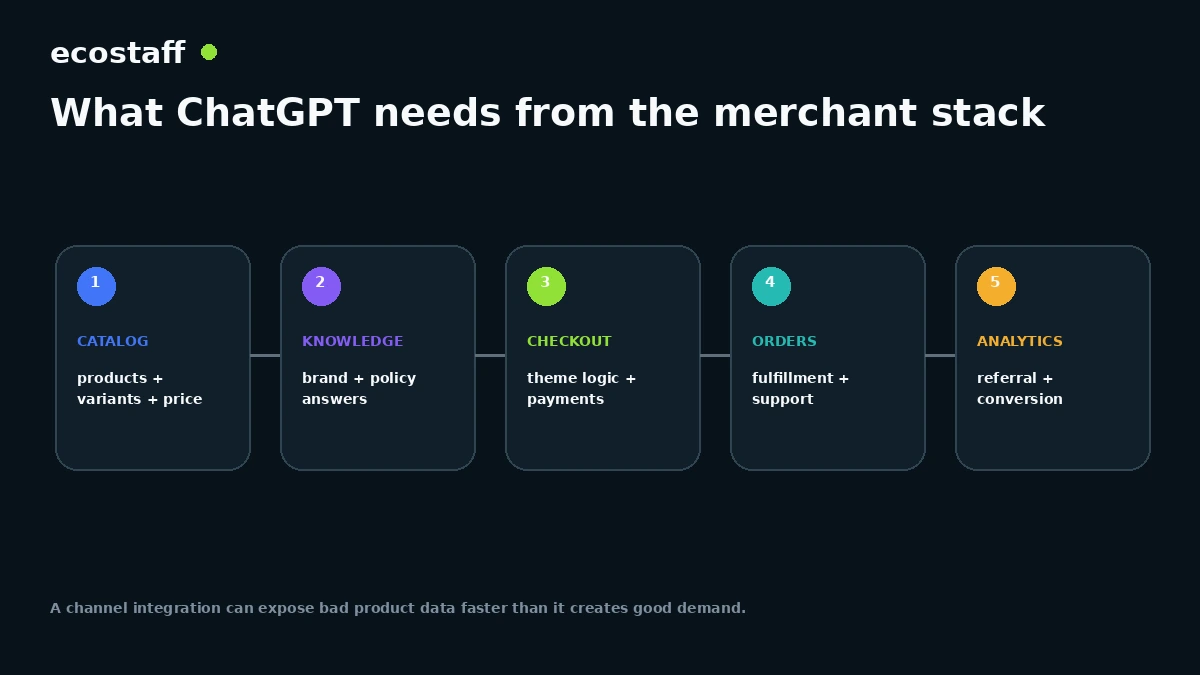
Agentic Storefronts also connect merchants to other AI channels, including Microsoft Copilot, Google AI Mode and the Gemini app. For merchants, the key operational task is not simply ‘turn on ChatGPT.’ It is to make product data, policy information, checkout customizations, attribution and post-purchase support reliable across a new discovery surface.
AI commerce moved from roadmap to distribution in early 2026. Shopify had introduced Agentic Storefronts in Winter ’26 and co-developed the Universal Commerce Protocol with Google in January. By March, the company said millions of merchants could sell to ChatGPT users through the same centralized agentic-commerce layer.
This changes the top of the funnel. The shopper can begin with a need rather than a product name, ask questions, compare options and reach a merchant only after the AI system has already narrowed the decision.
How the ChatGPT shopping flow works for Shopify merchants
Shopify said ChatGPT users could discover products across the Shopify ecosystem through Shopify Catalog. On supported mobile flows, the buyer could complete the purchase through an in-app browser, while merchant brand experience, pricing logic, payment methods and checkout customizations carried into the transaction.
On desktop, Shopify described a direct link to the merchant’s store in a separate browser tab. The exact buyer path can therefore differ by interface, which is why channel-specific measurement matters.
Merchant of record and customer ownership remain important
Shopify emphasized that merchants remain the merchant of record and retain ownership of the customer relationship and data. This is strategically different from marketplace models where the platform can become the main customer relationship.
Merchants should still review consent, privacy, customer-service and regional data obligations. ‘Customer stays yours’ does not remove the need for correct privacy notices and data governance.
ChatGPT referral attribution creates a new analytics segment
Shopify said orders flow into admin with ChatGPT referral attribution. This gives merchants a direct way to compare AI-channel orders against other acquisition paths.
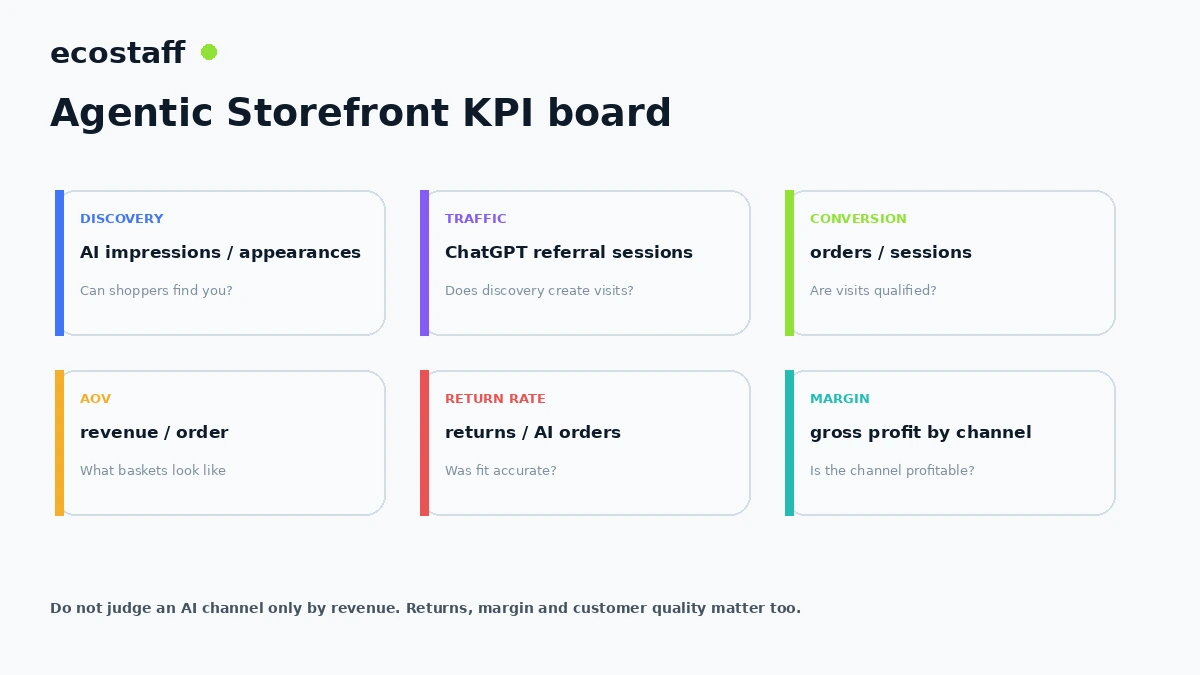
Build a dedicated reporting view instead of burying these sessions inside generic referral traffic. Early channel volume may be small, but product mix, conversion and return behavior can reveal whether the channel is finding the right customers.
Six metrics worth tracking
- AI-channel orders: volume and growth by source.
- Conversion rate: orders relative to attributable sessions or referrals.
- Average order value: whether conversational discovery changes basket size.
- Gross margin: channel profitability after discounts and product mix.
- Return rate: whether AI recommendations produce accurate fit.
- Repeat purchase: whether AI-acquired customers become direct customers later.
Product data becomes channel infrastructure
An agentic storefront can only represent products as well as the underlying catalog. Review titles, variants, inventory, images, price and compatibility information. If an AI system recommends a size, color or model that is unavailable, the discovery experience may be strong while the commercial outcome is poor.
Brand and policy knowledge matter in conversation
Traditional storefronts let buyers open tabs for shipping, returns and warranty. In an AI conversation, the buyer may ask those questions directly. Shopify Knowledge Base and structured merchant information make policy accuracy more important.
Create one authoritative source for shipping cutoffs, return windows, warranty coverage, exclusions and product restrictions. Avoid contradictory policy text across old blog posts, FAQs and product descriptions.
Checkout customizations need channel QA
Shopify said merchant pricing logic, payment methods and checkout customizations carry into the ChatGPT shopping flow. Merchants should still test the specific channel because third-party apps, UI extensions and region-specific logic can behave differently.
| Checkout area | What to test | Failure risk |
|---|---|---|
| Discounts | Automatic + code combinations | Price mismatch or invalid offer. |
| Payments | Wallets and card methods | Expected method unavailable. |
| Shipping | Rates and delivery dates | Agent promise conflicts with checkout. |
| Subscriptions | Recurring-product rules | One-time recommendation enters wrong flow. |
| Markets | Currency, language, tax | AI discovery sends wrong regional experience. |
The new Agentic plan broadens the ecosystem
Shopify also made its Agentic plan publicly available in March 2026 for brands not using Shopify as their primary ecommerce platform. Shopify described the plan as a way to add products to Shopify Catalog and reach AI channels without moving the main online store to Shopify.
For non-Shopify brands, that creates a strategic question: is adding a catalog distribution layer enough, or does the business need deeper checkout and order integration? The answer depends on operational complexity.
UCP is the protocol behind part of the channel expansion
Google AI Mode and Gemini integrations use the Universal Commerce Protocol co-developed by Shopify and Google. The protocol provides standardized commerce capabilities for agentic transactions.
Read Universal Commerce Protocol: What eCommerce Teams Need to Know for the architecture behind agentic checkout.
Do not confuse AI-channel availability with product visibility
Being technically eligible does not guarantee that every product appears for every relevant prompt. Product discovery still depends on the AI platform, product data, relevance and channel rules.
The merchant can control data quality, channel configuration and conversion experience. Avoid agencies or tools that promise guaranteed placement in generative recommendations.
Create an owner for agentic commerce
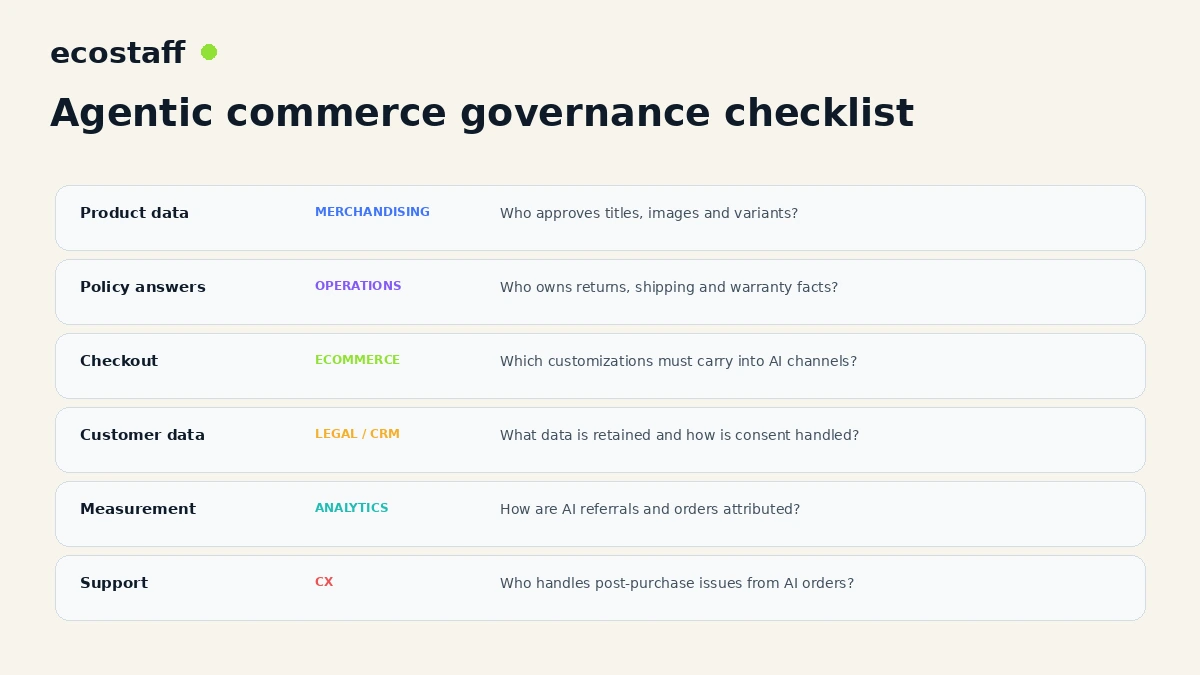
AI commerce touches more functions than a normal channel integration. Assign clear responsibility so catalog errors, policy changes and reporting do not fall between teams.
- Merchandising owns product and variant accuracy.
- Operations owns availability, shipping and return promises.
- Ecommerce owns checkout and channel configuration.
- Analytics owns attribution and channel reporting.
- Customer experience owns AI-order support issues.
- Legal or privacy owners review customer-data handling.
A 30-day Agentic Storefront pilot
- Confirm channel eligibility and configuration.
- Audit the top 100 products by revenue.
- Review shipping, returns and warranty answers.
- Test several product-discovery prompts.
- Complete test purchases on supported devices.
- Verify order attribution in Shopify admin.
- Track AI orders, AOV, margin and returns.
- Review support tickets from AI-referred orders.
- Fix recurring catalog or policy gaps.
- Decide whether to expand assortment and marketing support.
How to choose an agency for agentic storefront work
A credible Shopify agency should understand catalog data, Shopify Markets, checkout customizations, attribution, product feeds, UCP and customer data. The project is not just a chatbot build.
You can compare Shopify agencies on Ecostaff.
Frequently asked questions
Do Shopify merchants need a separate ChatGPT app integration?
Shopify said Agentic Storefronts provide out-of-the-box access for eligible merchants, with no separate app integration required for the core discovery connection.
Does Shopify charge a separate transaction fee for ChatGPT orders?
In its March 24 announcement, Shopify said there were no transaction fees beyond standard processing rates for this Agentic Storefront flow.
Does checkout always happen inside ChatGPT?
No. Shopify described supported mobile flows using an in-app browser, while desktop can link directly to the merchant store. Channel behavior can evolve, so merchants should verify current documentation.
Do AI-channel customers remain the merchant’s customers?
Shopify said merchants remain merchant of record and retain ownership of customer relationships and data.
Sources and further reading
- Shopify – Millions of merchants can sell in AI chats, March 24, 2026
- Shopify – Agentic Storefronts
- Shopify – The agentic commerce platform, January 11, 2026
- Shopify – Introducing Agentic Storefronts, December 10, 2025
Conclusion
March 2026 turned Agentic Storefronts from a platform direction into a real merchant distribution channel. Shopify merchants could reach ChatGPT users while keeping orders, checkout logic and customer relationships connected to the Shopify operating system.
The opportunity is new qualified discovery. The work is familiar commerce discipline: accurate catalog data, reliable policies, stable checkout, clear attribution and strong post-purchase experience.