

Quick answer: what is the Universal Commerce Protocol?
The Universal Commerce Protocol (UCP) is an open standard for agentic commerce announced by Google and Shopify on January 11, 2026. It gives AI platforms and merchants a shared way to discover commerce capabilities, create and update checkout sessions, negotiate payment handlers and support order lifecycle interactions without every agent building a completely custom integration for every merchant.
For eCommerce teams, UCP matters because the next distribution layer may be an AI conversation rather than a traditional storefront session. The protocol can standardize transaction plumbing, but merchants still own product truth, tax, fulfillment, fraud, customer service and the commercial rules that make checkout reliable.
Agentic commerce creates an integration problem at ecosystem scale. A shopper may discover a product in an AI assistant, ask follow-up questions, add several items, choose delivery and begin checkout without first visiting a merchant website. If every AI platform needs a different proprietary checkout integration, merchants and developers face the same fragmentation problem that marketplaces and payment methods created in earlier generations.
UCP is designed as a shared language between platforms and businesses. Shopify and Google co-developed the protocol, and Shopify positioned it as infrastructure for selling through AI Mode in Google Search, Gemini, Microsoft Copilot and other agentic channels.
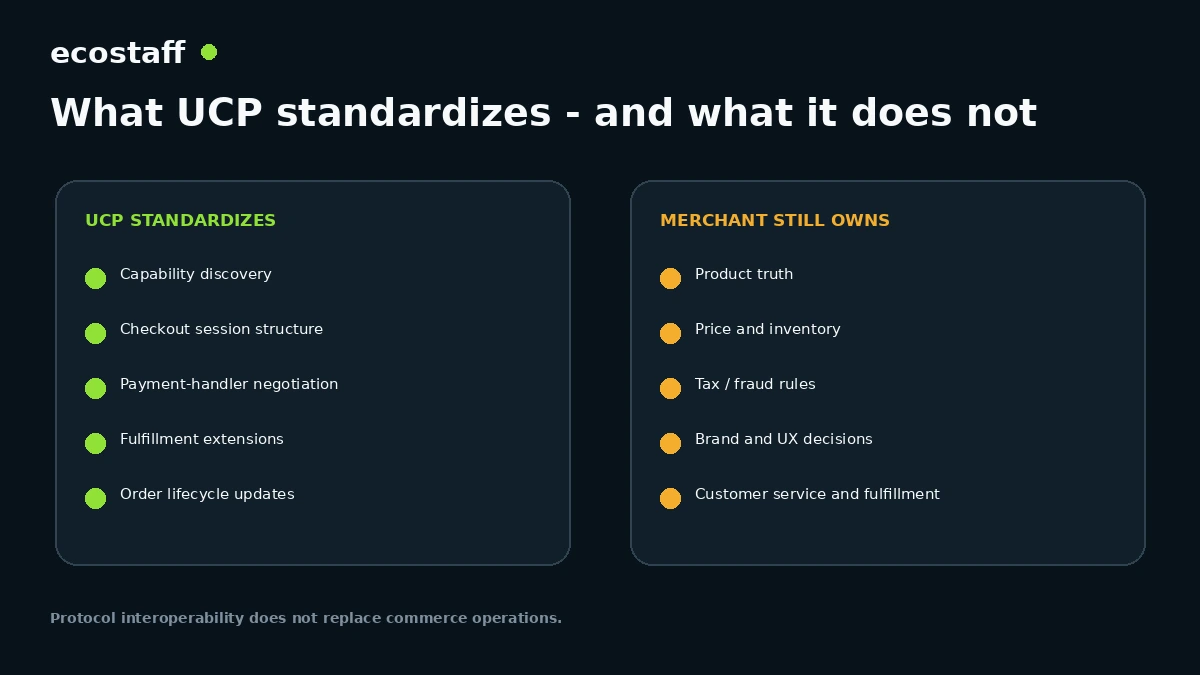
What UCP standardizes
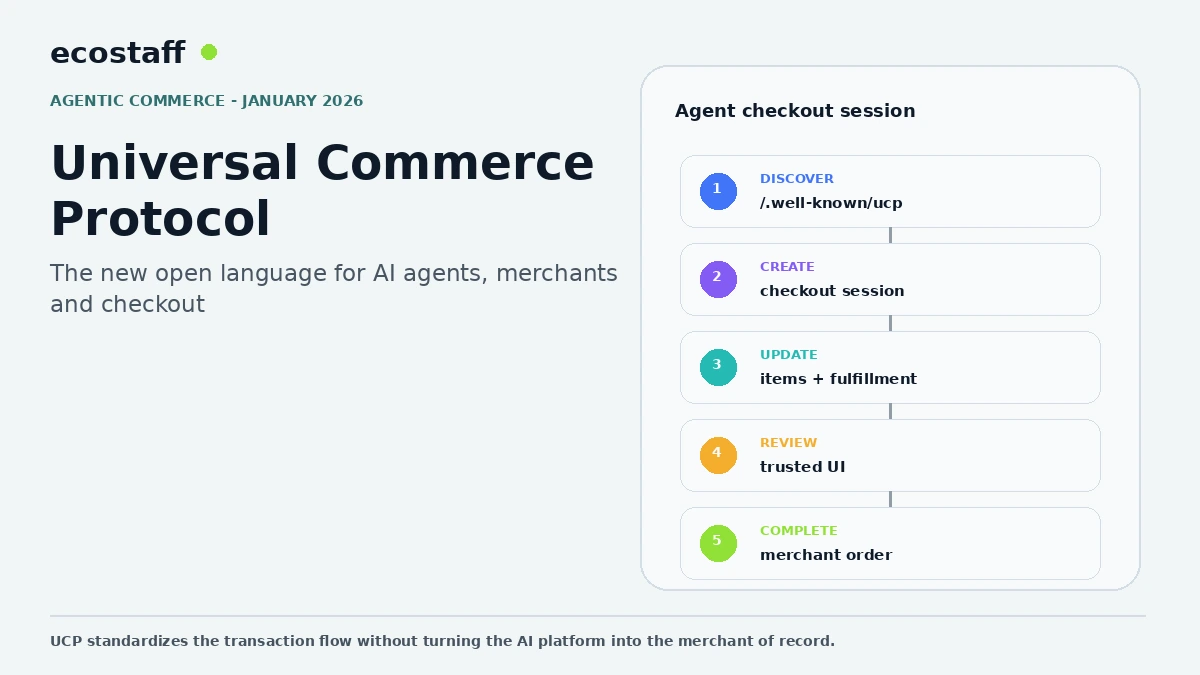
The January 2026 UCP specification defined capabilities such as checkout, identity linking and order updates. The core idea is capability discovery: a platform can inspect a business’s UCP profile and learn what transaction functions and payment handlers it supports.
- Checkout: create and manage checkout sessions, including items and tax calculations.
- Identity linking: authorize a platform to perform approved actions for a user.
- Order: communicate asynchronous order lifecycle updates such as shipping, delivery and returns.
- Payment handlers: negotiate supported payment methods rather than requiring one fixed provider.
- Extensions: support areas such as fulfillment without making every checkout identical.
Merchant of record remains with the business
One of the most important architectural details is commercial responsibility. UCP’s checkout specification says the business remains the merchant of record. The AI platform can facilitate the session, but the merchant remains the seller responsible for the transaction.
That means UCP does not erase tax obligations, return policies, fulfillment promises or customer-service responsibility. It creates interoperability around the transaction flow.
Human review remains part of checkout
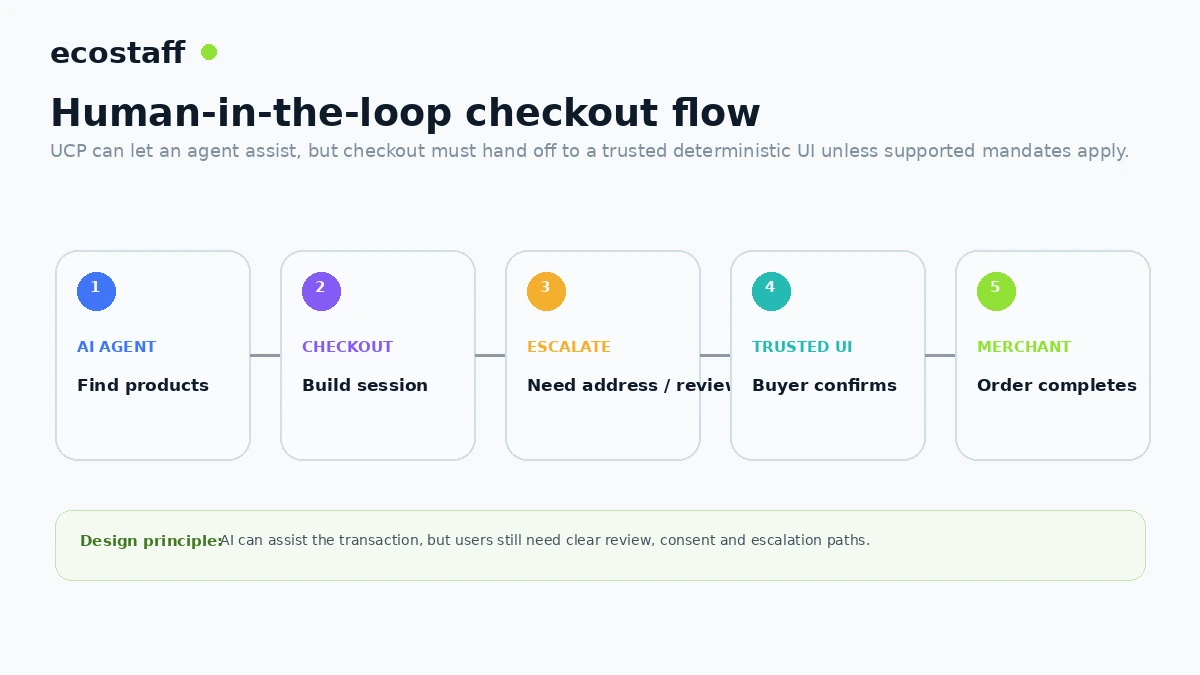
The UCP checkout guidance requires the agent to hand control to a trusted and deterministic UI for final review unless the relevant mandate extension is supported. This is important for buyer trust and for complex cases that need direct user interaction.
A furniture order may require a delivery window. A regulated item may need extra eligibility information. A high-risk payment may need a verification step. UCP includes escalation and continuation patterns so the transaction can move from agent assistance to merchant or platform UI instead of failing silently.
Why UCP matters to eCommerce architecture
Historically, merchants optimize around channels: web store, marketplace, social commerce, retail POS and mobile app. Agentic commerce adds a new abstraction. The business needs product and checkout systems that can serve several AI interfaces without creating a different source of truth for each one.
| Architecture layer | What UCP changes | What the merchant still needs |
|---|---|---|
| Catalog | Agent can discover transaction capabilities | Accurate products, variants, images and availability. |
| Checkout | Shared session structure | Discount, tax, fulfillment and error logic. |
| Payments | Handlers can be negotiated | Fraud, supported methods and payment operations. |
| Fulfillment | Extensible transaction model | Warehouse, carrier and delivery rules. |
| Orders | Lifecycle data can be communicated | Customer support, returns and operational execution. |
UCP and Merchant Center are different layers
Google also announced new tools for retailers in January 2026, including Merchant Center attributes for conversational commerce and a Business Agent experience in Search. Those tools help product discovery and brand interaction. UCP is closer to transaction infrastructure.
A merchant can therefore think in three layers: product discovery data, conversational brand and product answers, and transaction capabilities. Strong agentic commerce requires all three to agree.
UCP and Shopify Agentic Storefronts
Shopify announced that UCP would power embedded selling in Google AI Mode and the Gemini app and that merchants could manage AI commerce channels through Agentic Storefronts. This gives Shopify merchants a platform-managed route into UCP-based commerce.
For the platform background that led to this release, see Shopify Winter ’26: Agentic Storefronts and 12 Updates eCommerce Teams Should Review.
What developers should understand
UCP is not tied to one transport. Shopify’s UCP materials describe support for transports such as REST, GraphQL, JSON-RPC, A2A and MCP, with the business logic represented through shared commerce capabilities.
For engineering teams, the practical benefit is separation. The same checkout capability can potentially be exposed through different agent transports without rewriting the underlying commerce rules.
Security and permission design
Agentic checkout increases the importance of explicit permissions. A product-search ability is lower risk than price changes, refunds or order modifications. Merchants should treat agent access like API access: use minimum privileges, clear authentication, logging, rate controls and escalation.
- Separate read-only discovery from transaction actions.
- Define which checkout fields an agent may update.
- Keep sensitive payment handling inside supported trusted flows.
- Log agent-originated order and checkout activity.
- Require human review for irreversible or high-risk actions.
- Document fallback behavior when an agent cannot complete a request.
Prepare catalog and policy data before protocol work
A technically correct UCP integration cannot compensate for poor product data. If the catalog contains duplicate variants, stale availability or incomplete delivery information, the agent will simply expose those weaknesses in a new channel.
The merchant should therefore audit product IDs, variant logic, price, inventory, images, shipping rules, return policy, warranty and restricted-product logic before investing heavily in agentic checkout.
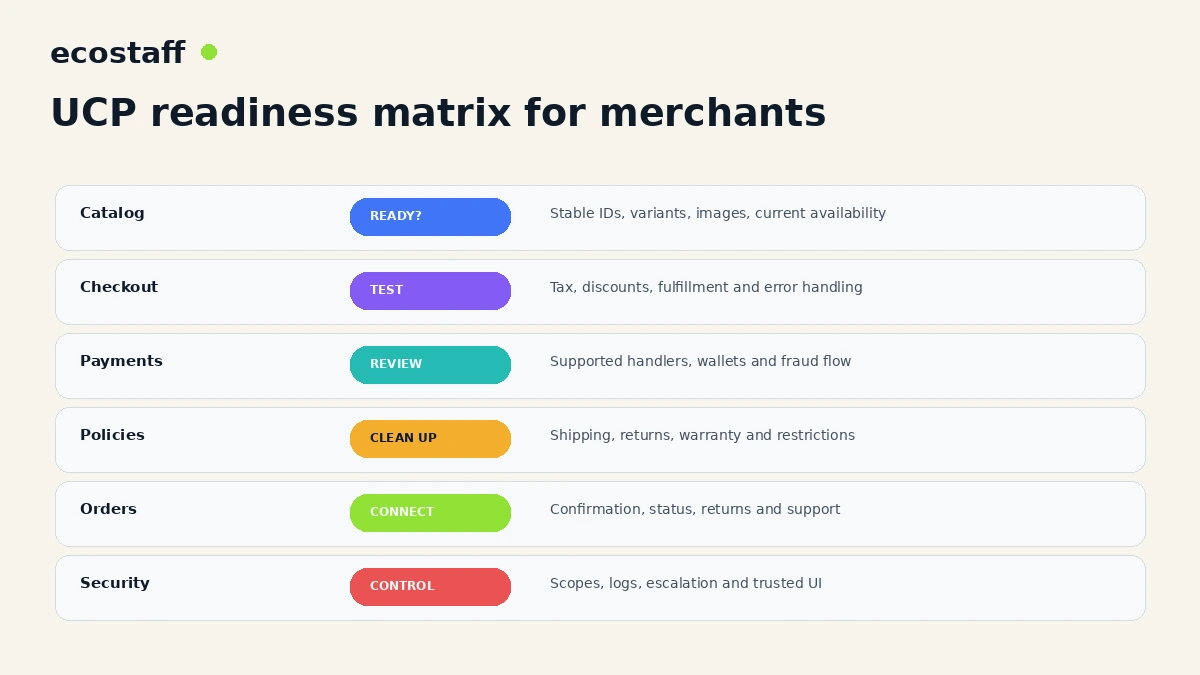
A practical UCP readiness checklist
- Map the current product and inventory source of truth.
- Review variant IDs and catalog consistency.
- Document supported payment methods and fraud requirements.
- Map tax and shipping calculation dependencies.
- Identify human-review points in checkout.
- Review returns, cancellations and order-status flows.
- Define agent permissions and logging requirements.
- Identify which AI channels are strategically relevant.
- Decide whether the commerce platform already provides UCP support.
- Create sandbox tests before exposing production checkout.
- Measure conversion, margin and support impact by agentic channel.
- Keep a fallback path to the merchant storefront.
When should a merchant build directly against UCP?
Most merchants should first evaluate whether their commerce platform, payment provider or agency already exposes supported UCP capabilities. Direct implementation is more relevant to large custom platforms, marketplaces, middleware providers and brands with specialized agentic-commerce requirements.
The strategic question is not ‘Can we implement the protocol?’ It is ‘Which customer journey becomes meaningfully better, and can our operational systems support it?’
How to evaluate an agency for agentic commerce
Ask whether the agency understands the full order path, not only AI APIs. They should be able to explain catalog ownership, checkout session state, payments, fulfillment, order updates, customer data, analytics and failure handling.
Use Ecostaff to compare eCommerce service providers. The agency evaluation guide provides a broader procurement framework.
Frequently asked questions
Is UCP owned only by Shopify?
No. Shopify and Google announced UCP as an open standard co-developed together. The specification is published separately at ucp.dev.
Does UCP let AI complete every purchase without the user?
No. The checkout specification requires finalization through a trusted UI unless supported mandate extensions allow another flow. Escalation and human review remain part of the model.
Does a merchant become PCI compliant because it supports UCP checkout?
The UCP specification says businesses do not need to become PCI DSS compliant merely to support the checkout capability when payment handlers manage the payment instrument flow. Merchants should still review their actual payment architecture and obligations.
Is UCP only for Shopify stores?
No. Shopify is an important implementer, but UCP is designed as an open protocol. Other commerce platforms and custom systems can implement it.
Sources and further reading
- Google – New tech and tools for retailers to succeed in an agentic shopping era, January 11, 2026
- Shopify – The agentic commerce platform, January 11, 2026
- Universal Commerce Protocol – Specification overview
- Universal Commerce Protocol – Checkout capability
- Shopify – Universal Commerce Protocol
Conclusion
UCP is important because it treats agentic commerce as infrastructure rather than a one-off chatbot integration. Shared capabilities can reduce channel fragmentation and make it easier for merchants to transact through new AI surfaces.
But interoperability is only the outer layer. Reliable agentic commerce still depends on accurate products, stable checkout rules, payment operations, fulfillment and customer service. Merchants that strengthen those foundations will be better prepared regardless of which AI channel grows fastest.