

Quick answer: what did Google’s November 2024 site reputation abuse update mean?
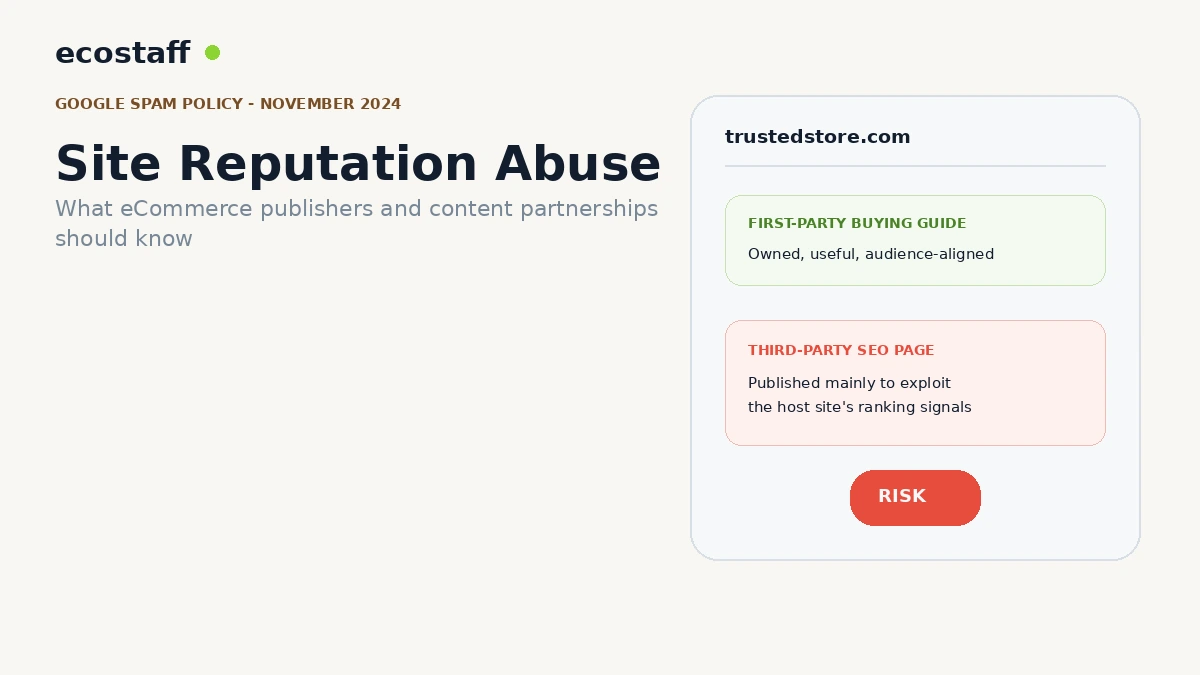
On November 19, 2024 Google clarified that publishing third-party pages mainly to exploit the host site’s established ranking signals can violate its site reputation abuse policy, even when the host has some first-party involvement or oversight.
For eCommerce publishers, marketplaces and brands, this made governance around guest posts, white-label content, sponsored buying guides, coupon sections, affiliate pages and licensed content more important. A commercial relationship does not automatically create a violation, but pages should exist because they serve the site’s real audience and editorial purpose – not mainly because the host domain can rank them.
Many commerce sites publish content created with outside partners. That can be useful: brands contribute product expertise, agencies share implementation knowledge, and subject-matter experts can strengthen a buying guide. The risk appears when the host site’s reputation becomes the product being sold.
Google’s November clarification focused on the underlying nature of third-party content. First-party review, licensing, partial ownership or other involvement does not automatically change content that is fundamentally third-party and published to exploit the host site’s ranking signals.
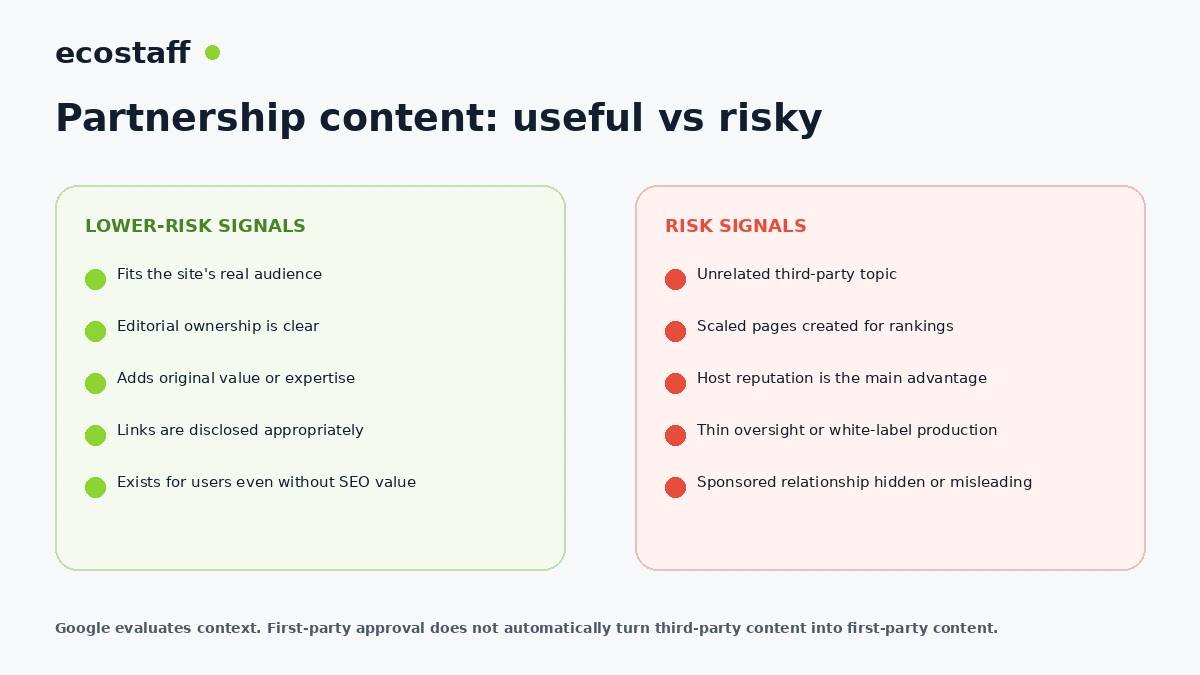
What is site reputation abuse?
Google defines site reputation abuse as publishing third-party pages on a site in an attempt to abuse Search rankings by taking advantage of the host site’s ranking signals. The key issue is the purpose and relationship between the host site, the third-party content and the attempt to rank.
What changed in November 2024?
Google clarified that different levels of first-party involvement do not automatically remove the third-party nature of content. The company specifically discussed arrangements such as white-label services, licensing and partial ownership.
That clarification matters because publishers cannot rely on a contract or editorial approval process as proof that a section is safe. Google says it evaluates many considerations and does not simply take a site’s description of the relationship at face value.
Examples that eCommerce teams should review
| Content model | Potential value | Main policy question |
|---|---|---|
| Guest expert article | Adds specialist knowledge to the site’s audience | Would the site publish this because readers need it even without ranking value? |
| Sponsored buying guide | Funds useful content and may disclose a commercial relationship | Is the editorial purpose real, and are links handled appropriately? |
| White-label coupon section | Adds a large third-party section operated by another company | Is the host’s ranking reputation the primary reason the content exists here? |
| Affiliate comparison pages | Can help buyers compare options | Does the page contain original analysis and fit the site’s core purpose? |
| Licensed content library | Expands coverage quickly | Is it commodity third-party material added mainly to capture search demand? |
Why this matters for eCommerce content partnerships
Commerce businesses often have strong domains, established topical authority and large audiences. That makes them attractive hosts for third parties seeking rankings. It also means content partnerships need a governance model before scale.
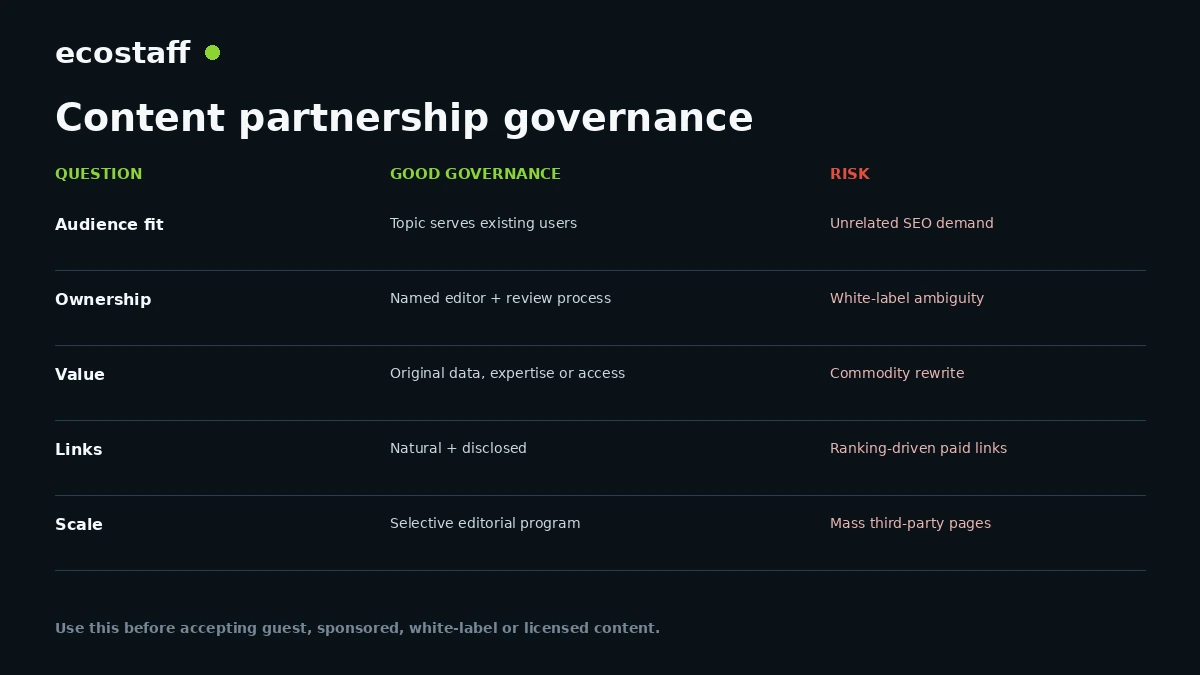
Five governance questions before publishing third-party content
- Audience fit: Is the topic clearly useful to people who already use this site?
- Editorial ownership: Who decides the angle, evidence, claims, updates and removals?
- Original value: What does this page add beyond commodity summaries available elsewhere?
- Commercial disclosure: Are sponsorship, affiliate relationships and paid links handled clearly?
- Scale: Would the model still make sense if Search traffic disappeared tomorrow?
Links require separate treatment
Google’s site reputation abuse policy and its link-spam policies are related but not identical. A useful third-party article can still have problematic paid links. Sponsored placements should use appropriate link attributes such as rel="sponsored", and user-generated links may use ugc where relevant.
Do not use a content partnership as a disguised link-selling program. If the commercial product is essentially access to the host’s ranking signals, the risk is much higher.
White-label sections deserve extra scrutiny
A white-label partner may operate a section of the site, provide templates, publish content and monetize traffic while the host supplies the domain. That model is exactly where editorial ownership and audience fit need to be explicit.
Ask who would own the content if the commercial agreement ended, who responds to factual errors, how topics are selected and whether the host has the expertise to review the material meaningfully.
What about guest articles from agencies or vendors?
A guest article can be useful when the contributor has real expertise and the topic serves the audience. For Ecostaff, for example, a technical agency could contribute practical knowledge about Shopify checkout migration or Magento performance. The editorial team should still control scope, factual standards, disclosure and links.
The article should not be accepted simply because the contributor wants a backlink. The stronger model is expertise exchange: original knowledge or evidence in return for transparent attribution, with no guarantee of ranking or followed links.
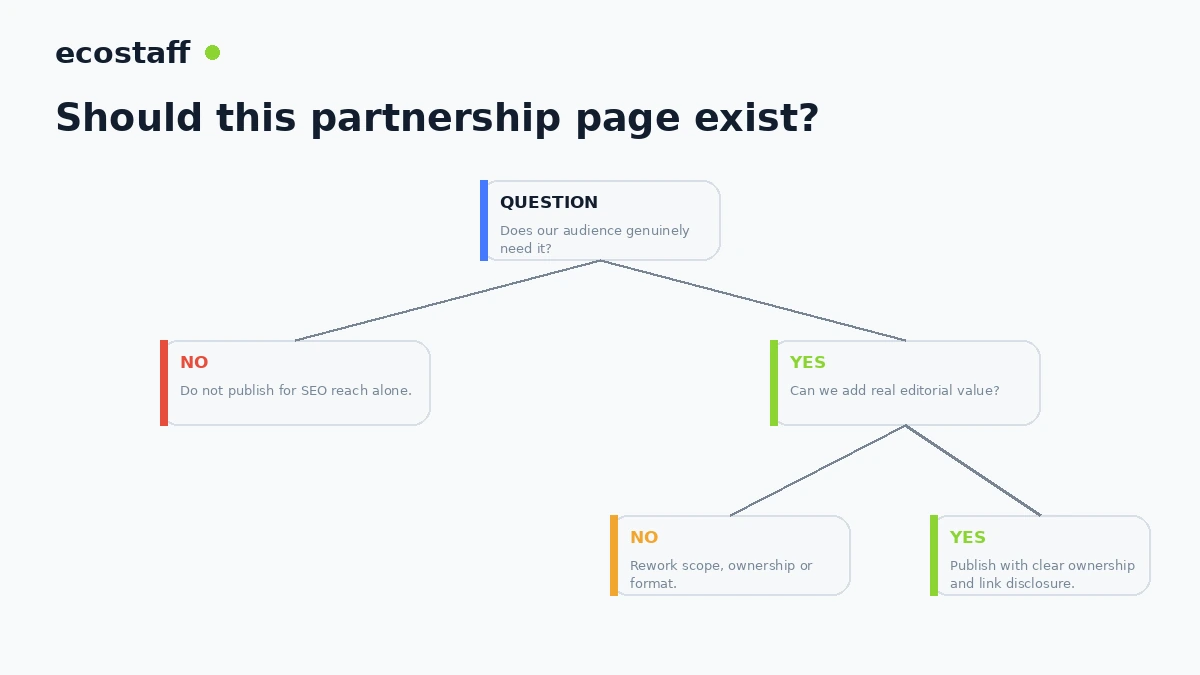
A safe editorial workflow for partnerships
- Define the site’s allowed partnership topics.
- Require a clear contributor or sponsor identity.
- Set evidence and sourcing standards.
- Keep final editorial control with the host.
- Review claims, examples and commercial references.
- Apply sponsored or UGC link attributes when appropriate.
- Add disclosures where the relationship could affect reader interpretation.
- Keep a review/update date for factual or time-sensitive content.
- Monitor whether a third-party section is drifting away from the site’s core audience.
- Be willing to reject high-volume content even when it creates short-term revenue.
How this applies to Ecostaff’s own content partnership model
Ecostaff can use expert contributions from ecommerce service providers, but the value proposition should be the article itself: useful expertise for buyers and practitioners. Company badges, author attribution or links can support the relationship, but they should not become a sale of ranking signals.
That means contributor articles should follow the same editorial standard as internally produced guides: relevant topic, primary sources where needed, practical detail, clear authorship and transparent commercial disclosure.
Frequently asked questions
Are all guest posts risky?
No. Google does not prohibit legitimate contributor content. The policy targets third-party pages published to abuse search rankings through the host site’s ranking signals.
Does reviewing a third-party article make it first-party content?
Not automatically. Google’s November 2024 clarification specifically says that varying degrees of first-party involvement do not necessarily change the fundamental third-party nature of the content.
Can sponsored content rank in Google?
Sponsored content is not automatically excluded from Search. However, the page still needs to comply with spam policies, and paid links should be qualified appropriately.
Should brands remove every old partner article?
No. Audit intent, audience fit, quality, ownership and link treatment. Remove or rework content that exists mainly to exploit rankings or that cannot be made genuinely useful.
Sources and further reading
- Google Search Central – Updating our site reputation abuse policy, November 19, 2024
- Google Search Central – Spam policies for Google web search
- Google Search Central – Qualify outbound links
- Google Search Central – Creating helpful, reliable, people-first content
Conclusion
The November 2024 clarification made one principle clearer: first-party involvement does not automatically legitimize third-party pages whose main purpose is to exploit a host site’s ranking reputation.
For eCommerce businesses, the practical answer is better partnership governance. Publish outside expertise when it serves the audience, keep real editorial ownership, disclose commercial relationships and treat links as a secondary outcome rather than the product being sold.