

Quick answer: what did Google’s May 2026 AI Search guidance change?
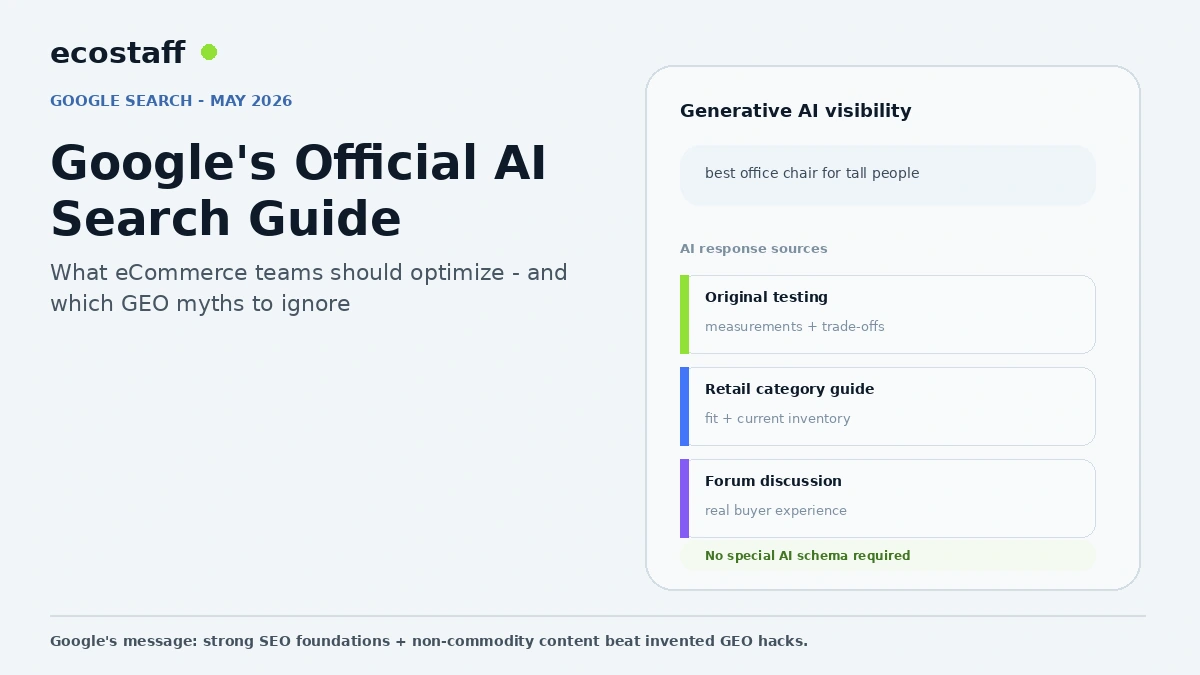
On May 15, 2026, Google published dedicated guidance for optimizing websites for generative AI features such as AI Overviews and AI Mode. The central message was surprisingly traditional: SEO fundamentals still apply because generative AI features are rooted in Google’s core Search ranking and quality systems.
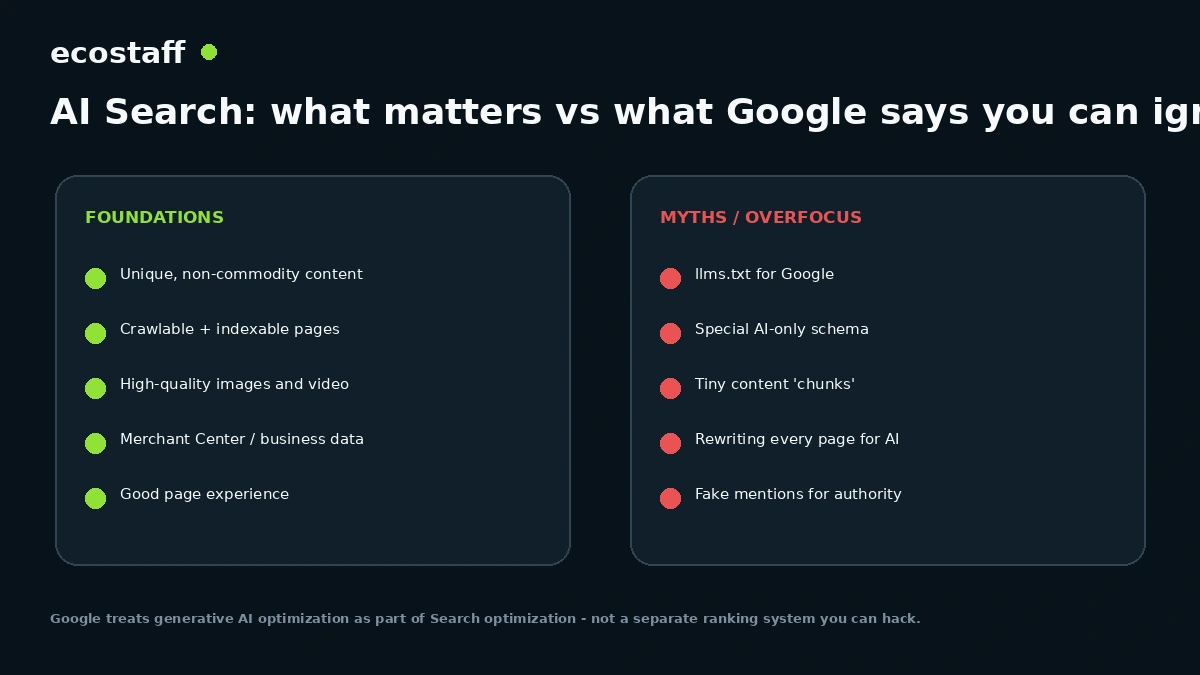
For eCommerce teams, the biggest practical clarification was what not to chase. Google said you do not need llms.txt for Google Search, special AI-only markup, artificial content chunking, AI-specific rewrites or a unique schema type to appear in generative AI features. Instead, focus on unique non-commodity content, crawlable pages, product and Merchant Center data, strong images and video, page experience and Search Console measurement.
By 2026, the SEO market had created a crowded vocabulary around AEO, GEO, AI visibility and answer-engine optimization. Some of the underlying work was useful, but the labels also encouraged a new generation of shortcuts: special AI text files, invented schemas, formulaic content chunks and campaigns designed to manufacture brand mentions.
Google’s official guide narrowed the problem. Its generative AI features use core Search systems to retrieve current pages, including retrieval-augmented generation and query fan-out. In other words, a website still has to be discoverable, indexable, relevant and useful before an AI feature can make productive use of it.
SEO is still the foundation of AI Search
Google explicitly said that SEO best practices remain relevant because AI Overviews and AI Mode are rooted in core Search ranking and quality systems. The systems may use techniques such as query fan-out to explore related aspects of a user’s question, but the underlying retrieval still depends on Search.
For eCommerce, that means canonicalization, internal linking, crawlability, JavaScript rendering, structured product information and page experience remain useful work. AI Search does not create a bypass around poor technical SEO.
Query fan-out changes how we think about search intent
A generative AI system can issue several related queries to understand one complex user request. A shopper searching for a washing machine may implicitly need information about dimensions, energy use, delivery, noise, installation and reliability even if the original question is short.
The wrong response is to create a separate page for every possible fan-out query. Google warned that generating many pages primarily to manipulate Search or AI responses can violate scaled content abuse policies.
The stronger response is to make strategic category, product and guide pages genuinely complete for the decision they support.
Non-commodity content becomes more defensible
Google’s guide emphasized unique, compelling and non-commodity content. For commerce sites, manufacturer copy, generic buying tips and templated category introductions are especially easy to reproduce.
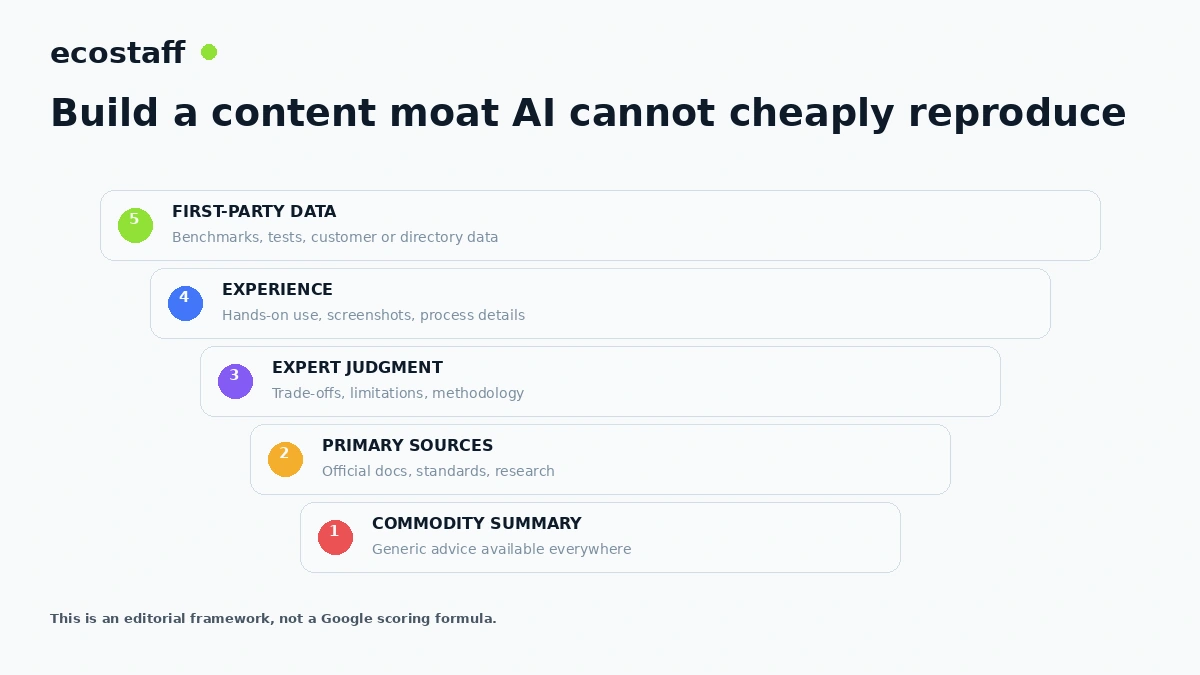
- First-party tests: measurements, fit notes, durability checks or performance results.
- Operational data: delivery times, return reasons, support questions or compatibility information.
- Original imagery: products in use, scale references, comparison photography or installation examples.
- Expert judgment: trade-offs, edge cases, limitations and who should not buy the product.
- Transparent methodology: how a ranking, test or recommendation was produced.
llms.txt does not improve Google Search visibility
Google’s guide said its Search systems do not use llms.txt or other special AI text files as a visibility signal. A business can maintain such files for other services that use them, but Google said the file neither helps nor harms ranking in Google Search.
This is useful governance guidance. Do not assign engineering work to an llms.txt project for Google unless another tool or integration has a specific operational reason to use it.
There is no special AI Search schema
Structured data still matters for ordinary Search features and for clarifying machine-readable content, especially in ecommerce. However, Google said there is no special schema.org markup required for generative AI Search.
Continue using supported Product, Offer, Organization, Breadcrumb and other relevant schema because it improves overall Search understanding and eligibility, not because an agency claims it unlocks an AI-only ranking layer.
Do not chunk content for the model
Google also rejected the idea that pages need to be broken into artificially small content chunks so AI can understand them. Page structure should follow the user’s needs. Some topics benefit from concise sections and tables; others need a longer explanation.
Use headings, lists and tables because they improve comprehension, navigation and accessibility, not because of a rigid AI extraction formula.
eCommerce details are a specific visibility layer
Google’s guide explicitly called out Merchant Center, product information and Google Business Profile as useful ways to make local and ecommerce details visible in both AI responses and standard Search.
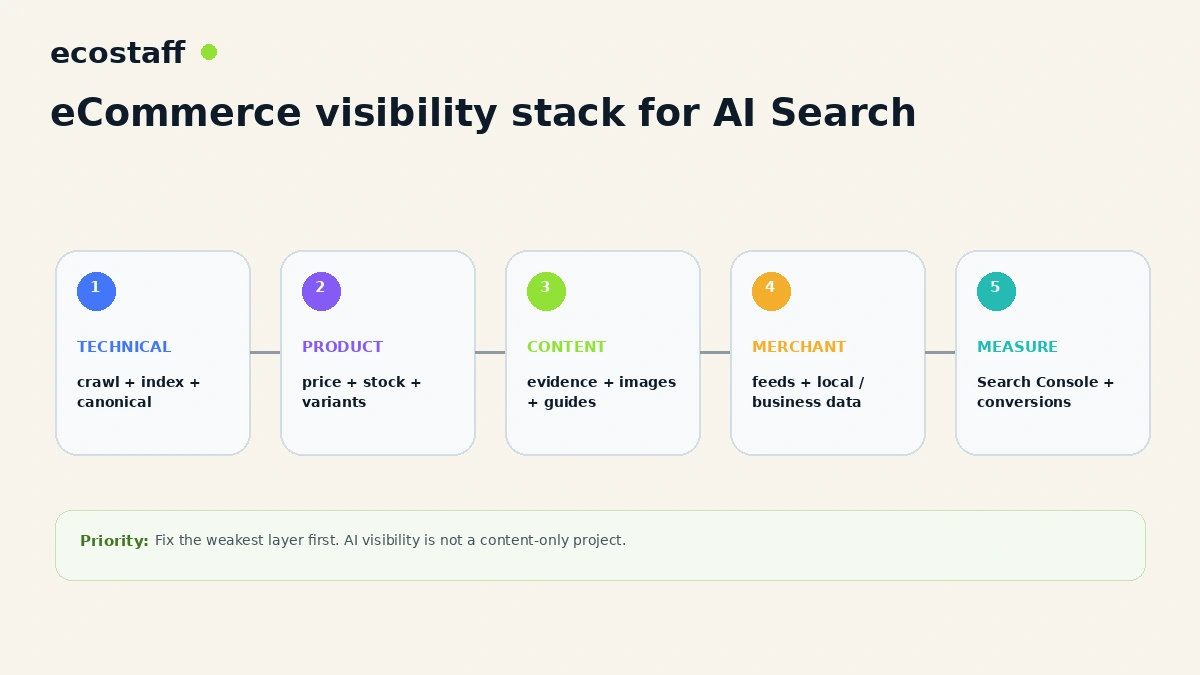
| Layer | What to verify | Business owner |
|---|---|---|
| Technical SEO | Indexability, canonicals, rendering, internal links | SEO / engineering |
| Product data | Price, inventory, variants, identifiers | Merchandising |
| Editorial evidence | Original guides, images, testing, methodology | Content / experts |
| Merchant data | Merchant Center, local and business details | Feed / local teams |
| Measurement | Generative AI Search Console views and conversions | Analytics |
Images and video create additional discovery opportunities
Google noted that generative AI Search can include relevant images and video. For ecommerce this is especially important because product choice is often visual. Strong image SEO and video SEO remain useful rather than being replaced by AI text.
- Use high-resolution product images.
- Map images correctly to variants.
- Show products in context and at useful scale.
- Use descriptive filenames and alt text where appropriate.
- Publish original comparison or instructional video when it helps the buyer.
- Keep important media crawlable.
AEO and GEO are not separate Google ranking systems
Google acknowledged the terms AEO and GEO but said that, from its perspective, optimization for generative AI Search is optimization for the Search experience and is therefore still SEO.
This does not mean every AI platform works the same way. It means vendors should not sell a Google-specific ‘GEO secret’ that contradicts Google’s published Search guidance.
How to evaluate AI Search vendors
- Ask which recommendations come from official Google documentation.
- Ask what Search Console or analytics evidence supports the diagnosis.
- Reject guarantees of AI Overview or AI Mode placement.
- Be cautious with proprietary scores presented as if they were Google metrics.
- Prioritize work that improves users, Search and commerce data at the same time.
Measure generative AI visibility in Search Console
Google’s guide pointed site owners toward dedicated generative AI performance reporting in Search Console. The important measurement shift is to connect visibility with business outcomes rather than celebrating appearances alone.
An ecommerce team should compare AI visibility with landing pages, product discovery, conversion, revenue, gross margin and branded demand where possible.
Agent-friendly websites are the next layer
Google also acknowledged browser agents and emerging protocols such as the Universal Commerce Protocol. Agents may inspect rendered pages, DOM structure and accessibility trees to complete tasks.
For transaction architecture, see Universal Commerce Protocol: What eCommerce Teams Need to Know in 2026.
A practical 2026 AI Search audit
- Verify important pages are crawlable and indexable.
- Audit duplicate and faceted URL systems.
- Check Product and Offer structured data.
- Review Merchant Center diagnostics.
- Identify strategic pages that contain only commodity information.
- Add first-party data, expertise or original media where useful.
- Improve images and video on high-value pages.
- Review JavaScript rendering and page experience.
- Ignore AI-only hacks that lack official support.
- Build Search Console views for generative AI visibility.
- Connect visibility to conversion and revenue.
- Review agentic-commerce readiness separately from Search ranking.
How Ecostaff should apply this standard
For a directory and editorial site such as Ecostaff, non-commodity content means using first-party directory data, transparent evaluation methodology, original comparisons and evidence from primary platform sources rather than generic agency-list content.
The earlier eCommerce SEO in 2025 guide covers the transition into AI Overviews, while the AI Mode shopping guide focuses specifically on product discovery.
Frequently asked questions
Do I need llms.txt to appear in Google’s AI results?
No. Google says Google Search ignores llms.txt for visibility and ranking purposes.
Is there special schema for AI Overviews or AI Mode?
No. Google says there is no special structured data required for generative AI Search. Continue using supported schema for normal Search features.
Should I rewrite all ecommerce content for AI?
No. Write for users and make pages useful. Google says AI systems can understand synonyms and meaning without exact query variants.
Does AI Search make technical SEO less important?
No. A page still needs to be technically eligible for Search, crawlable and indexable before it can be considered for generative AI features.
Sources and further reading
- Google Search Central – A new resource for optimizing for generative AI in Google Search, May 15, 2026
- Google Search Central – Optimizing your website for generative AI features on Google Search
- Google Search Central – Generative AI performance reports in Search Console
- Google Search Central – Spam policies for Google web search
Conclusion
Google’s May 2026 AI Search guide is useful because it removes noise. There is no special Google AI schema, no llms.txt advantage and no requirement to rewrite pages into tiny machine-friendly chunks.
The durable strategy is harder but more valuable: strong technical SEO, accurate commerce data, original non-commodity content, high-quality media and measurement tied to business outcomes.