

Quick answer: what should eCommerce teams do after Google’s June 2025 core update?
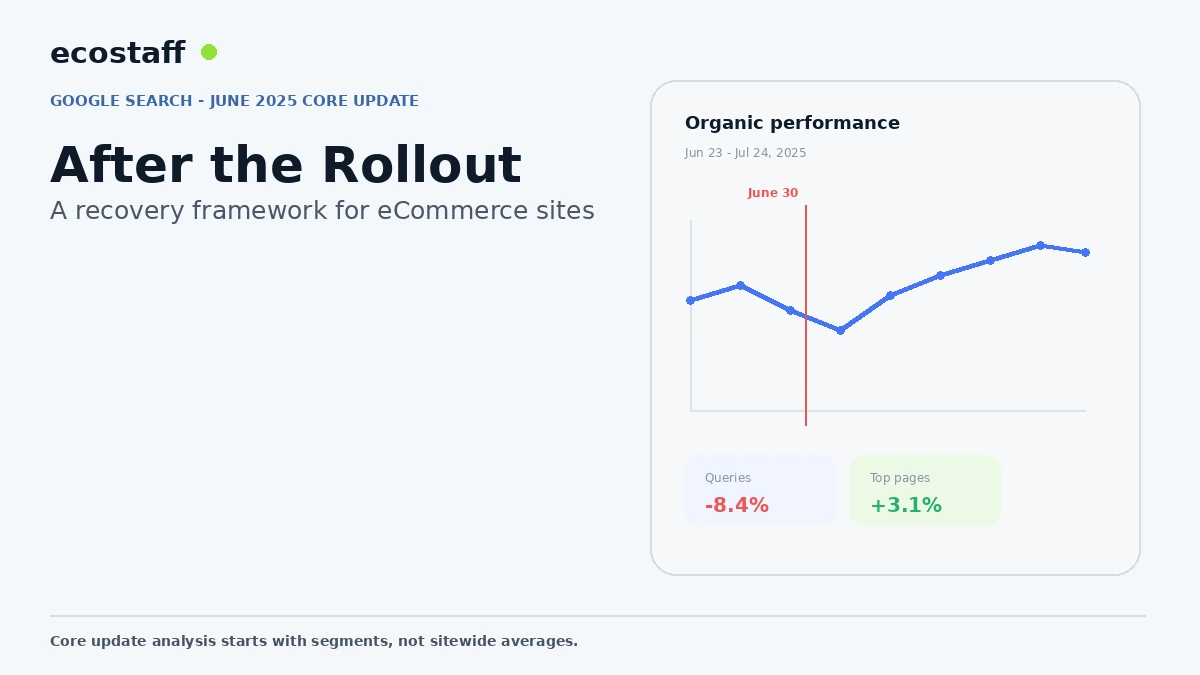
Google released the June 2025 core update on June 30, 2025 and completed the rollout on July 17. As with other core updates, the right response for eCommerce teams is to analyze which page groups and queries changed, compare stronger results and make meaningful improvements rather than reacting with broad rewrites or one-factor SEO fixes.
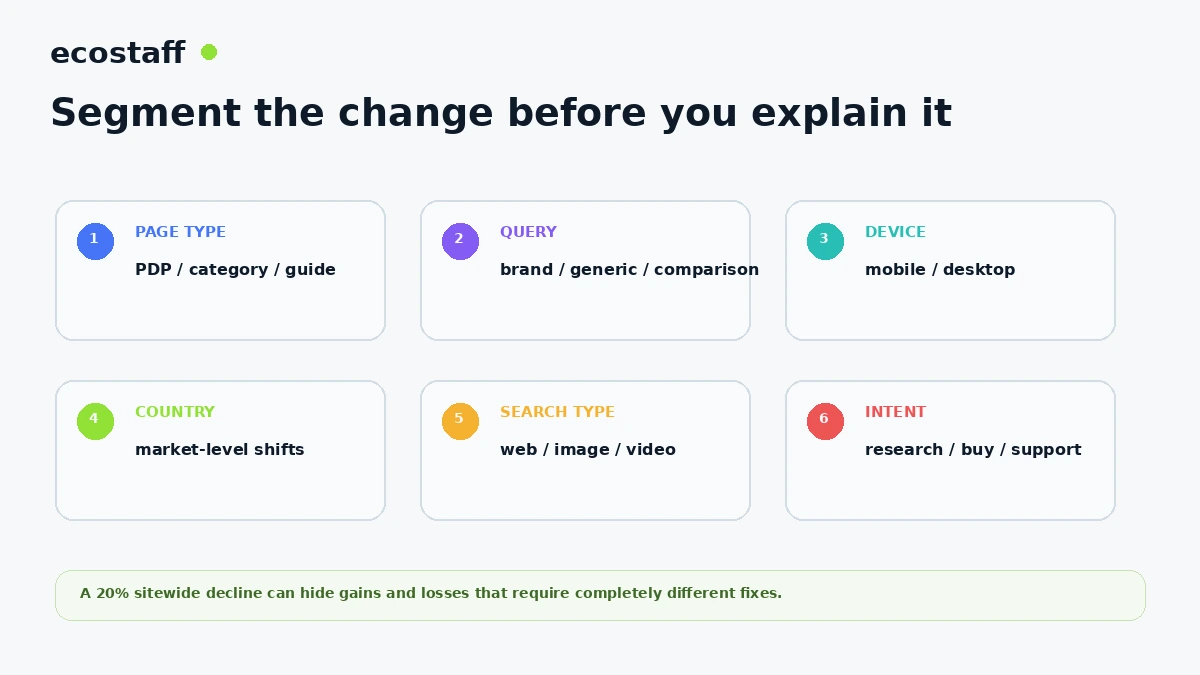
A sitewide traffic average is not enough. Segment product pages, categories, editorial guides, branded queries, non-branded queries, countries, devices and search types. Different segments can move in opposite directions and require completely different actions.
Core updates are broad changes to Google’s ranking systems. They can shift visibility across many industries at once, but that does not mean every decline has the same cause. An ecommerce site may lose category visibility while product pages improve, or lose informational queries while branded demand stays stable.
The goal of the analysis is therefore to identify the affected system. If only one content template declined, a sitewide redesign is unlikely to be the best first move.
The June 2025 core update timeline
Google’s Search Status Dashboard records the June 2025 core update as starting on June 30 at 07:30 Pacific and completing on July 17 at 01:00 Pacific. Google initially said the rollout could take up to three weeks.
Analysis should avoid drawing firm conclusions from the first hours of a rollout. Compare stable periods before and after completion and annotate other releases, tracking changes or commercial events that overlap.
Start with page groups, not individual URLs
One URL can move for many reasons. A template group is more informative. Group pages into product detail pages, collection or category pages, buying guides, blog content, brand pages and service pages. Then compare impressions, clicks, average position and query mix.
| Segment | What to compare | Why |
|---|---|---|
| Product pages | Brand/model queries, image traffic, commercial terms | Shows whether product-level evidence and relevance changed. |
| Category pages | Generic category queries, filters, landing engagement | Reveals assortment and intent alignment. |
| Buying guides | Comparison and research queries | Highlights editorial usefulness and evidence quality. |
| Branded queries | Brand + product terms | Separates demand from generic ranking movement. |
| Countries | Market-specific pages and queries | Local competition and indexing can differ. |
| Devices | Mobile vs desktop | Page experience and SERP behavior may diverge. |
Compare query intent before comparing content length
If a category page loses to a buying guide, the problem may be intent rather than insufficient words. Search results can change because Google interprets the query differently or competitors satisfy the task better.
Review the actual results for the affected queries. Identify whether Google is favoring retailers, marketplaces, reviews, guides, video or other formats. Then decide whether the existing page still matches the dominant buyer task.
Build a competitive gap analysis
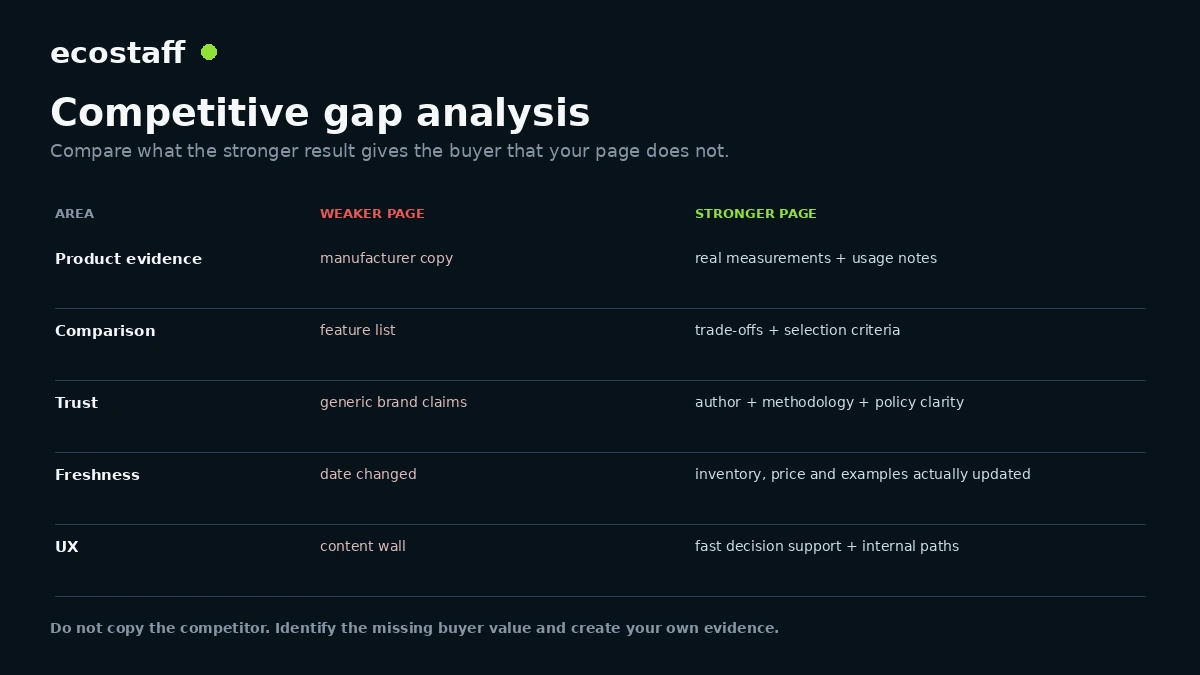
Do not copy the ranking page. Identify what makes it more useful. It may include original measurements, better product availability, clearer comparison criteria, stronger imagery, real testing, more trustworthy policies or a simpler decision path.
Category pages: common weaknesses
- Generic SEO introductions that do not help product selection.
- Duplicate copy across many categories.
- Filters that create indexable URL duplication.
- Poor assortment information or stale availability.
- No explanation of important differences between product types.
- Thin internal links to relevant buying guides or subcategories.
- Slow or interaction-heavy faceted navigation.
Product pages: common weaknesses
- Manufacturer descriptions reused without added value.
- Missing dimensions, compatibility or variant differences.
- Poor image coverage or mismatched variant imagery.
- Unclear shipping, returns or warranty information.
- Reviews with no context or weak moderation.
- Out-of-stock pages handled inconsistently.
- Structured data that disagrees with visible product information.
Editorial pages: common weaknesses
- Generic summaries with no first-party evidence.
- Headlines that promise a test or comparison the article did not perform.
- No methodology for ranked lists.
- Sources that cite only secondary articles.
- Artificial date updates with no meaningful content change.
- Author credentials unrelated to the topic.
- Content created mainly to extend into unrelated high-volume topics.
Use first-party evidence as a moat
For an ecommerce business, first-party evidence can include product tests, return reasons, customer questions, support data, size guidance, compatibility matrices, shipping data, inventory availability, installation measurements and original photography.
Not every page needs proprietary research, but strategic pages should contain information competitors cannot reproduce instantly.
Check technical foundations after content fit
Technical SEO still matters, but do not use a core update as an excuse to chase every audit warning. Prioritize issues that affect crawling, indexing, canonicalization, rendering, internal links, structured data or the user’s ability to interact with the page.
The technical SEO mistakes guide covers common ecommerce issues such as faceted navigation, canonicals and crawl waste.
A disciplined recovery roadmap
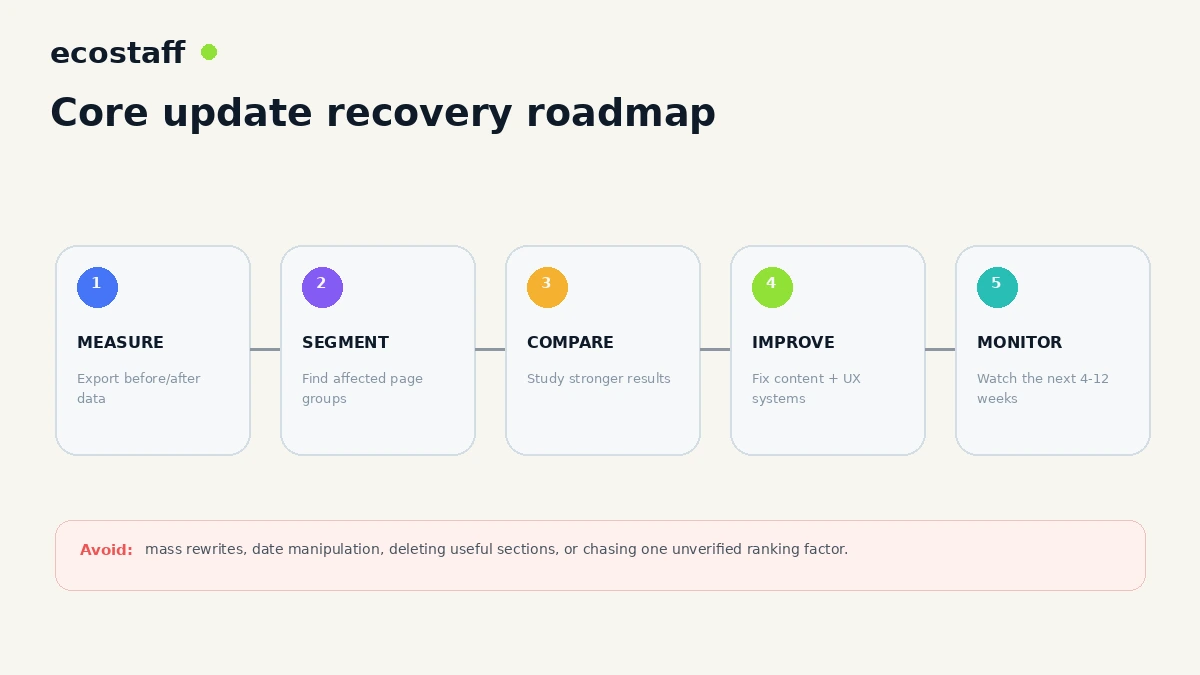
- Export a stable before-and-after Search Console window.
- Segment by page type, query intent, device, market and search type.
- Identify the largest sustained losses and gains.
- Review the live search results for affected query groups.
- Compare buyer value, not only keyword usage.
- Audit first-party evidence, trust and page experience.
- Fix systemic template or data problems before isolated copy edits.
- Validate technical SEO where it affects discovery or indexing.
- Publish meaningful improvements.
- Monitor for several weeks and document the change.
What not to do
- Do not rewrite every page based on a single SEO tool score.
- Do not change dates without real updates.
- Do not delete useful content because a competitor has less text.
- Do not mass-generate new pages to replace lost traffic.
- Do not assume one backlink, one schema field or one Core Web Vital caused the change.
- Do not switch agencies solely because a core update caused short-term volatility.
How to evaluate an SEO partner after an update
A credible partner should be able to show the segmentation behind its diagnosis. Ask which page groups changed, what query intent shifted, what the stronger results provide and which recommendations are expected to improve user value.
Use Ecostaff to compare ecommerce service providers. For AI-era organic strategy, also see eCommerce SEO in 2025.
Use winners as well as losers
Core update analysis is often biased toward declines. Export the pages and queries that gained as well. Winners can reveal which parts of the site already align with search demand and buyer usefulness. For example, product pages with detailed compatibility data may improve while generic category copy declines. That is a stronger internal signal than copying an unrelated competitor.
| Pattern | Possible interpretation | Useful next step |
|---|---|---|
| Detailed PDPs gain, thin categories lose | Product-level evidence is stronger than category guidance | Upgrade category decision support and internal links |
| Guides gain, PDPs lose | Research intent may dominate some queries | Clarify commercial intent and product evidence |
| Brand queries stable, generic drops | Demand is intact but discovery weakened | Focus on non-brand page groups and competitive fit |
| Image traffic gains, web traffic falls | Visual assets perform differently from page rankings | Audit image discovery and result-page intent |
| One country drops | Market-specific competition or localization issue | Review hreflang, local content, assortment and SERPs |
Separate content quality from index architecture
An excellent page cannot rank if Google cannot discover or index the intended URL reliably. At the same time, fixing canonicals will not make a generic buying guide distinctive. Run the diagnosis in two tracks: technical eligibility and competitive usefulness.
Technical eligibility questions
- Is the intended URL indexable and canonical?
- Does internal linking point consistently to it?
- Are faceted URLs creating crawl waste or duplicates?
- Does rendered content include the important product and category information?
- Do structured data and visible content agree?
- Are mobile interactions and navigation usable?
Usefulness questions
- Does the page answer the buyer’s actual task?
- Does it contain original facts, examples or evidence?
- Are comparisons transparent about trade-offs?
- Can the reader identify who created or reviewed the content?
- Are important commercial details current?
- Is the page clearly better for the intended audience than a generic summary?
Create a page-group improvement backlog
Once the diagnosis is clear, avoid editing pages randomly. Build work at the template or data-system level where possible. If all category pages lack useful subcategory guidance, fix the template and merchandising workflow. If product pages miss warranty details, improve the product data source instead of adding manual copy to ten products.
- Rank affected page groups by lost impressions and commercial value.
- Define the buyer problem for each group.
- List systemic content, data, UX and technical weaknesses.
- Choose changes that can improve the whole group.
- Pilot on a controlled subset.
- Measure crawling, ranking and commercial outcomes.
- Roll out when the pattern is validated.
How long should recovery measurement run?
Core-update recovery is not an A/B test with a guaranteed two-week result. Large pages may be recrawled at different speeds, search demand changes and Google’s systems continue to evolve. Use several checkpoints rather than one deadline: technical validation after deployment, early Search Console movement, and a longer 4-12 week trend for affected query groups.
Document other variables such as promotions, stock changes, seasonality, new competitors and site releases. Without annotations, teams may attribute normal commercial changes to an algorithm update.
Frequently asked questions
How long did the June 2025 core update roll out?
Google’s Search Status Dashboard shows the rollout from June 30 through July 17, 2025.
Should a store change pages during a core update rollout?
Critical errors should always be fixed, but broad conclusions are better made after a stable data window. Avoid reacting to daily volatility.
Can a site recover without waiting for another core update?
Google’s broader core-update guidance has said improvements can be reflected over time as systems recrawl and reassess pages. Recovery timing is not guaranteed.
Should we focus on E-E-A-T?
Use experience, expertise, authoritativeness and trust as quality concepts, not as a single score. The practical work is stronger evidence, clear responsibility and reliable information.
Sources and further reading
- Google Search Status Dashboard – June 2025 core update
- Google Search Central – Core updates and your website
- Google Search Central – Creating helpful, reliable, people-first content
- Google Search Central – Page experience guidance
Conclusion
The June 2025 core update is best treated as a diagnostic event, not a reason for panic SEO. Segment the affected parts of the site, study what stronger results do better and improve the underlying content, data and UX systems.
For ecommerce teams, durable search performance comes from making product and category decisions easier for buyers while keeping the technical architecture clear enough for search systems to understand.