

Quick answer: what should eCommerce teams know about Google’s August 2025 spam update?
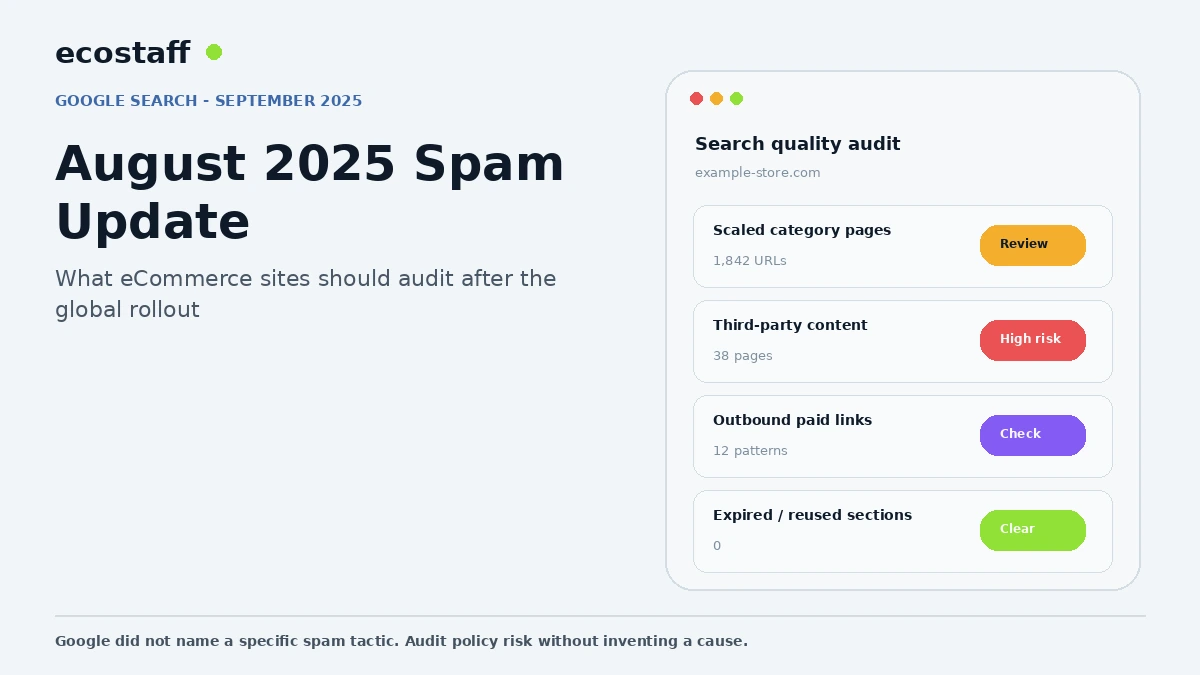
Google launched the August 2025 spam update on August 26 and completed the rollout on September 22, 2025. Google said it applied globally and to all languages. Google did not publish a list of specific spam tactics targeted by this update, so eCommerce teams should avoid inventing a cause from ranking movement alone.
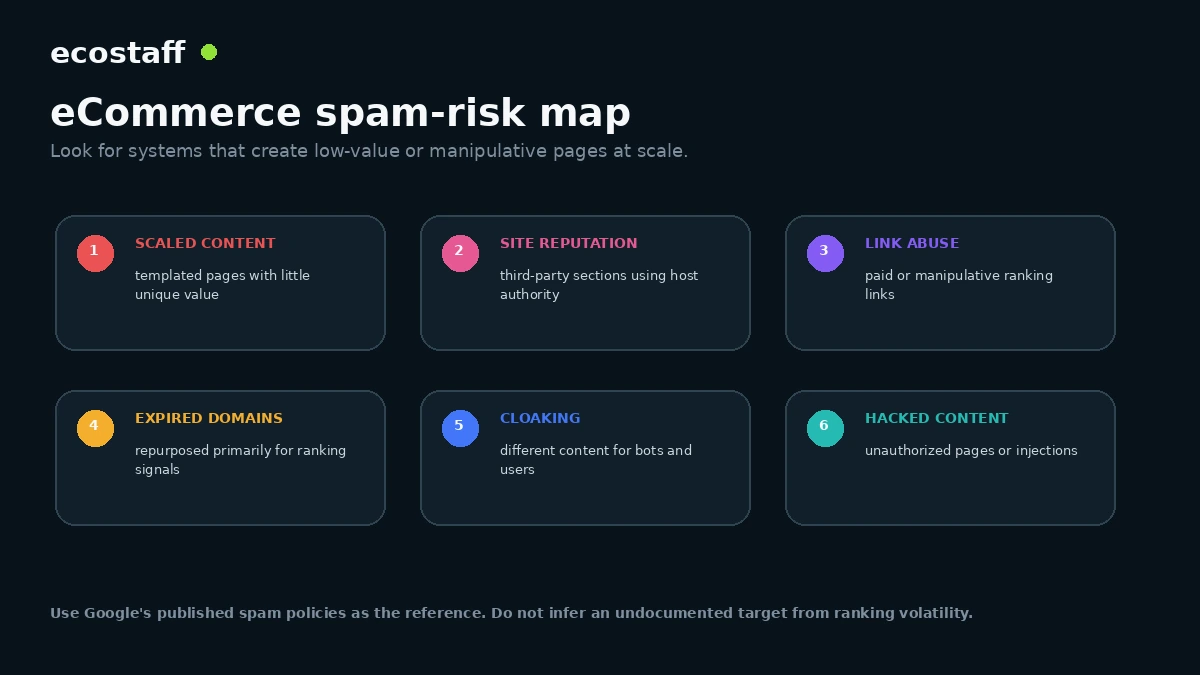
The useful response is to compare affected page groups and query types, then audit the site’s production systems against Google’s published spam policies. Pay particular attention to scaled low-value pages, third-party content, manipulative links, expired-domain reuse, cloaking, hacked content and other patterns that exist primarily to influence rankings rather than help users.
Spam updates are different from broad core updates. Core updates reassess ranking systems broadly, while spam updates improve Google’s systems for detecting practices that violate Search spam policies. The practical challenge for a retailer is that rankings can still move during both types of update, but the diagnosis should not begin with the assumption that Google has penalized the site.
The August 2025 rollout was long enough to overlap with ordinary commercial volatility, site changes and seasonal demand. That makes segmentation essential. A large store may see gains in product pages, losses in programmatic location pages and no movement in branded search at the same time.
What Google officially confirmed
Google’s Search Status Dashboard recorded the update as starting on August 26, 2025 at 09:00 Pacific and ending on September 22. The dashboard said the update applied globally and to all languages.
That is the important limit of what Google publicly confirmed about this rollout. The company did not say that the update specifically targeted AI content, affiliate pages, ecommerce categories or any other single tactic. Treat claims about a hidden target as speculation unless Google publishes supporting information.
Start by separating spam risk from normal ranking movement
A ranking decline during a spam update does not prove the site violated a policy. Search demand changes, competitors improve, pages become unavailable, tracking breaks and Google can reassess relevance for many reasons. Use the rollout window as a diagnostic marker, not a verdict.
| Pattern | Possible explanation | Next action |
|---|---|---|
| Only thin programmatic pages decline | Low-value page system or changing query fit | Audit purpose, uniqueness and indexing rules. |
| Product pages decline across the catalog | Could be relevance, data, technical or competitive change | Check product evidence, availability, canonicals and SERPs. |
| Third-party section declines | Potential site reputation or content-quality issue | Review ownership, audience fit and policy compliance. |
| Branded traffic is stable | Brand demand remains intact | Focus diagnosis on generic discovery pages. |
| Traffic drops but impressions remain stable | CTR, SERP or measurement issue | Check Search Console, analytics and result-page changes. |
Scaled content is an eCommerce-specific risk area
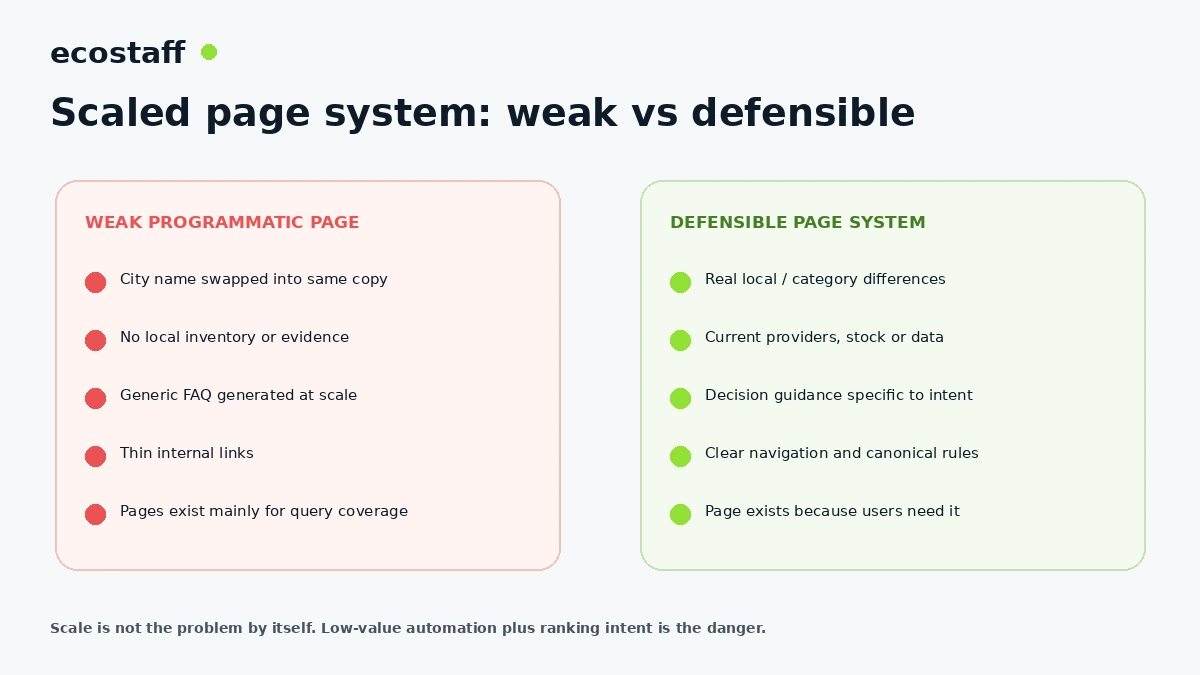
Commerce sites naturally generate pages at scale: categories, filters, brands, locations, marketplaces, product combinations and comparison pages. Scale itself is not a spam violation. The risk grows when pages are generated mainly to capture search demand and add little unique value.
Local landing pages
A location page should contain meaningful local information: actual service coverage, relevant providers, local availability, shipping conditions, supported currencies, legal or tax differences, or genuine local expertise. Replacing only the city name across hundreds of pages creates very little user value.
Faceted pages
Filters are valuable for shoppers but can create enormous numbers of crawlable combinations. Decide which combinations deserve indexable landing pages and which should remain navigational states. The indexed version should have a clear search intent and enough inventory or information to justify itself.
Comparison and ‘best’ pages
A comparison page should reveal the criteria, evidence and methodology behind the recommendation. Repeated lists produced from the same template without new analysis are easy to scale but difficult to defend as distinctive content.
Third-party content needs stronger governance
Google’s site reputation abuse policy is especially relevant to established commerce domains. A marketplace, retailer or industry portal may attract agencies, publishers or affiliate partners that want content hosted on its domain. A legitimate partnership can be useful, but the article should exist because it serves the site’s audience, not because the host’s reputation makes the page easier to rank.
Ecostaff already uses a separate editorial standard for contributor and partnership content. See the site reputation abuse guide for a deeper governance framework.
Audit outbound links separately
Paid, sponsored or affiliate relationships are not automatically spam, but ranking-driven links should be qualified appropriately. Review guest articles, sponsored pages, footer links, partner directories and old advertorial content. The goal is to understand why the link exists and whether the relationship is disclosed.
Expired domains and acquired content sections
Acquisitions and domain migrations are normal business events. Risk increases when an old domain or content section is repurposed primarily to exploit its previous ranking signals for unrelated topics. If the business acquires a site, preserve or redirect content based on user and brand logic, not only inherited authority.
Hacked and injected content
Commerce sites are attractive targets because they have trusted domains, user accounts and payment-related infrastructure. Spam injected through compromised plugins, user-generated areas or hidden files can create thousands of unwanted URLs.
- Review Search Console security and manual-action reports.
- Monitor newly indexed URLs and unexpected directories.
- Keep WordPress, plugins, themes and extensions updated.
- Remove unused admin accounts and integrations.
- Use server and application logs to investigate suspicious changes.
- Check sitemap files and internal links for injected URLs.
A practical post-update audit
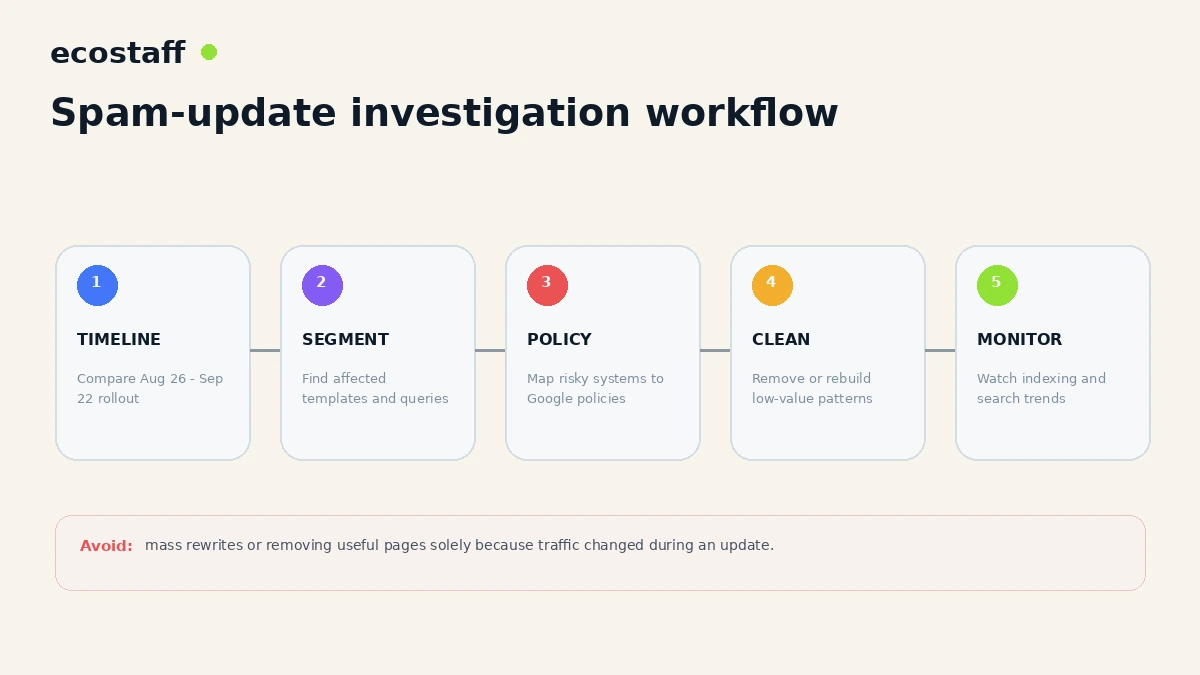
- Annotate the August 26 to September 22 rollout window.
- Export stable before-and-after Search Console data.
- Segment by template, query intent, country, device and search type.
- Identify systems that generate large numbers of pages.
- Review third-party and sponsored content ownership.
- Audit outbound links and affiliate relationships.
- Inspect security, indexed URLs and unexpected content.
- Map findings to Google’s published spam policies.
- Remove or rebuild genuinely low-value or manipulative systems.
- Monitor crawling, indexing and query trends after changes.
What not to do after a spam update
- Do not assume AI-written content was the target unless the content itself violates a published policy.
- Do not delete strong pages just because they lost traffic during the rollout.
- Do not buy replacement links to compensate for ranking losses.
- Do not change dates or authorship to create artificial trust.
- Do not generate thousands of new pages to recover traffic.
- Do not accept a vendor’s claim that one secret factor caused the decline without evidence.
How to evaluate an agency after an update
A strong SEO partner should show the evidence behind the diagnosis. Ask which templates changed, whether Search Console supports the claim, which Google policy is relevant and what user problem the proposed fix solves. An agency that jumps directly to mass rewrites or link purchases is creating additional risk.
Use Ecostaff to compare eCommerce service providers. The agency selection guide provides a structured framework for comparing process, evidence and delivery risk.
Create governance for programmatic pages before scaling again
A one-time cleanup does not solve a production-system problem. If the site relies on programmatic category, location, brand or comparison pages, define a publishing threshold before new URLs can be created. That threshold should include minimum inventory or provider coverage, a clear user task, unique data, an internal-link path and a rule for canonicalization or noindex when the page no longer qualifies.
The same governance should cover updates. A page that was useful at launch can decay when inventory disappears, providers leave the market or local information becomes stale. Schedule periodic checks for indexed programmatic templates rather than waiting for a ranking update to reveal the weakness.
- Define which data fields must be unique before a page can publish.
- Set a minimum inventory, provider or evidence threshold.
- Prevent empty or near-empty combinations from being indexable.
- Create rules for stale pages and discontinued locations.
- Track indexed URL counts by template over time.
- Assign a human owner for each scaled page system.
Frequently asked questions
Did Google say the August 2025 spam update targeted AI content?
No. Google’s public status notice said the update applied globally and to all languages, but it did not identify AI content as the specific target.
Was the update a manual action?
No. The Search Status Dashboard described it as a ranking-system spam update. Manual actions are separate actions that can appear in Search Console.
Should programmatic SEO pages be removed?
Not automatically. Evaluate whether each page type exists for a real user need, contains meaningful unique value and is technically controlled. Programmatic systems can be useful when the underlying data and intent justify the pages.
How long should we monitor after cleanup?
There is no guaranteed recovery window. Technical cleanup can be verified quickly, while crawling and ranking changes may take longer. Track affected page groups over several weeks and document other site changes.
Sources and further reading
- Google Search Status Dashboard – August 2025 spam update
- Google Search Central – Spam policies for Google web search
- Google Search Central – Site reputation abuse policy clarification
- Google Search Central – Creating helpful, reliable, people-first content
Conclusion
The August 2025 spam update should be treated as a policy and production-system audit, not a reason for speculative SEO surgery. Google confirmed the rollout dates and global scope, but not a single hidden target.
For eCommerce teams, the durable response is to reduce systems that create low-value or manipulative pages, strengthen editorial and partner governance, secure the site and make sure scaled content exists because it helps buyers.