

Quick answer: what changed for eCommerce SEO after AI Overviews?
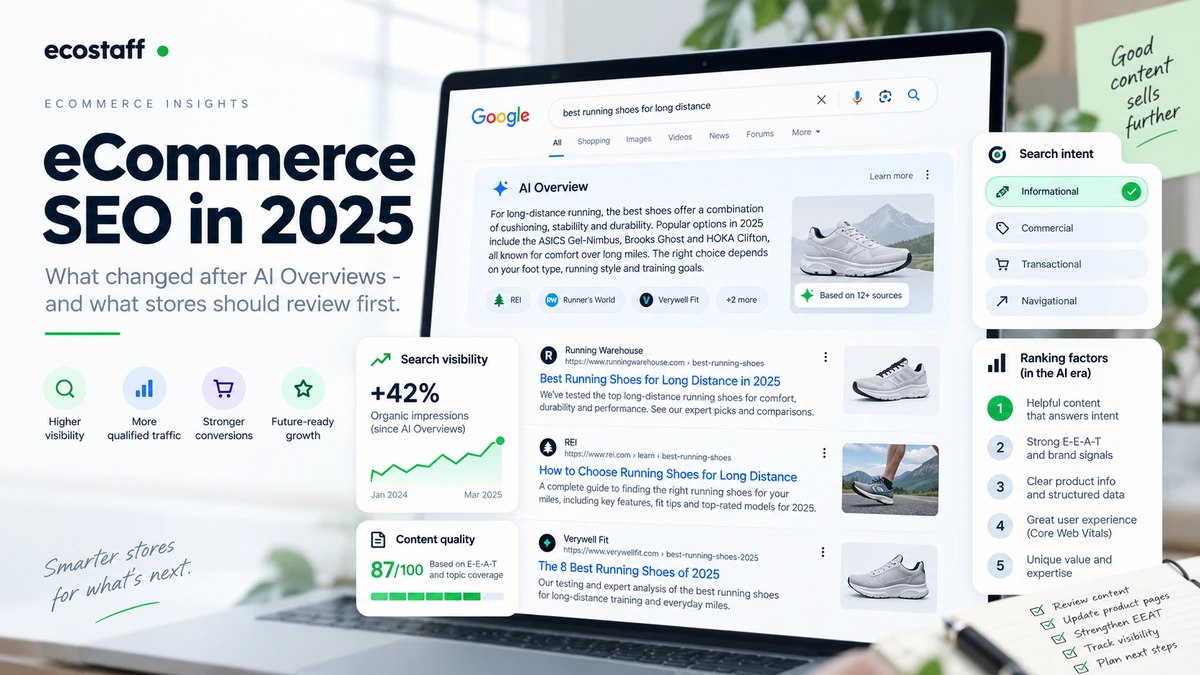
AI Overviews changed how some informational and commercial research queries are presented, but they did not replace the fundamentals of eCommerce SEO. By October 2024 Google said AI Overviews were expanding to more than 100 countries and would reach more than one billion monthly users. On March 5, 2025 Google announced a Gemini 2.0 upgrade for AI Overviews in the U.S. and introduced an experimental AI Mode for more complex questions.
For eCommerce sites, the practical response is to improve product and category facts, original media, decision support, structured data, internal linking, Merchant Center data and brand trust. Search journeys may contain more synthesis before a click, so teams should measure the value of organic visits and product discovery rather than optimizing only for a traditional blue-link CTR.
AI Overviews do not turn eCommerce SEO into a new discipline with a secret markup or a special writing formula. They do change the shape of some search journeys. A shopper can ask a broad question, receive a synthesis, refine the query and then click to a retailer, manufacturer, review site or guide when they need more detail.
That creates two simultaneous goals for commerce sites: make products and facts easy for search systems to understand, and create pages worth visiting after a high-level answer has already been summarized.
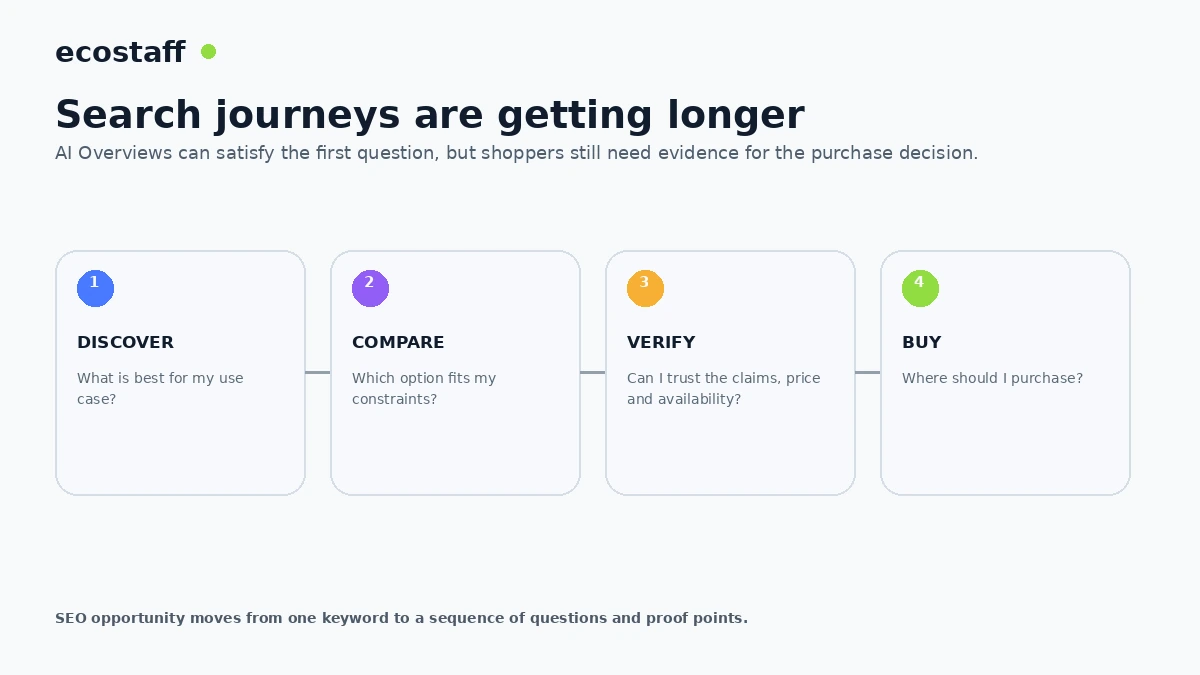
AI Overviews became a mainstream search surface
Google launched AI Overviews broadly in 2024 and expanded them to more than 100 countries in October, saying the feature would reach more than one billion global users each month. Google also added more prominent links to supporting websites and said those designs increased traffic to supporting sites in its testing.
In March 2025 Google upgraded AI Overviews with Gemini 2.0 for harder queries in the U.S. and introduced AI Mode as an experiment. The strategic signal is clear: people can ask longer, more specific questions and continue with follow-up queries instead of restarting the search journey.
What AI Overviews change for eCommerce SEO
What this changes for eCommerce keyword strategy
Traditional keyword research still matters, but a single query is less useful as the only unit of planning. Build content around a decision journey: discovery, comparison, verification and purchase. Product and category pages need to answer different questions than editorial guides.
| Journey stage | Typical question | Best commerce asset |
|---|---|---|
| Discover | What type of product solves this problem? | Buying guide, category education, visual examples |
| Compare | Which option fits my use case or budget? | Comparison guide, category filters, product matrix |
| Verify | Can I trust size, compatibility, reviews or availability? | Product page, first-party evidence, policies, structured facts |
| Buy | Where can I get the right option now? | Product page, Merchant Center feed, local/store availability |
Original evidence becomes more valuable, not less
If a page only paraphrases facts available everywhere else, a synthesized search experience can reduce the need to click it. Pages become more defensible when they contain information that is difficult to reproduce: first-party measurements, expert methodology, useful images, comparison criteria, fit guidance, support insights or proprietary data.
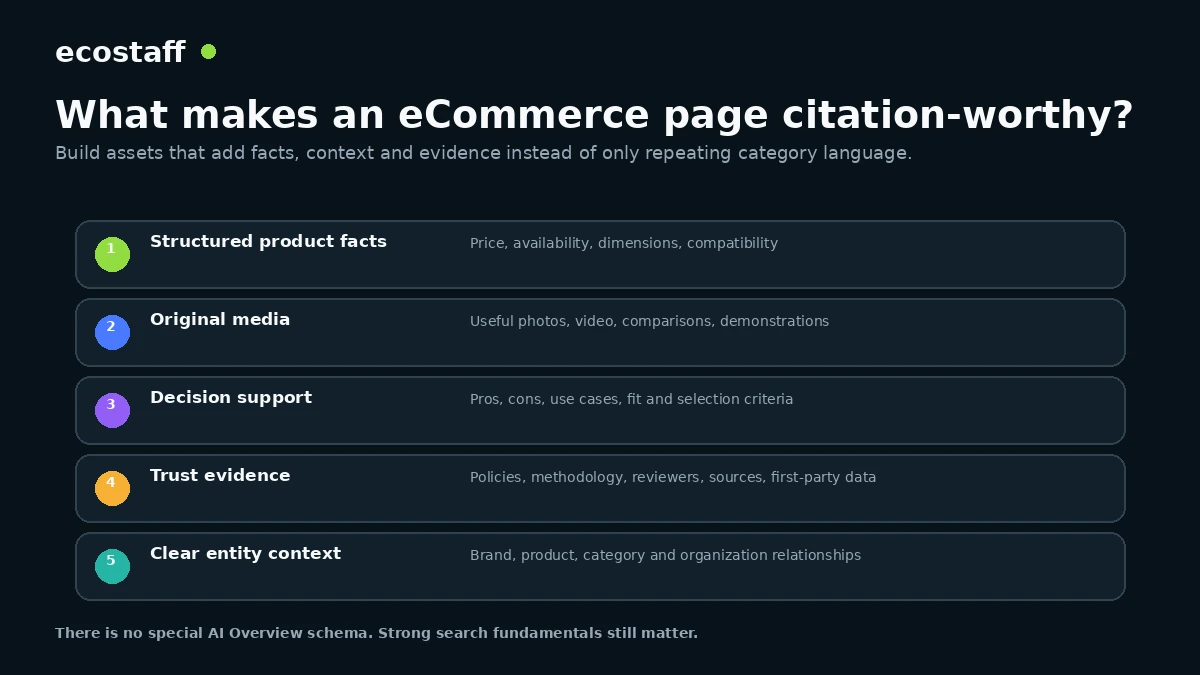
Product data quality matters across search and shopping surfaces
Google Shopping was rebuilt around AI in late 2024 using the Shopping Graph and product listings. eCommerce teams should therefore treat Merchant Center feeds, price, availability, identifiers, shipping and return data as part of organic discoverability, not only paid media operations.
Keep feed data consistent with visible product pages. A strong page with stale price or availability creates a poor shopper experience and weakens trust in the merchant data.
Images and visual search deserve their own SEO workflow
Google reported billions of visual searches through Lens and continued making shopping information available in visual search. For merchants, product imagery is both conversion content and search content. Use high-resolution originals, descriptive filenames where practical, useful alt text, crawlable image URLs and image sitemaps or product feeds where relevant.
Structured data is support, not a substitute for content
Product structured data can help Google understand price, availability, reviews, variants and merchant information. The markup should match the visible page and the underlying commercial facts. Do not add schema that claims information users cannot see or verify.
Internal links help connect entities and decision paths
Search systems still need crawlable links. Connect buying guides to relevant categories and products, link categories to important products, and create paths between related platform, use-case or compatibility pages. Internal linking also tells users what to explore next after an AI Overview has answered the broad question.
Do not invent an AI Overview optimization checklist
- Do not create pages only to answer dozens of near-identical long-tail prompts.
- Do not add fake quotations, experts or first-hand experience.
- Do not generate product reviews for items nobody tested.
- Do not create new schema types or hidden metadata that search engines do not support.
- Do not remove useful detail because you assume AI will summarize it anyway.
- Do not measure success only by ranking position on one query.
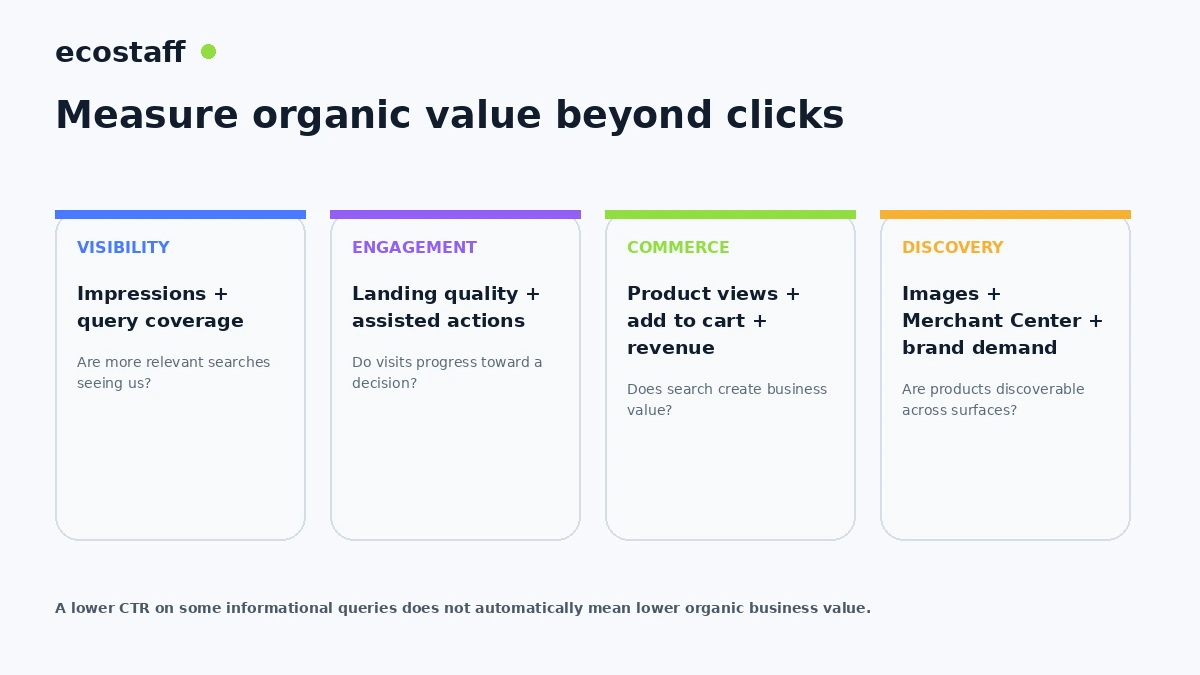
Measure value beyond click-through rate
Some informational queries may generate fewer clicks because the search result provides more context. That does not automatically mean organic search has become less valuable. Look at query coverage, landing-page quality, product discovery, assisted actions, new-user conversion, revenue and brand demand.
A practical eCommerce SEO plan for 2025
- Audit crawlability, indexation and canonical signals.
- Improve high-value product and category facts before publishing more generic content.
- Identify buyer questions that require evidence or comparison.
- Create original images, demonstrations, data or expert analysis where appropriate.
- Keep Merchant Center price, availability and product identifiers accurate.
- Validate Product and Organization structured data against visible content.
- Improve internal linking between editorial, category and product pages.
- Track Search Console by page and query clusters, then connect organic sessions to commercial outcomes.
- Review brand trust, policies and author/editorial methodology.
- Use AI to accelerate research and workflows, but keep factual and editorial responsibility with humans.
How this connects to previous Google updates
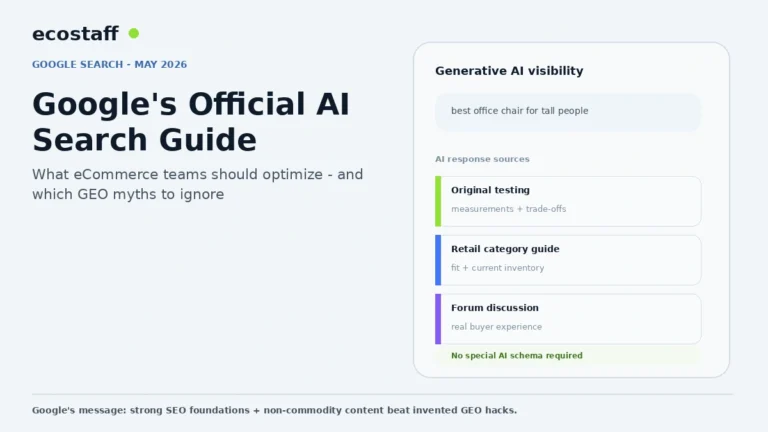
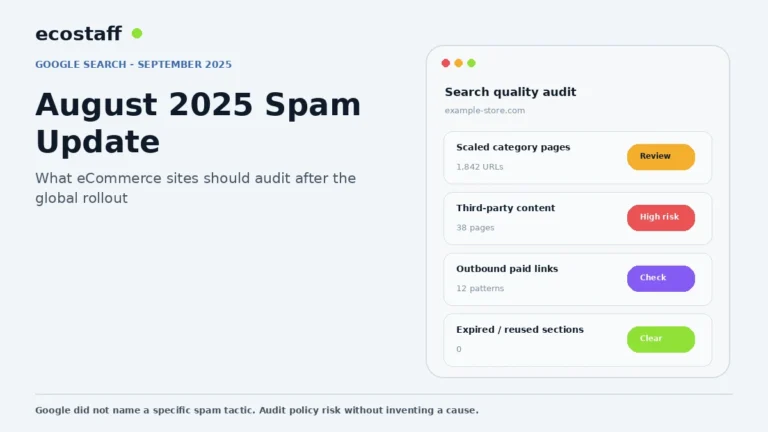
AI search does not replace the quality direction reinforced by the August 2024 core update or the governance concerns in the site reputation abuse guidance. The same long-term strategy still applies: publish useful material that fits the site, provide evidence and avoid scaled commodity pages.
When should an eCommerce team involve an SEO agency?
Specialist support is useful when the site has a large catalog, complicated faceted navigation, multiple markets, Merchant Center issues, migration risk or weak content operations. Ask agencies how they connect technical SEO, product data, content and measurement instead of treating AI Overviews as a standalone service.
You can compare eCommerce service providers on Ecostaff and use the agency selection framework before choosing a partner.
Frequently asked questions
Do AI Overviews mean SEO is dead?
No. AI Overviews use web content and supporting links, while eCommerce discovery also spans product results, images, Shopping surfaces and classic results. The format changes, but discoverability still depends on useful, accessible and trustworthy content.
Is there a special AI Overview schema?
Google does not provide a special AI Overview schema. Use supported structured data that accurately describes the visible page and product information.
Should eCommerce sites write longer articles for AI search?
Length is not the goal. Cover the buyer question with enough original evidence, detail and structure to be genuinely useful.
Sources and further reading
- Google – AI Overviews expanding to more than 100 countries
- Google – Expanding AI Overviews and introducing AI Mode, March 5 2025
- Google – The new Google Shopping rebuilt with AI
- Google – New ways to connect to the web with AI Overviews
- Google Search Central – Creating helpful, reliable, people-first content
Conclusion
AI Overviews change part of the search interface, not the core job of eCommerce SEO. Merchants still need crawlable pages, reliable product data, strong internal links and useful content. The difference is that generic summaries face more pressure because search can synthesize them before a click.
The opportunity is to become the source that adds evidence: accurate product facts, original visuals, specific decision support and a trustworthy commerce experience.