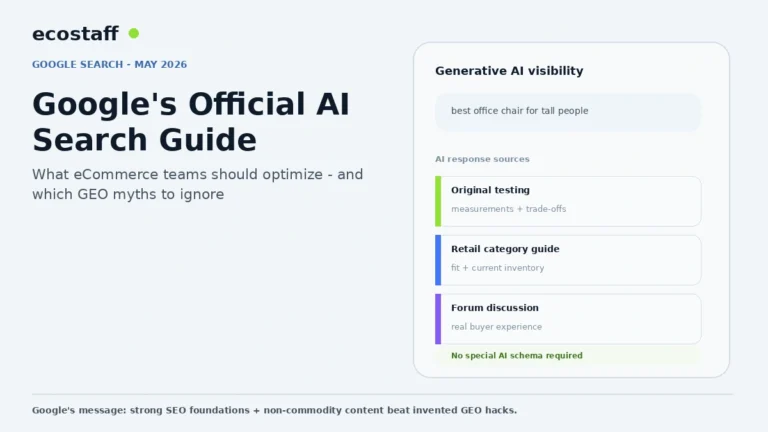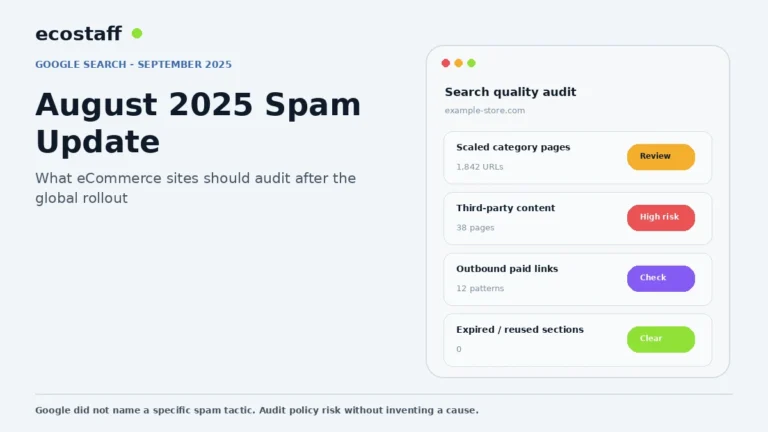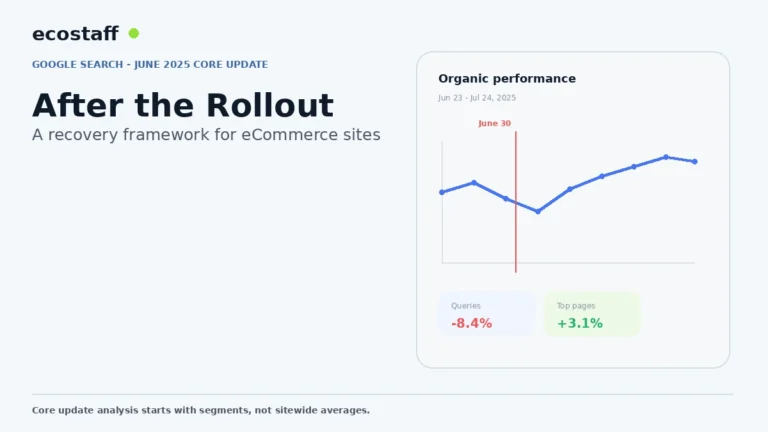


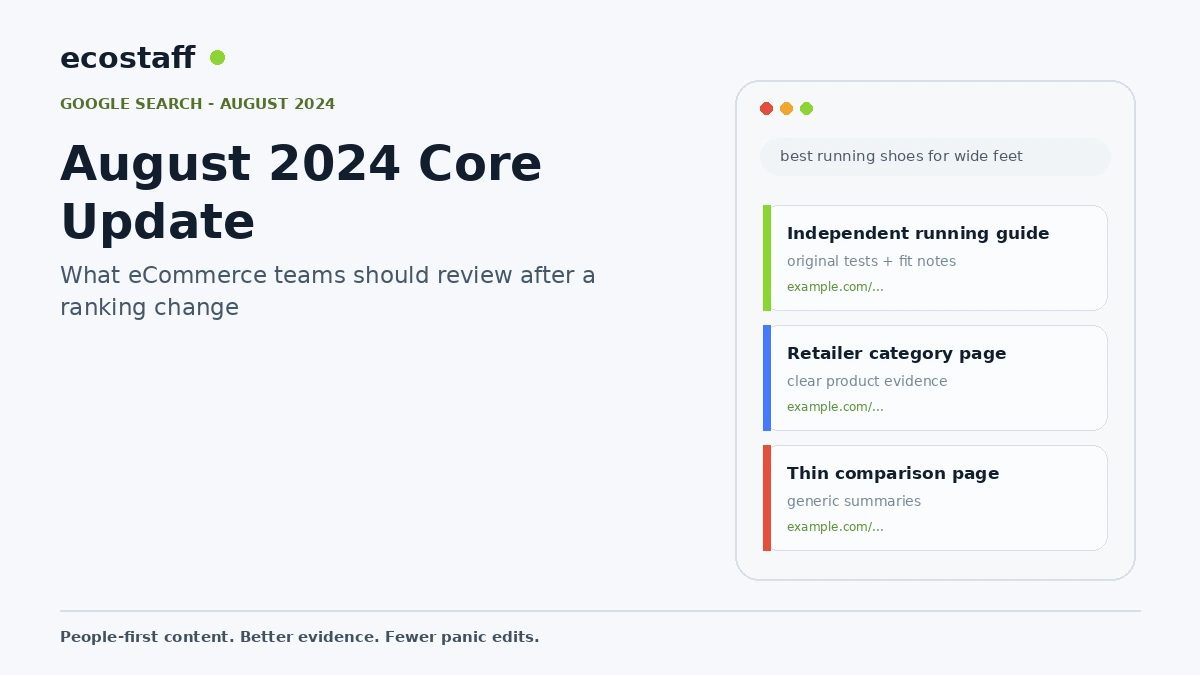
Quick answer: what should eCommerce teams do after the August 2024 core update?
Google launched the August 2024 core update on August 15, 2024 to surface more genuinely useful content and less content created mainly to perform well in Search. For eCommerce teams, the right response to ranking movement was not to rewrite every category page or remove elements because of an SEO rumor. Google recommended assessing the pages and queries that changed, looking at the size of the drop and making meaningful improvements that help users.
An eCommerce audit should focus on buyer usefulness: original product or category information, first-party evidence, clear authorship, strong internal navigation, accurate commercial details, helpful comparison criteria and a good page experience. Small ranking changes usually do not justify drastic action.
Core updates are broad ranking-system changes. They are not penalties aimed at one site type, one CMS or one specific SEO tactic. That distinction matters because eCommerce teams often react to ranking volatility by making large technical or content changes before they understand which pages, queries or search types actually moved.
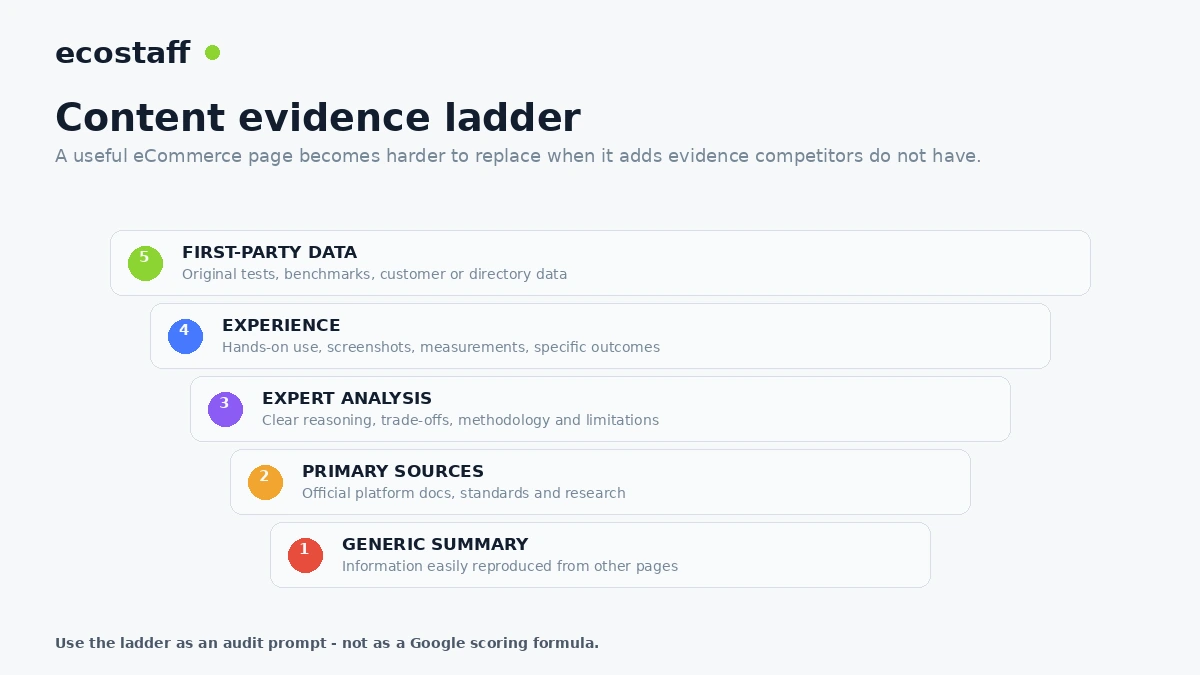
Google’s August announcement also highlighted small and independent sites that publish useful, original content. For merchants, marketplaces and commerce publishers, that reinforces a practical direction: pages need to offer something a searcher cannot get from a generic rewrite of manufacturer copy or from a list built only around keywords.
What Google said about the August 2024 core update
Google said the update was designed to continue improving Search quality by showing more content that people find genuinely useful and less content that feels created only to perform well in Search. Google also said the update took feedback from creators into account and aimed to better capture improvements that sites had made.
That does not create a checklist of ranking factors. It creates an audit direction: evaluate whether the site as a whole and the affected pages are genuinely useful, reliable and people-first.
Start with diagnosis, not with content production
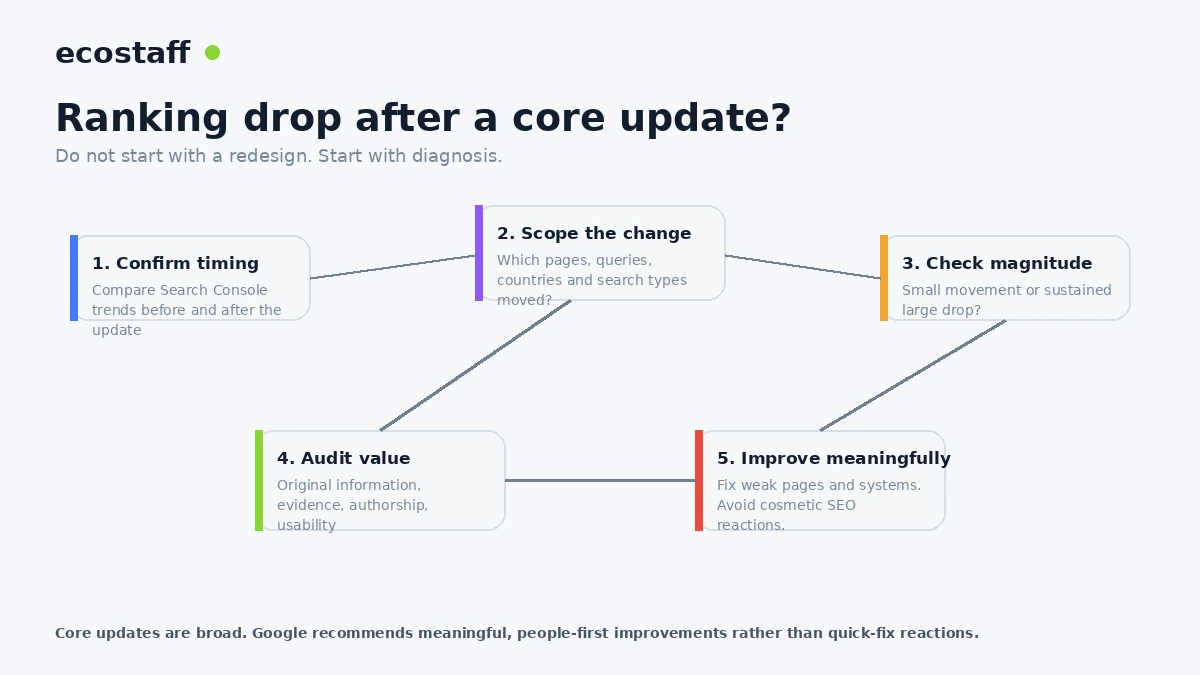
Before commissioning new copy, pull Search Console data for the period before and after the update. Separate branded and non-branded queries, country, device and search type. Then identify whether the movement is concentrated in a small group of pages or broad across the site.
| Signal | What it may indicate | What to do next |
|---|---|---|
| Small position movement | Normal competitive reordering | Avoid drastic changes. Keep monitoring. |
| Large drop on a few pages | Page-level usefulness or intent mismatch | Compare those pages with stronger results and audit value. |
| Broad category decline | Template, content or site-level quality issue | Review the category system, internal linking, commercial data and duplication. |
| Image Search decline | Visual or image-discovery issue | Audit product imagery, alt text, image pages and technical accessibility. |
| Traffic drops but rankings look stable | Demand, SERP layout or measurement change | Check query demand, CTR and analytics before blaming the update. |
What helpful looks like on an eCommerce page
Category pages
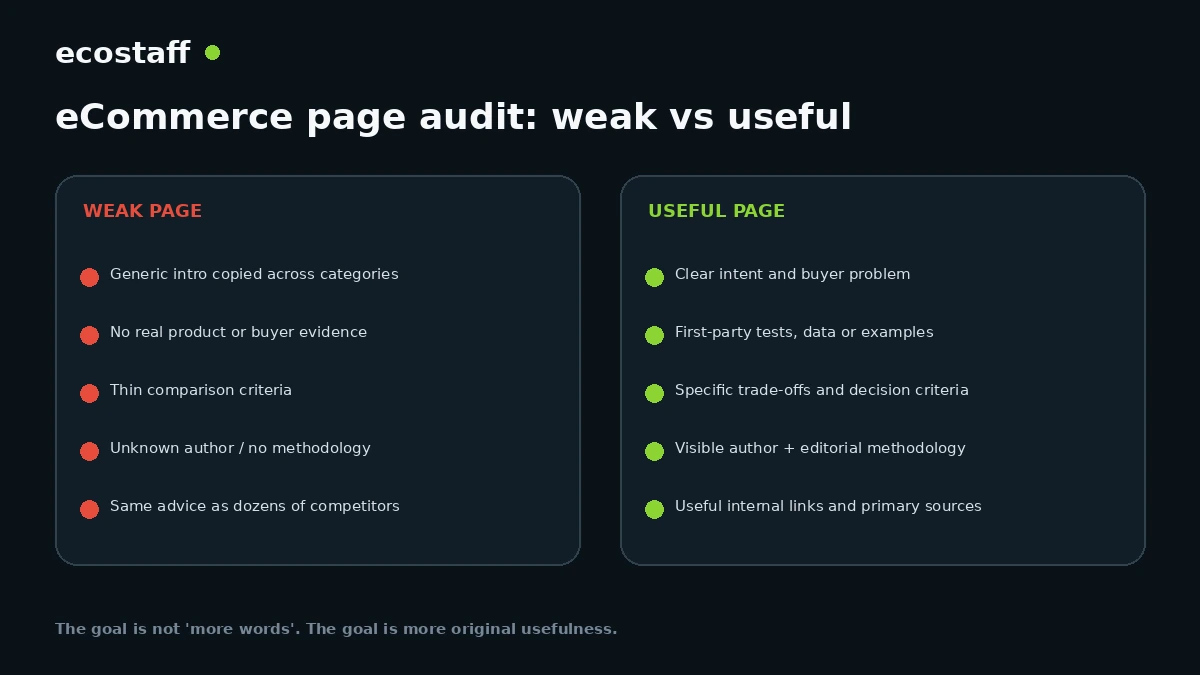
A strong category page helps shoppers understand the assortment and make a decision. Useful additions can include selection criteria, fit or compatibility guidance, dimensions, material differences, use cases, comparison tables, shipping or return details and links to deeper product or buying-guide content.
Product pages
Manufacturer text is rarely enough to create distinctive value. Add accurate specifications, real photographs, in-scale imagery, installation or usage guidance, compatibility details, FAQs derived from customer questions, review context and clear commercial terms.
Buying guides and editorial content
A buying guide should reveal how the recommendation was produced. First-hand testing, directory data, methodology, expert review and specific trade-offs are more defensible than a long article that merely summarizes other websites.
Five areas eCommerce teams should audit
- Original value: Does the page contain information, evidence, analysis or tools that are not available on dozens of other pages?
- Search intent: Does the page solve the actual buyer task, or does it only include keywords around the task?
- Trust: Are authorship, company identity, policies, sources and commercial terms clear?
- Page experience: Is the content easy to use on mobile, reasonably fast, secure and free from disruptive interstitials?
- Site focus: Does the content fit the site’s real audience and purpose, or was it created mainly to capture unrelated search demand?
Why eCommerce sites are vulnerable to scaled low-value content
Large catalogs create a natural temptation to automate thousands of near-identical category, filter or location pages. Automation itself is not automatically a problem, but scale magnifies weak inputs. If every page has the same generic introduction with only a keyword swapped, the site creates little additional value for users.
The better programmatic model combines structured data with unique local or category evidence, meaningful differences in inventory or service availability, buyer-specific guidance and clear rules for when a page deserves to exist.
Do not make these panic changes
- Do not change every title tag because one competitor moved above you.
- Do not delete useful content only because you heard long pages are bad.
- Do not add author boxes to pages where the underlying content remains generic.
- Do not change publication dates to create artificial freshness.
- Do not mass-produce new pages because you believe more URLs will recover visibility.
- Do not remove useful functionality simply because a Core Web Vital or SEO tool reports one issue.
A better recovery workflow
Google’s core-update guidance recommends looking at top pages and queries, assessing the magnitude of movement and focusing on meaningful, sustainable changes. For a commerce site, that means improving the systems that create weak pages, not only editing individual paragraphs.
Fix the production system behind weak pages. If ten category pages are thin because product data is incomplete, improve the product-data workflow. If every buying guide lacks evidence, change the editorial methodology.
How agencies should be evaluated after a ranking drop
Core-update volatility can make merchants vulnerable to vendors promising fast recovery. A credible SEO or ecommerce agency should start with evidence: Search Console segmentation, technical checks, intent analysis, content comparison and a prioritized plan. Be cautious with guarantees or claims that one isolated factor caused the decline.
Ecostaff lets buyers compare eCommerce service providers. For a structured procurement process, use the 10-point agency selection guide.
Frequently asked questions
Was the August 2024 core update a penalty?
No. Google describes core updates as broad changes to ranking systems, not site-specific penalties. A site can lose positions because other content is assessed as more helpful or relevant.
Should we wait for the next core update before improving pages?
No. Google says improvements can be reflected through ongoing system changes and do not always require waiting for another major announced update. Results are not guaranteed, and meaningful improvements can take time to be reassessed.
Should we rewrite pages that only dropped a few positions?
Usually not as a reflex. Google explicitly advises against drastic action for small position changes. Compare user value and make changes only when they improve the page.
Is E-E-A-T a single ranking score?
No. Google explains E-E-A-T as a conceptual way to think about experience, expertise, authoritativeness and trust. It is not one public score that can be optimized directly.
Sources and further reading
- Google Search Central – August 2024 core update
- Google Search Central – Core updates and your website
- Google Search Central – Creating helpful, reliable, people-first content
- Google Search Central – Page experience guidance
- Search Engine Land – August 2024 core update rollout completed September 3
Conclusion
The August 2024 core update reinforced a direction that matters for eCommerce: usefulness has to survive beyond keyword targeting. Strong commerce pages combine accurate structured data with evidence, clear decision support, trust and a usable buying experience.
If visibility changed, diagnose first. Then improve the pages and production systems that are genuinely weak. A sustainable recovery plan should make the site better for shoppers even if Google had never announced an update.