

Quick answer: what changed with Shopify B2B in April 2026?
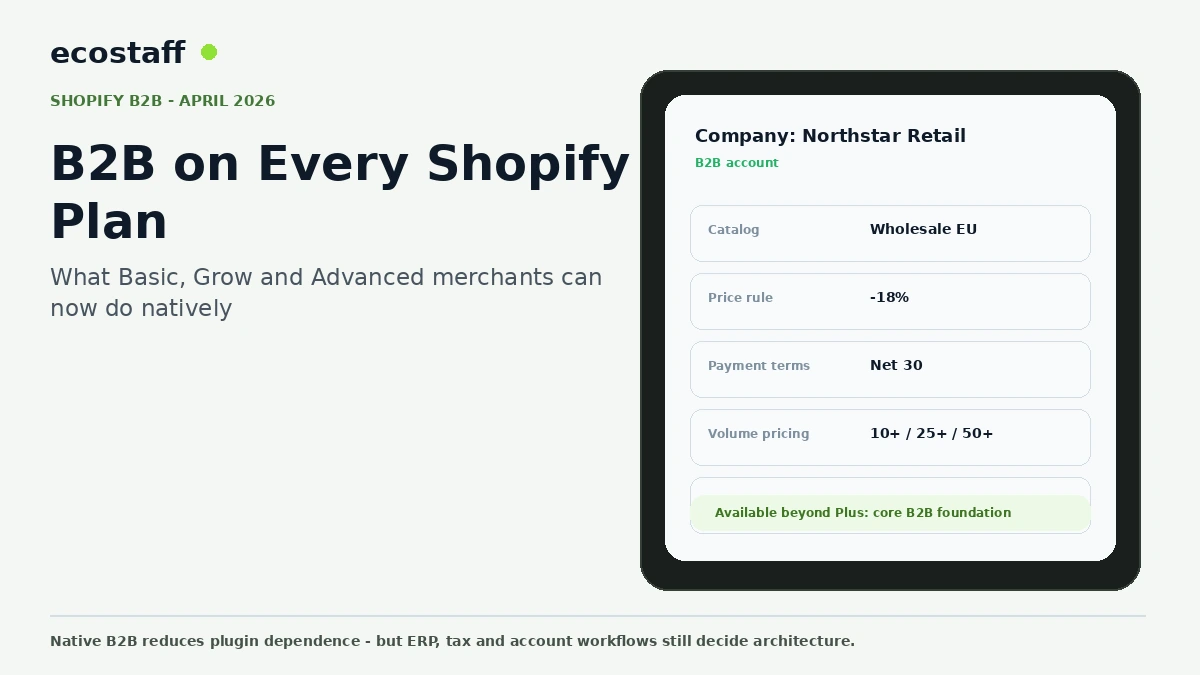
On April 2, 2026, Shopify expanded foundational native B2B features to merchants on Basic, Grow and Advanced plans at no additional cost. Non-Plus merchants gained company profiles, up to three active B2B catalogs assigned through Markets, payment terms, volume pricing, vaulted credit cards and ACH payments in the U.S.
Shopify Plus still retains deeper B2B capabilities, including unlimited catalogs, direct catalog assignment to companies and locations, partial payments and deposits. The practical result is that many smaller wholesale programs can now consolidate DTC and B2B in one Shopify environment without immediately moving to Plus or relying on as many third-party workarounds.
For years, Shopify’s native B2B stack was mainly associated with Plus. Smaller merchants often used wholesale apps, discount-code workarounds, duplicate stores or manual email ordering. The April 2026 change lowered the platform threshold for running a structured wholesale operation.
That does not mean every B2B business now fits a non-Plus Shopify plan. Wholesale complexity often lives in ERP pricing, credit limits, tax exemptions, approval flows, invoices and customer-specific contracts rather than in the storefront alone.
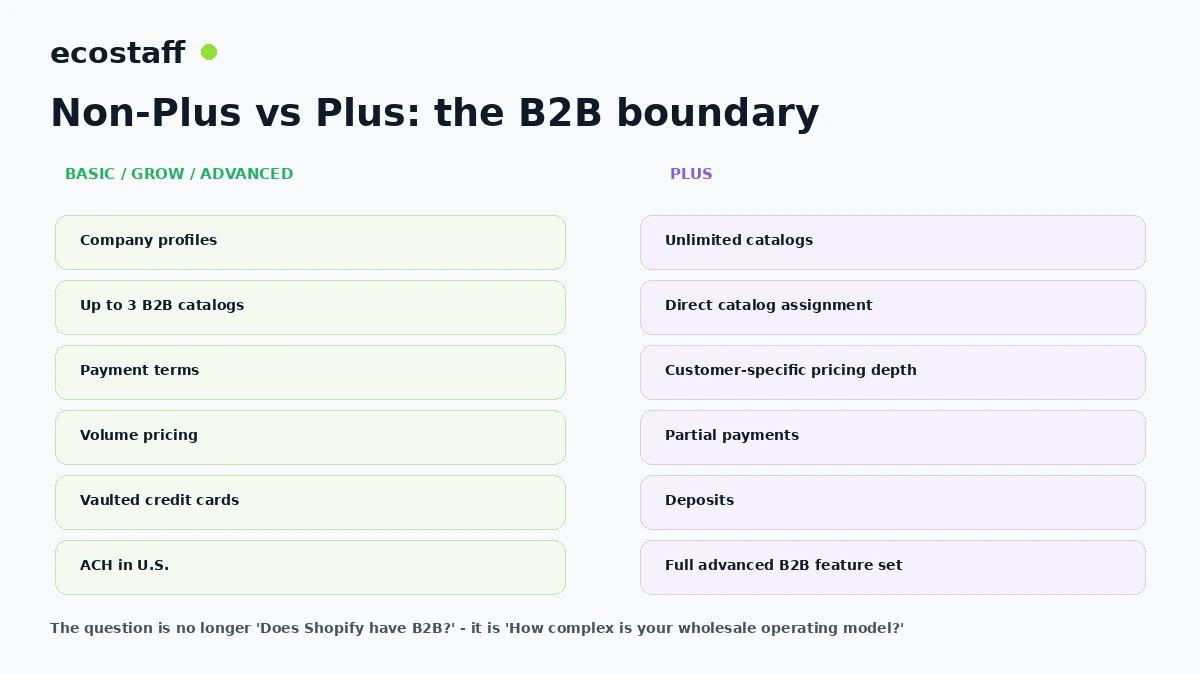
What non-Plus merchants gained
- Company profiles: represent wholesale buyer organizations in Shopify.
- Up to three active B2B catalogs: create tailored pricing through Markets.
- Payment terms: support invoicing-style purchase timing.
- Volume pricing: set quantity-based pricing rules.
- Vaulted credit cards: support repeat B2B purchasing.
- ACH payments in the U.S.: offer a common B2B payment method.
Shopify said these foundational features were available to Basic, Grow and Advanced merchants without additional feature charges.
What still remains on Plus
Shopify Plus remains the target for more complex B2B operations. Shopify highlighted unlimited catalogs, direct catalog assignment to companies and company locations, partial payments and deposits as Plus-level capabilities.
The correct plan decision should therefore be based on operating complexity, not only wholesale revenue.
The key architecture question: can B2B and DTC share one catalog?
Many businesses sell the same physical products to consumers and wholesale buyers but apply different prices, quantities, payment terms and merchandising rules. Native B2B works best when both channels can share product, inventory and fulfillment foundations.
If wholesale uses different SKUs, separate legal entities, special manufacturing rules or disconnected inventory systems, consolidation may require more integration work than the storefront features imply.
Catalog limits matter
Non-Plus merchants can use up to three active B2B catalogs. That is enough for many simple models: one domestic wholesale catalog, one international catalog and one strategic tier. It may be insufficient for businesses with customer-specific contracts across hundreds of accounts.
| Wholesale model | Likely fit | Reason |
|---|---|---|
| One wholesale price list | Strong non-Plus fit | Simple catalog and standard payment terms. |
| Three regional tiers | Potential fit | Can map to the three catalog limit. |
| Customer-specific pricing | Review Plus | Catalog count and direct assignment become important. |
| Contract pricing by location | Plus / integration review | Account-location rules become more complex. |
| Highly negotiated enterprise accounts | Architecture review | ERP or CPQ may remain authoritative. |
Payment terms can remove manual invoicing steps
Native payment terms let merchants represent wholesale purchase timing more naturally than consumer checkout. But finance still needs to define credit policy, overdue handling, order approval and reconciliation.
A storefront can offer Net 30, but it does not automatically know whether a specific customer should receive a $50,000 credit line. That decision often lives in ERP, accounting or credit systems.
Volume pricing moves common wholesale logic into core
Volume pricing can replace some wholesale-app logic for merchants with predictable quantity breaks. Review how the feature interacts with promotional discounts, minimum quantities, taxes and contract pricing.
Do not expose a wholesale price accidentally to retail buyers. Test buyer authentication, Markets configuration and the fallback experience for logged-out visitors.
B2B order flow still crosses the back office
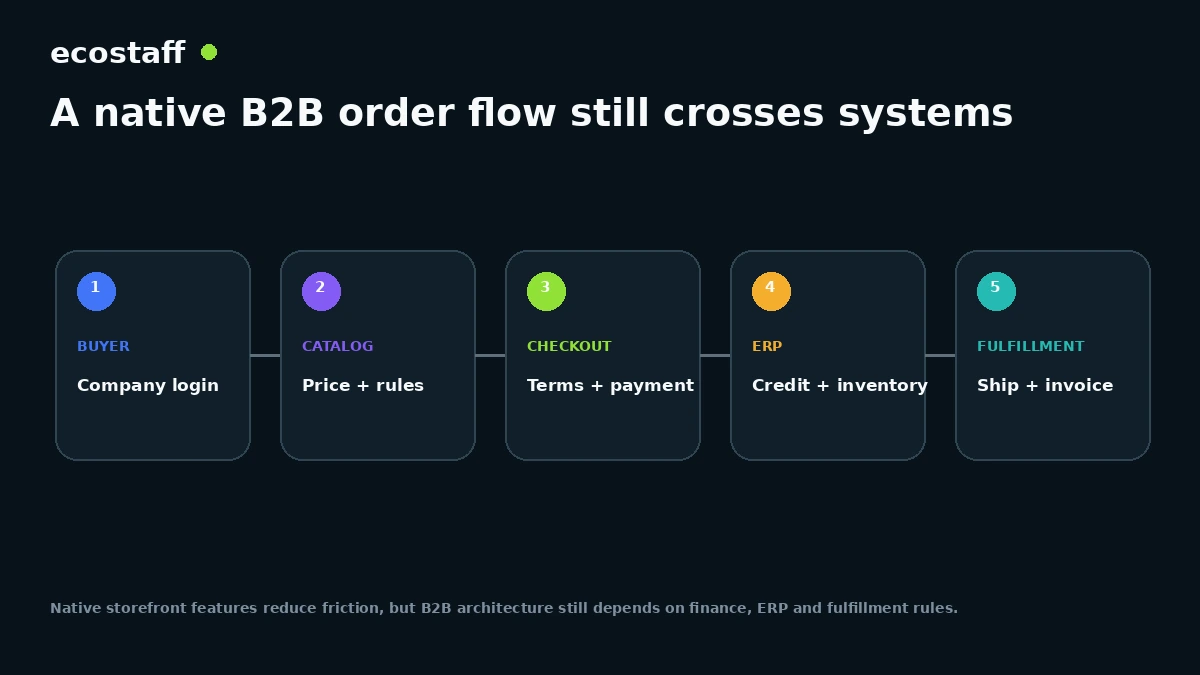
Wholesale transactions can require credit checks, inventory allocation, purchase-order references, sales-rep approval, freight quoting and invoice workflows. Map these systems before removing an existing B2B app or portal.
When non-Plus is likely enough
- Wholesale uses a small number of price lists.
- Buyers can self-serve with standard terms.
- Company accounts do not need many location-specific rules.
- Inventory is shared with DTC.
- ERP integration is relatively simple.
- Deposits and partial payments are not core requirements.
When Plus or deeper integration is more likely
- Dozens or hundreds of custom catalogs are required.
- Pricing is negotiated per customer or location.
- Partial payments and deposits are standard.
- Multiple buyers and locations need differentiated rules.
- Complex ERP credit and approval logic drives the order.
- Wholesale storefront customization is strategic.
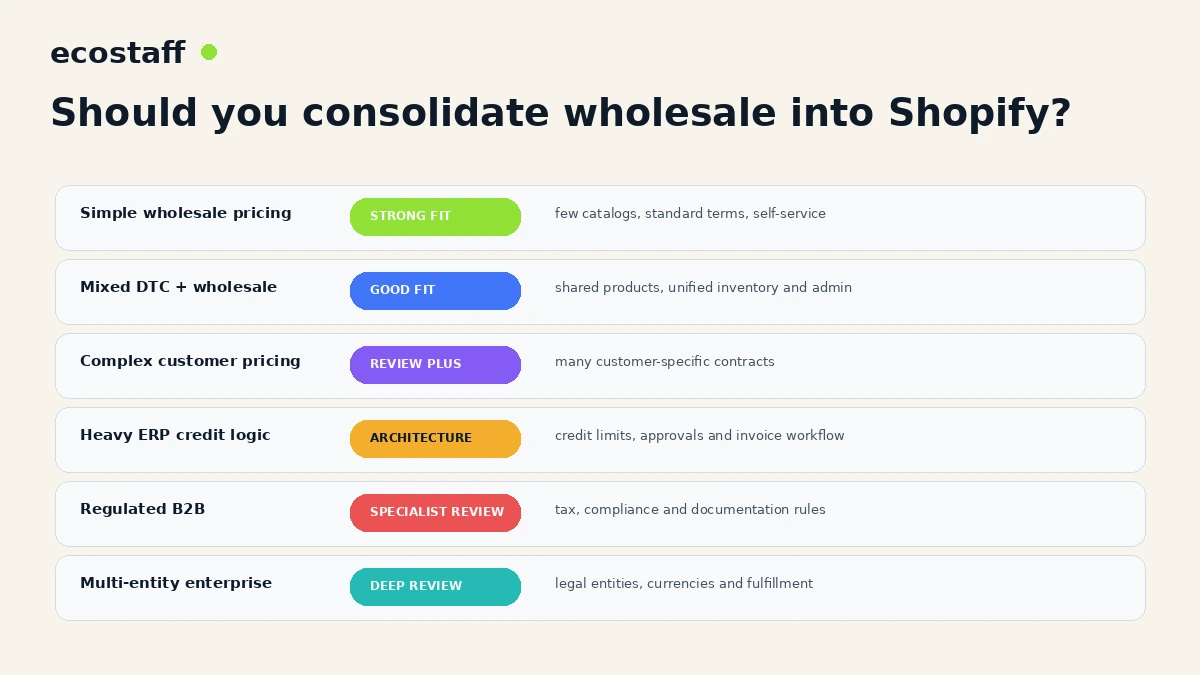
Should merchants remove wholesale apps immediately?
No. Native feature availability does not mean feature parity with every specialized wholesale app. Inventory the app’s real functions first: quote requests, customer approval, sales reps, invoices, minimums, special taxes, quick order forms, reorder lists, ERP sync and reporting.
Remove the app only if the native stack covers the required workflow and migration risk is justified by lower complexity or cost.
DTC and B2B analytics should remain separate
A unified platform is useful, but management reporting should distinguish retail and wholesale. B2B order frequency, gross margin, payment terms and customer lifetime value behave differently from consumer ecommerce.
- Revenue and gross margin by channel.
- Average order value.
- Repeat purchase interval.
- Outstanding receivables.
- Discount and volume-pricing impact.
- Customer acquisition cost where relevant.
- Returns and fulfillment cost.
A migration checklist for app-based wholesale
- List every current wholesale feature and manual workaround.
- Segment must-have versus nice-to-have capabilities.
- Map buyers, companies and locations.
- Map price lists to Shopify B2B catalogs.
- Test payment terms and volume pricing.
- Validate buyer authentication and DTC isolation.
- Review tax-exempt and regional tax flows.
- Test ERP, inventory and fulfillment synchronization.
- Recreate reporting by B2B channel.
- Pilot with a small group of wholesale accounts.
- Collect buyer feedback.
- Remove legacy apps only after stable parallel testing.
How to choose a Shopify B2B implementation partner
A good partner should understand wholesale operations, not only Shopify configuration. Ask about ERP, tax, credit, pricing, company accounts, catalogs, payment terms and fulfillment. The agency should be able to tell you when native Shopify is enough and when Plus or custom integration is justified.
Use Ecostaff to compare Shopify companies. For the previous B2B platform evolution, see Shopify Summer ’25.
Frequently asked questions
Is Shopify B2B now available on Basic?
Shopify announced foundational native B2B features for Basic, Grow and Advanced plans on April 2, 2026.
How many B2B catalogs can non-Plus merchants use?
Shopify said non-Plus merchants can use up to three active B2B catalogs assigned through Markets.
Does Plus still have B2B advantages?
Yes. Shopify Plus retains deeper features including unlimited catalogs, direct catalog assignments, partial payments and deposits.
Can a merchant run DTC and wholesale in one store?
That is a core goal of Shopify’s native B2B model. Whether one store fits depends on catalog, account, ERP and legal complexity.
Sources and further reading
- Shopify – Shopify brings native B2B features to millions more merchants, April 2, 2026
- Shopify Changelog – Key B2B features now available on non-Plus plans
- Shopify – B2B on Shopify
Conclusion
Shopify’s April 2026 B2B expansion removed a major platform barrier for smaller wholesale programs. Basic, Grow and Advanced merchants gained enough native B2B capability to replace many simple plugin and manual workflows.
The decision is now less about whether Shopify can support B2B and more about operating complexity. Merchants with a few catalogs and standard payment rules can consolidate more easily. Complex enterprise wholesale still requires careful architecture, and often Plus or ERP integration.