

Quick answer: what mattered most in Shopify Summer ’25?
Shopify released Summer ’25 on May 21, 2025 with more than 150 updates. The Edition introduced Horizon as a new theme foundation, expanded AI-assisted storefront building, improved Sidekick, added new B2B Markets capabilities and introduced developer-facing commerce tools such as Storefront MCP, Shopify Catalog and Storefront Web Components.
For merchants, the main question was not whether to use every new feature. The practical review was architectural: does Horizon simplify the storefront, can new Markets or B2B features replace custom workarounds, and is the business ready for AI shopping agents to consume its product and policy data?
Summer ’25 was one of Shopify’s more directional Editions. Horizon changed the storefront design system, while new AI and developer capabilities signaled that Shopify expected more shopping journeys to begin in conversational interfaces and external agents.
That makes the release relevant to more than theme developers. Merchandising, B2B, international, content, product data and integration teams all had decisions to make.
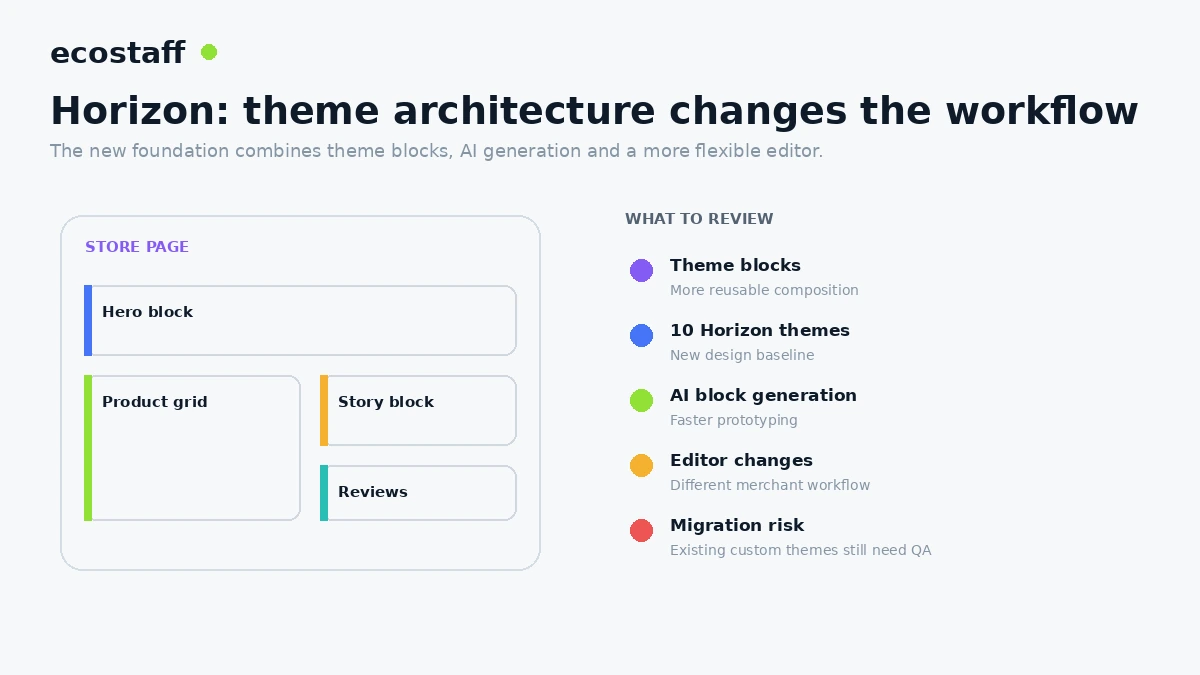
1. Horizon became Shopify’s new theme foundation
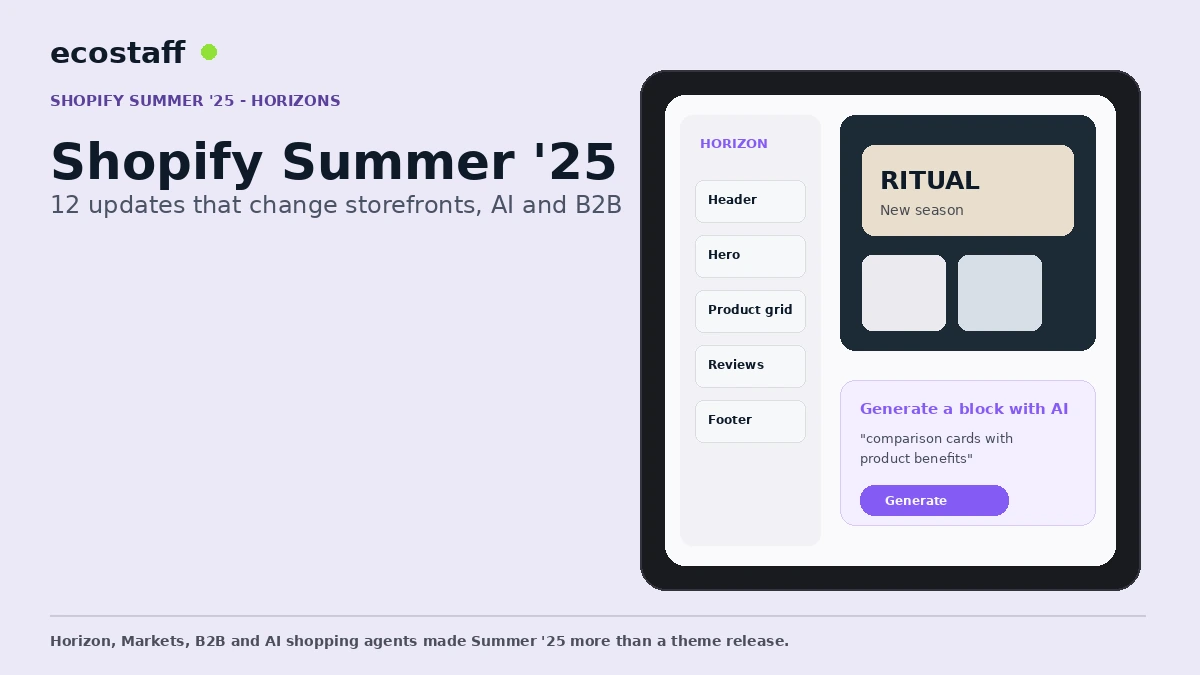
Shopify described Horizon as a new design foundation built around theme blocks. The Edition launched ten Horizon themes and expanded the editor with better block management and AI-assisted generation.
The value is flexibility, but merchants should not assume a migration is automatically beneficial. Existing high-performing custom themes may still be the better short-term choice if moving would recreate extensive merchandising, app and analytics work.
2. AI-generated theme blocks changed prototyping
Summer ’25 allowed merchants to describe a block and generate it with AI. This lowers the cost of prototyping, but it does not remove the need for design governance, accessibility, performance and QA.
Generated UI should be reviewed like custom code: responsive behavior, semantic markup, tracking, variant handling and maintainability still matter.
3. Sidekick expanded beyond simple help
Shopify continued making Sidekick more capable and available across languages. Merchants can use AI assistance for admin tasks and insights, but higher-risk changes still need human review. Sidekick is most valuable where it reduces repetitive operational effort rather than replacing business judgment.
4. Knowledge Base targeted AI shopping representation
Shopify introduced a Knowledge Base app designed to help merchants influence how their brand is represented in AI shopping chats. The app can generate AI-readable FAQs based on store policies and settings, while allowing merchants to edit and add answers.
This turns policy and brand information into a more explicit machine-readable content asset. Return, shipping, product and service answers should therefore be reviewed for accuracy, not treated as marketing filler.
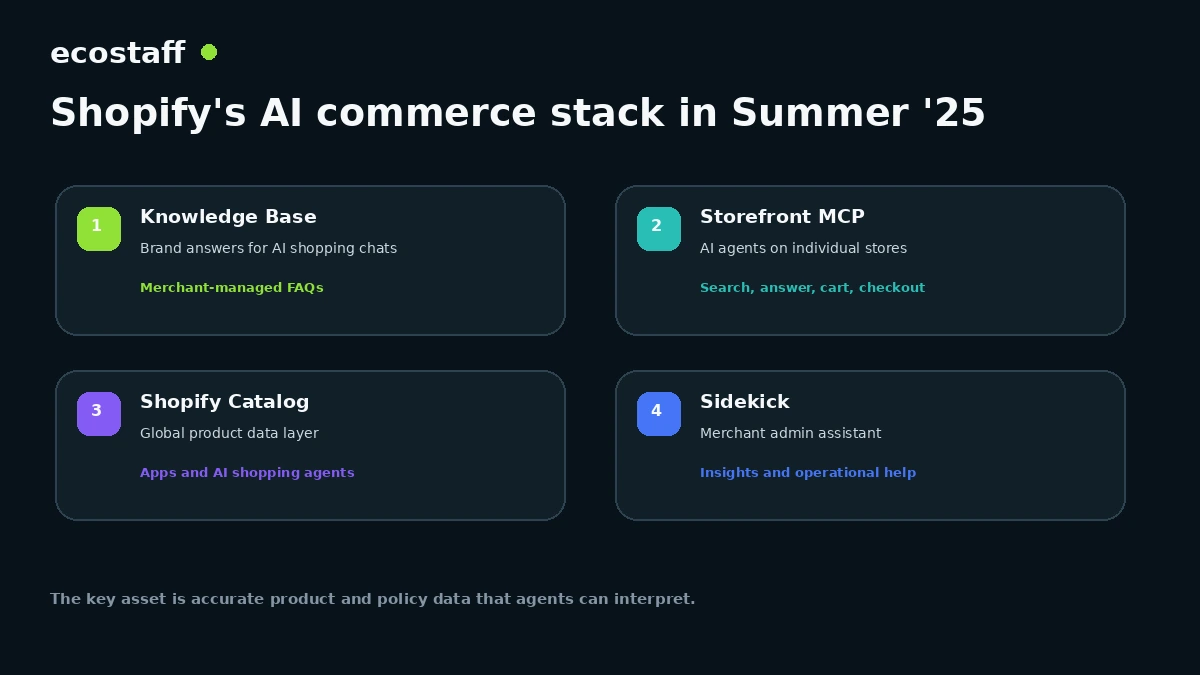
5. Storefront MCP created a new AI storefront layer
Shopify introduced Storefront MCP so developers can build AI agents for individual stores that search products, answer brand questions, create carts and initiate checkout.
The architectural implication is important: product data and policy data need to be reliable enough for another interface to act on them. A broken variant model or ambiguous delivery rule becomes more costly when an AI agent is expected to interpret it.
6. Shopify Catalog opened product data to AI applications
Shopify presented its Global Catalog as infrastructure for apps and AI agents that search product data across Shopify merchants. This is a further reason for merchants to treat catalog quality, identifiers, images and policies as strategic data.
7. Markets became more flexible
The updated Markets system allowed merchants to create more specific submarkets and manage buyer customizations in a more consolidated way. For Plus merchants, the release also expanded B2B Markets with distinct catalogs, currencies and storefront customizations.
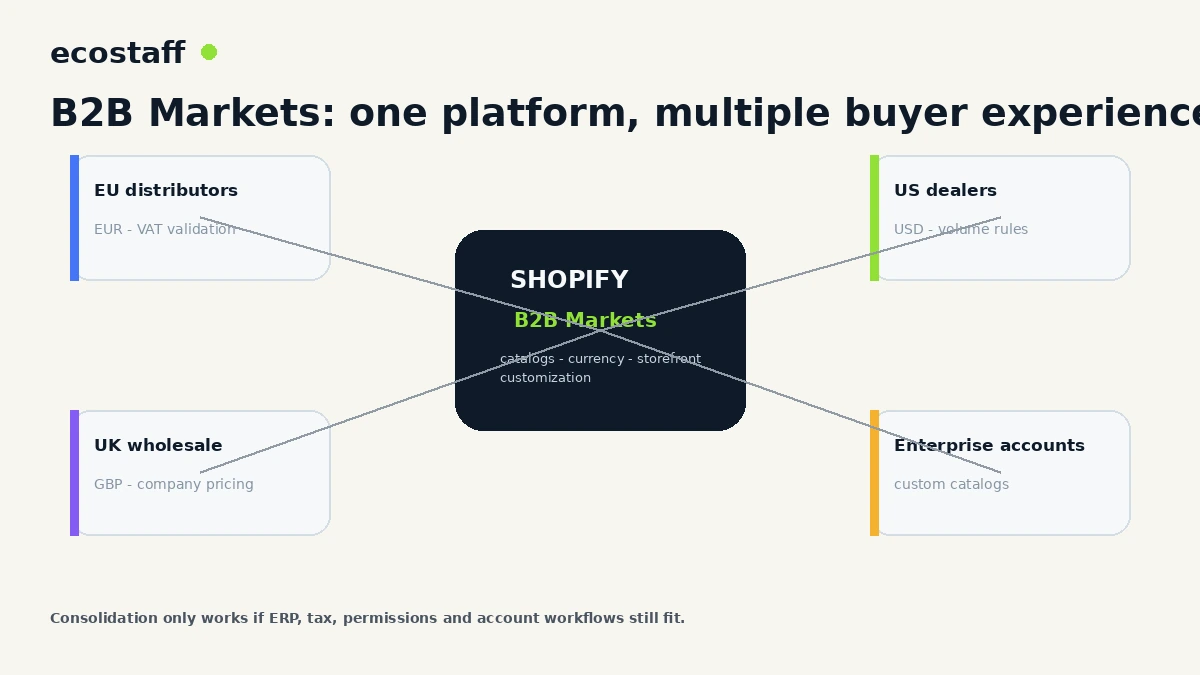
8. B2B VAT validation reduced manual work
Shopify added VAT number validation for EU and UK companies and described automatic tax exemption behavior with Shopify Tax. B2B merchants should still review their legal and tax requirements, but this can reduce manual verification workflows.
9. B2B order limits became easier to configure
The free Checkout Blocks app added minimum and maximum order value controls that can apply to B2B or all customers. This can replace some custom checkout logic for merchants with simple wholesale order rules.
10. NetSuite integration improved for B2B
Shopify highlighted an updated NetSuite ERP connector for synchronizing companies, orders, PO numbers and payment terms. Merchants should still test field mapping, error handling and order lifecycle behavior before changing an existing integration.
11. Storefront Web Components expanded composable options
Shopify introduced Storefront Web Components to embed commerce features into other sites with a relatively lightweight integration model. This creates an option between a standard theme and a fully custom headless storefront.
12. Developer tools became more AI-native
Shopify expanded its developer MCP tooling to support GraphQL, Functions and Polaris information in third-party AI coding environments. This can speed development, but merchant teams still need source control, review, security and testing.
| Update area | Potential value | Main migration question |
|---|---|---|
| Horizon | More flexible theme system | Does it replace enough custom theme complexity to justify migration? |
| AI blocks | Faster prototyping | Can generated output meet accessibility and performance standards? |
| Knowledge Base | Better AI brand answers | Are policies and FAQs accurate and maintained? |
| Storefront MCP | Store-level AI agents | Is product and policy data reliable enough for agent actions? |
| B2B Markets | More buyer segmentation | Do ERP, tax and account workflows fit the native model? |
| Storefront Web Components | Simpler embedded commerce | Can it replace a heavier custom storefront architecture? |
Should an existing Shopify store move to Horizon immediately?
No universal answer exists. New stores and merchants already planning a redesign have a stronger reason to evaluate Horizon. Stable custom storefronts should compare migration cost against the value of blocks, editor flexibility and future platform alignment.
Before moving, inventory custom sections, apps, tracking, metafields, markets, product templates, accessibility behavior and performance. Rebuild the critical conversion path first in a draft theme and compare it.
How agencies should approach Summer ’25
A strong Shopify agency should explain where native Summer ’25 features can remove custom code and where the merchant still needs custom development. Be cautious with partners who recommend a full redesign only because a new theme family exists.
You can compare Shopify agencies on Ecostaff. For earlier platform context, see Shopify Winter ’25 and Shopify in 2025: What Merchants Should Review First.
Summer ’25 review checklist
- Inventory current theme customizations and apps.
- Evaluate Horizon against the existing conversion-critical templates.
- Test AI-generated blocks for responsive, accessible markup.
- Review brand and policy answers in the Knowledge Base app.
- Audit catalog identifiers, images and structured product information.
- Identify where Storefront MCP or Web Components could simplify future builds.
- Review Markets and B2B segmentation requirements.
- Validate VAT and tax workflows with qualified advisers.
- Map ERP and company-account dependencies.
- Check whether native features can replace paid apps or custom code.
- Create a migration business case before redesign work starts.
- Measure performance and conversion before and after major changes.
A Horizon migration should be treated as a storefront replatform
Changing theme foundations can affect more than layout. Custom sections, app embeds, pixels, metafields, cart behavior, search, localization and accessibility can all behave differently. For a mature Shopify store, the correct comparison is not Horizon versus the current homepage screenshot. It is Horizon versus the entire production storefront system.
| Migration layer | What to inventory | Acceptance test |
|---|---|---|
| Theme sections | Custom Liquid, blocks, templates | All conversion-critical templates render correctly |
| Apps | Embeds, widgets, subscriptions, reviews | App features load and update without layout conflicts |
| Analytics | Pixels, custom events, consent | Events fire once with correct values and IDs |
| Markets | Domains, languages, currencies | Buyer experience matches market configuration |
| Performance | Theme JS, apps, media | Real-user interaction does not regress |
| Accessibility | Navigation, forms, focus | Keyboard and screen-reader spot checks pass |
When Horizon is likely to create the most value
- New storefront build: there is no migration debt to recreate.
- Scheduled redesign: the business already has budget and QA time for a broader change.
- Theme maintenance problem: the existing theme has accumulated fragile custom code.
- Content team bottleneck: merchants rely on developers for simple layout changes.
- App reduction project: native blocks and new Shopify features can replace overlapping tools.
Conversely, a stable high-converting storefront with extensive custom logic may not justify an immediate move. Platform alignment has value, but so does avoiding unnecessary migration risk.
How to prepare product and policy data for Shopify’s AI tools
Knowledge Base and Storefront MCP increase the value of clean source information. Review the policies and product facts an agent is likely to answer. If return conditions are split across old pages, if warranty details differ between product descriptions and support docs, or if variant names are inconsistent, the AI layer inherits those problems.
- Create one authoritative return and refund policy.
- Standardize shipping promises and cutoff times.
- Audit product titles, variants and option names.
- Document compatibility and exclusions.
- Keep company, tax and B2B account rules current.
- Review generated Knowledge Base answers before publishing.
- Assign an owner for quarterly AI-answer review.
B2B Markets fit-gap analysis
B2B Markets can reduce custom architecture, but wholesale operations often extend beyond catalogs and currencies. Before consolidation, map company hierarchies, payment terms, purchase orders, tax exemptions, sales-rep ownership, credit limits, ERP synchronization and approval flows.
If a native feature covers 80% of a process but the remaining 20% is commercially critical, the merchant still needs a clear integration or customization plan. Native-first should not become native-only.
Frequently asked questions
Was Horizon mandatory in 2025?
No. Horizon is a new theme foundation and set of themes, not a forced migration for every existing Shopify store.
Can AI-generated blocks replace developers?
They can accelerate simple prototyping, but production storefront work still requires design judgment, accessibility, data integration, analytics and QA.
Is Storefront MCP only for headless stores?
It is a developer interface for building AI-agent shopping experiences around store data and actions. The broader architecture should be evaluated against the merchant’s existing storefront and integration model.
Is B2B Markets available on every Shopify plan?
Shopify described multiple B2B Markets as a Plus capability. Availability should always be checked against the current plan and rollout status.
Sources and further reading
- Shopify – Summer ’25 Edition
- Shopify – New features, good vibes: Welcome to Summer ’25 Edition
- Shopify – Summer ’25 developer updates
- Shopify – Expanding your AI Horizons, Summer ’25 Edition
- Shopify Changelog – Updates to Markets
Conclusion
Shopify Summer ’25 was important because storefront design, B2B and AI commerce infrastructure moved forward at the same time. Horizon can simplify theme composition, while Knowledge Base, Storefront MCP and Shopify Catalog show how product data may be used outside the traditional storefront.
The right merchant response is selective adoption. Use the new native capabilities where they remove complexity, but require a clear business case before rebuilding a stable commerce stack.