

Quick answer: what changed in WooCommerce 11.0?
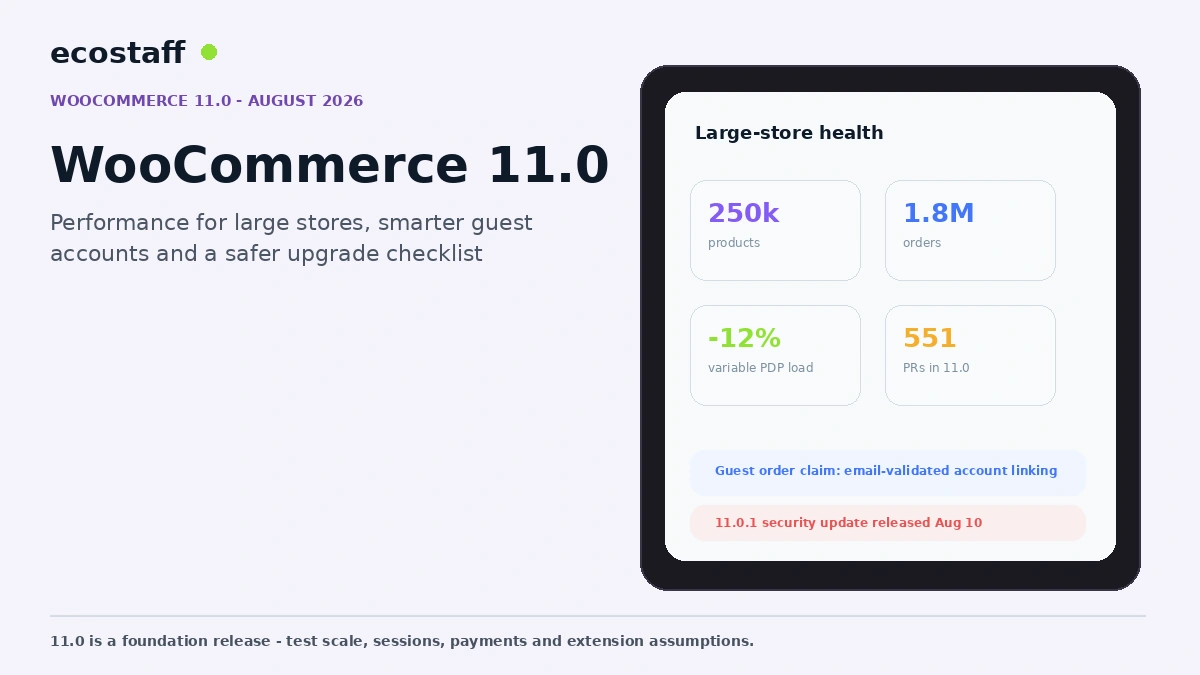
WooCommerce 11.0 was released on August 4, 2026 with 551 pull requests from 89 contributors, making it one of the project’s larger recent releases. The release focused on foundations: performance for large stores, guest-order claiming, more reliable analytics, Product Editor Beta retirement and an upgrade to Action Scheduler 4.0.0.
Store owners should also note WooCommerce 11.0.1, released August 10 as a security update with additional performance and compatibility fixes. Because 11.0 includes a database update and several compatibility changes, production stores should test current patches, payment flows, guest sessions, analytics and extension behavior in staging.
A major version number can suggest a dramatic redesign, but WooCommerce 11.0 was intentionally foundation-heavy. That is good news for established stores: query efficiency, analytics resilience and customer-account continuity can create more long-term value than a new admin feature.
It also means the upgrade risk lives under the surface. Background job changes, experimental editor retirement, caching and session behavior can affect extensions that assume older internals.
1. Performance work targets large stores
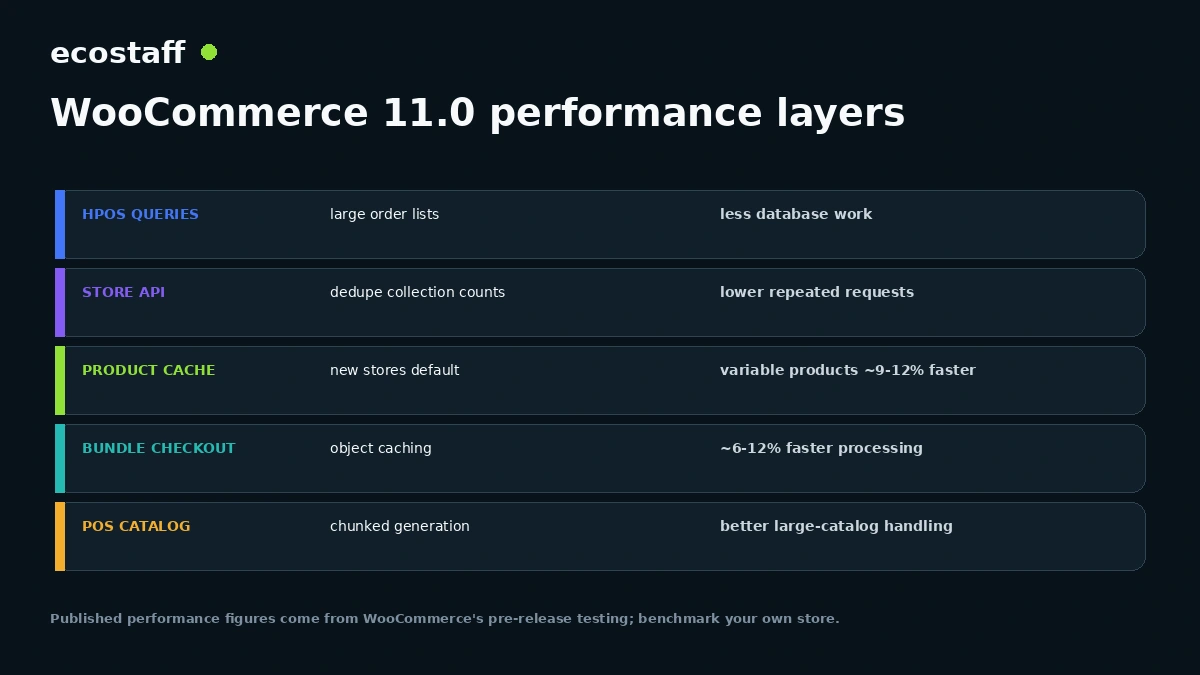
WooCommerce 11.0 included dozens of changes tagged around performance, caching and scalability. The release optimized HPOS order-screen queries, Store API collection-data requests, stock behavior and large-catalog processes.
For high-volume stores, improvements to query count and background processing can reduce database pressure that becomes visible only at scale.
2. Product object caching becomes more important
WooCommerce’s pre-release notes said product object caching would be enabled by default for new stores in 11.0. In WooCommerce’s testing, variable products loaded roughly 9-12% faster on product pages and bundle processing improved roughly 6-12% during checkout.
Treat those figures as platform testing rather than guaranteed merchant results. Benchmark a representative large variable product and bundle workflow on the actual hosting stack.
3. Guest customers can claim previous orders
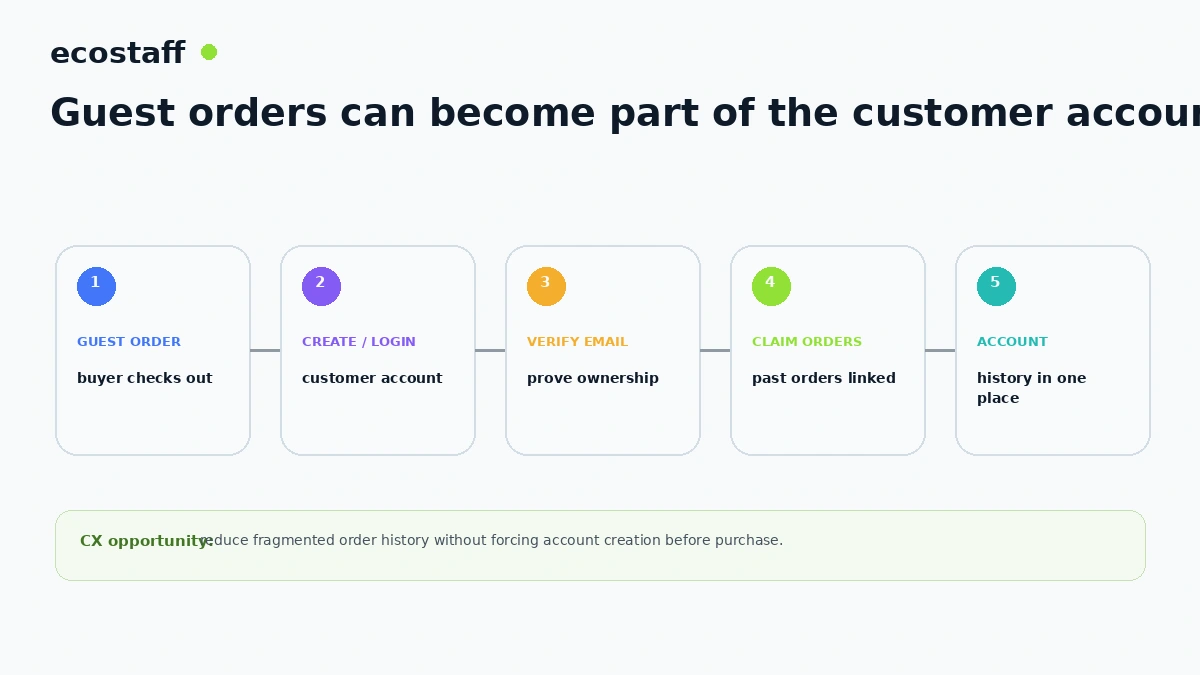
WooCommerce extended its post-checkout account model so a logged-in customer can verify ownership of an email address and connect previous guest orders to the account.
This is valuable for merchants that avoid forcing account creation during checkout. Customers can keep a low-friction first purchase and still build a useful order history later.
What to test in the guest-order claim flow
- Orders with the exact verified email address.
- Multiple historical guest orders.
- Account creation after a prior purchase.
- Privacy and access control for mismatched email addresses.
- Subscription or membership extensions that depend on account ownership.
- Customer-service workflows that use order ownership.
4. Analytics reporting becomes more resilient
WooCommerce 11.0 improved analytics event reliability, added refund data to the v3 sales-report API and made failed historical imports more visible with retry paths.
This matters because incomplete imports can create silent reporting gaps. Merchants should compare analytics totals with payment and order records after a major update.
5. Abandoned Cart / Checkout Recovery remains experimental
WooCommerce continued developing abandoned checkout recovery as a beta feature. Experimental features can be valuable for testing, but they should not be confused with mature lifecycle-marketing infrastructure.
If the store already uses an email or CRM platform, test duplication, consent, unsubscribe behavior and event timing before activating another recovery system.
6. Product Editor Beta is removed
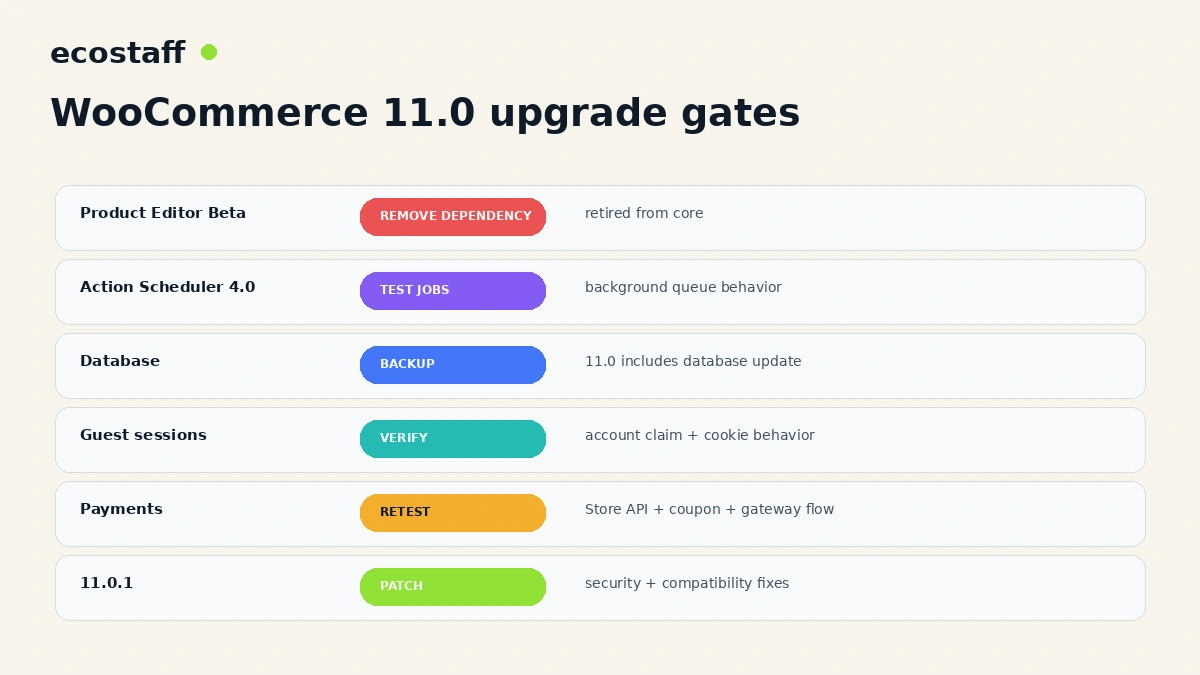
WooCommerce 11.0 completed removal of the experimental Product Editor Beta and related packages, flags and extension points. Product data remains intact and stores return to the supported editor path.
Extension developers that depended on experimental editor APIs need to audit their code. Merchants should check product-editing workflows used by internal teams and plugins.
7. Action Scheduler 4.0 is part of the upgrade
WooCommerce updated its internal Action Scheduler dependency to 4.0. Stores rely on scheduled actions for subscriptions, webhooks, email, imports, cleanup and many extension workflows.
After the upgrade, review the scheduled-actions queue for unusual failures or backlog growth. Background jobs can break operations without affecting the storefront immediately.
8. WooCommerce 11.0.1 adds security and compatibility fixes
WooCommerce 11.0.1 was released on August 10 as a security update. The release also added WordPress 7.1 compatibility work, tightened several permission and validation paths, improved guest-session cookie hashing and reduced log-related checkout overhead on stores with large log directories.
Production stores should use the current supported patch release rather than installing 11.0.0 because the headline article mentioned it.
A WooCommerce 11.0 upgrade plan
- Create and verify a database and file backup.
- Clone production to staging.
- Update critical extensions to compatible versions.
- Use the current WooCommerce 11.0.x patch release.
- Run the database update in staging.
- Test large variable and bundle products.
- Test guest checkout and account creation.
- Test claiming previous guest orders.
- Test refunds and analytics reports.
- Review failed analytics imports.
- Test every payment gateway.
- Review scheduled actions and background jobs.
- Audit any Product Editor Beta dependencies.
- Deploy during a monitored window.
Payment and Store API regression tests
WooCommerce 11.0.1 included fixes around Store API payment and coupon handling. A real test should include coupons with usage limits, guest checkout, logged-in checkout and existing order payment flows if the store supports them.
| Scenario | What to verify | Risk |
|---|---|---|
| Coupon limit | Usage limit respected | Unexpected discount leakage. |
| Guest cart | Session survives update | Cart loss. |
| Existing order payment | Correct coupons and totals | Incorrect payment amount. |
| Wallet / card gateway | Callback and order state | Paid order stuck pending. |
| Refund | Analytics + order totals | Reporting mismatch. |
Large log directories can become a checkout problem
WooCommerce 11.0.1 changed logging behavior so writing a log no longer requires scanning an entire large log directory. That is a useful reminder that operational hygiene can become performance work.
Keep logging at the level required to diagnose problems, but implement retention and cleanup rather than allowing years of files to accumulate.
How to evaluate a WooCommerce performance agency
Ask the provider to profile the real store: database queries, HPOS, Action Scheduler, object cache, Store API, extensions, PHP, hosting and frontend interaction. A generic ‘install cache plugin’ answer is not enough for a large WooCommerce operation.
Use Ecostaff to compare WooCommerce-focused companies. The WooCommerce 10.5 guide covers the earlier analytics and performance release.
Frequently asked questions
Was WooCommerce 11.0 backward compatible?
WooCommerce described 11.0 as backward compatible, but extensions and custom code still need testing because the release removed experimental APIs and changed internal dependencies.
Did WooCommerce 11.0 include a database update?
Yes. The official release notes state that a database update is included.
Was WooCommerce 11.0.1 a security update?
Yes. WooCommerce labeled 11.0.1 as a security update, along with performance and compatibility improvements.
Does guest-order claiming force customers to create accounts?
No. It improves the later account experience by allowing verified users to connect past guest orders after checkout.
Sources and further reading
- WooCommerce Developer Blog – WooCommerce 11.0 Release Notes
- WooCommerce Developer Blog – WooCommerce 11.0 pre-release highlights
- WooCommerce Developer Blog – WooCommerce 11.0.1 Release Notes
- WooCommerce Developer Blog – Product Editor beta retirement
Conclusion
WooCommerce 11.0 is a foundation release for stores that need stronger scale, analytics and account continuity. The most visible merchant feature is guest-order claiming, but the deeper changes are performance, caching, Action Scheduler and cleanup of experimental architecture.
Treat the upgrade like a production-system change: current patch, database backup, staging, transaction testing and background-job monitoring.