

Quick answer: what mattered most in Shopify Spring ’26?
Shopify released Spring ’26 on June 17, 2026 with more than 150 updates built around the idea of selling everywhere. The release expanded Agentic Storefronts into a central AI-commerce command center, opened Catalog API and Universal Commerce Protocol access more broadly to developers, added Sidekick App Extensions, introduced AI sales and marketing tools, and connected more online, Shop and retail experiences.
For merchants, Spring ’26 was less about one storefront feature and more about distribution architecture. Shopify wants product data structured once, distributed across AI and shopping surfaces, and measured centrally in the admin.
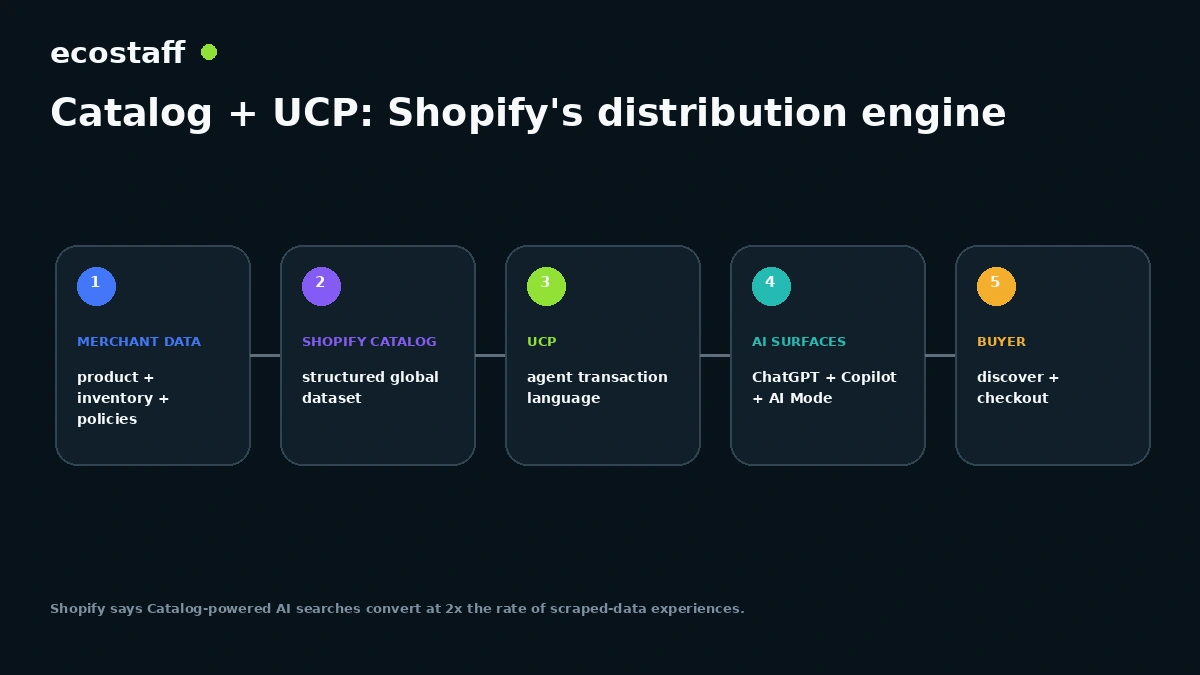
Winter ’26 introduced Agentic Storefronts. January brought UCP. March brought broader ChatGPT selling. Spring ’26 connected those pieces into an operating model: product data travels through Shopify Catalog, agentic channels are managed in admin, Sidekick helps merchants fix missing information, and developers can build new UCP-based commerce experiences without the previous approval barrier.
This makes the Edition relevant to ecommerce, marketing, data, app architecture and retail teams simultaneously.
1. Agentic Storefronts became an admin command center
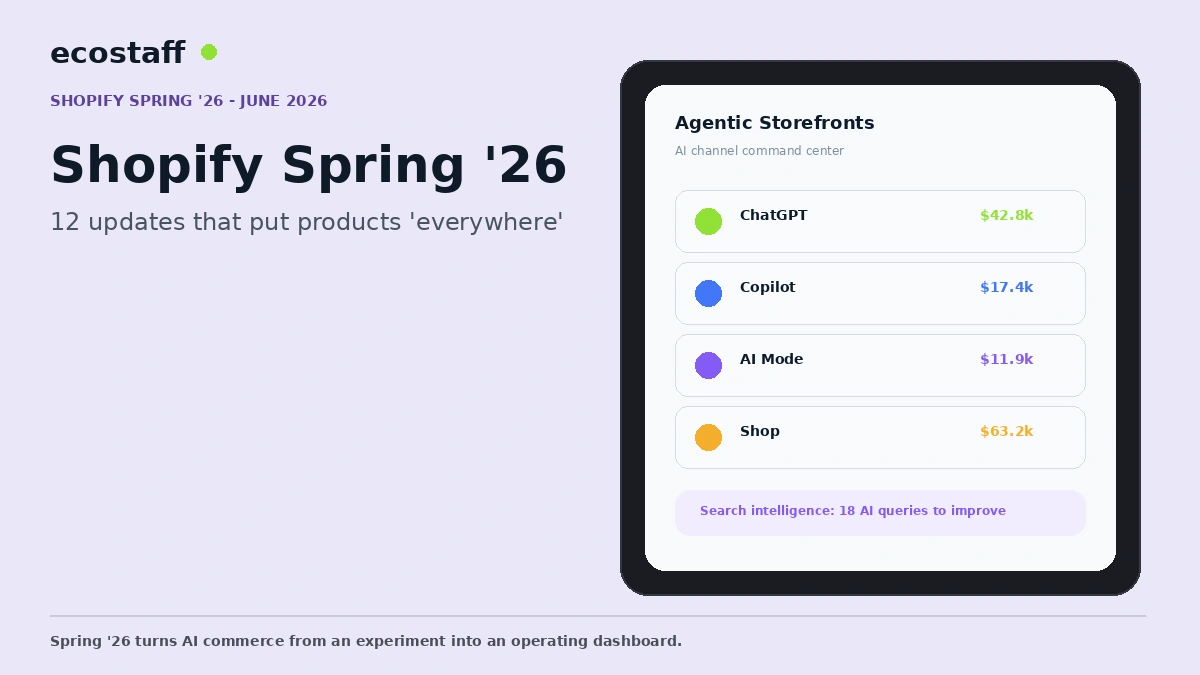
Shopify added centralized AI-channel management in the admin. Merchants can control product discovery and direct checkout for channels, then view orders, sales and conversions from surfaces such as ChatGPT, Copilot, AI Mode in Google Search, Gemini and Shop.
This is strategically important because AI commerce moves from a one-off experiment into something that can be governed like a real acquisition and sales channel.
2. Search intelligence exposes AI-query gaps
Shopify said the Agentic Storefronts admin can show important AI queries in a category, where products rank and where visibility is missing. Sidekick can then recommend product-data improvements when products appear but do not convert.
Merchants should treat these suggestions as diagnostic prompts, not guarantees. Improve product information because it helps channel accuracy and buyers, not because one automated recommendation promises rank.
3. Shopify Catalog becomes the source for broader AI distribution
Shopify described Catalog as a structured global dataset that distributes eligible merchant products to multiple AI and shopping surfaces. The Edition added richer search capabilities, including image search, multimodal search, product lookup and richer attributes such as size, color and delivery estimates.
Shopify also said Catalog-powered AI searches converted at twice the rate of scraped-data experiences in its own measurement. Merchants should treat that as a platform-reported result, not a universal benchmark.
4. UCP access opens to the broader developer ecosystem
Spring ’26 removed the earlier approval barrier for developers building with Shopify’s UCP and Catalog stack. Developers can register agent profiles and use public infrastructure to build discovery-to-checkout experiences.
For the protocol architecture, read the Ecostaff UCP guide.
5. Sidekick App Extensions bring third-party apps into conversation
Apps can expose data and actions to Sidekick. A merchant can ask about campaign performance, loyalty, returns or other connected tools without manually switching contexts.
This is useful, but app permissions become more important. Merchants should understand which data and actions each extension exposes and which operations still require confirmation.
6. Shopify AI Toolkit becomes generally available
Shopify announced its AI Toolkit as generally available for developers, connecting coding assistants to Shopify reference material, live store data and command-line tools. This can accelerate app and integration work.
The governance rule is the same as with any AI-generated code: source control, code review, permissions, tests and ownership still matter.
7. Static apps reduce infrastructure overhead
Spring ’26 introduced static apps that can run without a separately managed application server for supported use cases. Shopify handles hosting and parts of the app environment.
For agencies and merchant teams, this can reduce hosting and operational complexity for narrow internal tools. It does not mean every app should be rebuilt as a static app.
8. Next Gen Events rebuilds webhook infrastructure
Shopify described a rebuilt events system with more targeted field-level filtering and customizable GraphQL payloads. For integrations, this can reduce noisy webhooks and unnecessary downstream processing.
Merchants with ERP, WMS, CRM or loyalty integrations should ask their app and integration partners whether the new event model can simplify data flows.
9. AI sales associate arrives in Shopify Inbox
Shopify introduced an AI sales associate that can answer storefront questions, recommend products and handle order inquiries using catalog, inventory and policy data. Merchants control tone and when a human should take over.
This creates a useful support and conversion use case, but inaccurate policy or inventory data will also be answered faster. Quality of source information remains the foundation.
10. Campaign Autopilot moves marketing toward bounded automation
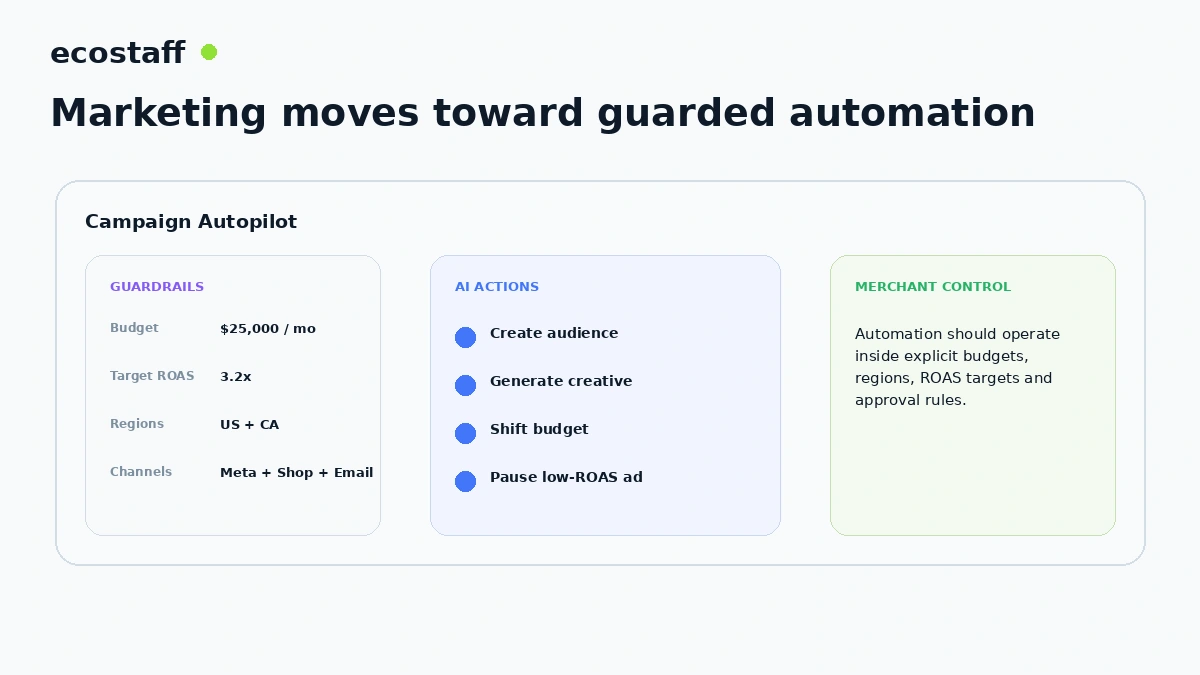
Shopify showed Campaign Autopilot as an early-access AI marketing tool that can run campaigns across channels within merchant-defined constraints such as budget, region and return targets.
The safe operating model is bounded automation: define budgets, exclusions, approval rules and stop conditions before letting a system shift spend.
11. Shop Campaigns expands distribution
Shop Campaigns expanded into more channels, including ChatGPT and other external surfaces. The model remains performance-oriented: merchants pay when the campaign converts under the relevant program rules.
Merchants should still compare incrementality and margin, not only attributed revenue.
12. Shop connects digital and physical journeys
Spring ’26 added more links between the Shop app and retail stores, including local inventory visibility, in-store pickup context and return workflows. Shopify also continued POS improvements.
For omnichannel merchants, the value is operational continuity: one buyer profile and inventory system should support online research, local stock and in-store service.
The 12 updates by priority
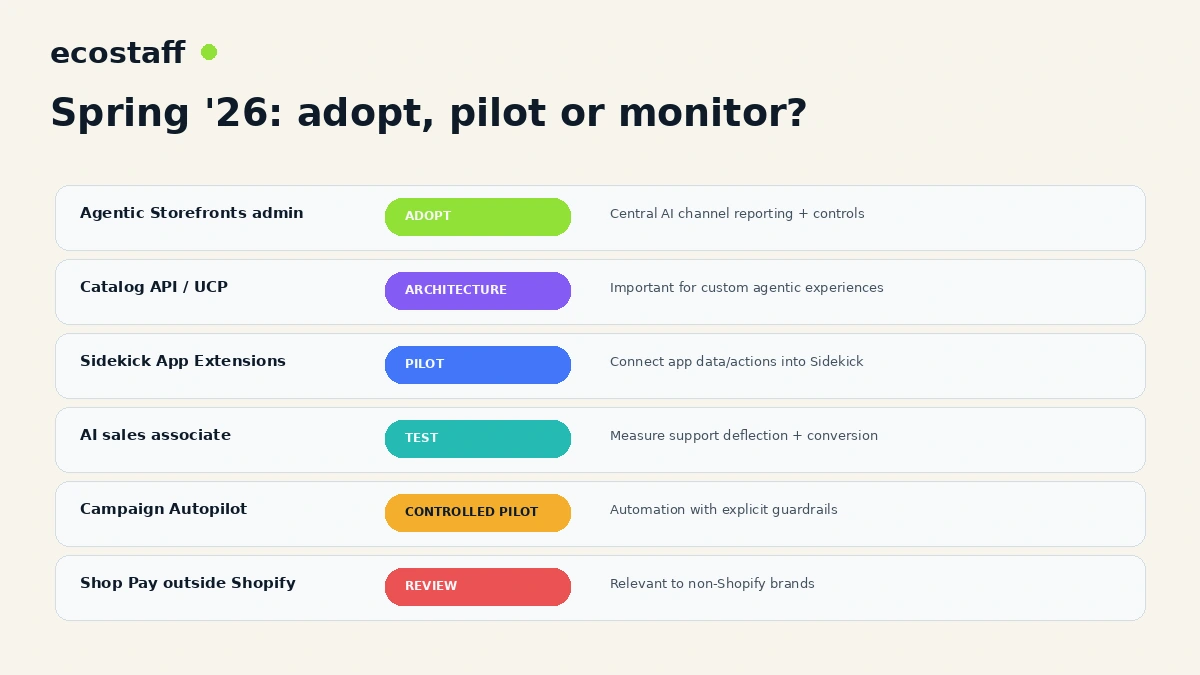
| Area | Recommended action | Why |
|---|---|---|
| Agentic Storefronts admin | Adopt | Central visibility and controls for AI channels. |
| Catalog data quality | Prioritize | Affects product representation across surfaces. |
| UCP / Catalog API | Architecture review | Important for custom agentic products and partners. |
| Sidekick App Extensions | Pilot | Reduces app switching if permissions are clear. |
| AI sales associate | Test | Potential support and conversion impact. |
| Campaign Autopilot | Controlled pilot | Marketing automation needs clear guardrails. |
| Omnichannel Shop / POS | Review | Useful when retail and online share inventory. |
A Spring ’26 merchant review process
- Open Agentic Storefronts and review active AI channels.
- Audit product titles, variants, images and missing specifications.
- Compare AI-channel orders, sales and conversion.
- Review Catalog eligibility for strategic products.
- Identify any custom apps that could use Sidekick extensions.
- Map webhook-heavy integrations that may benefit from Next Gen Events.
- Test the AI sales associate against real customer questions.
- Define approval and budget controls before using campaign automation.
- Review Shop and retail flows if local inventory matters.
- Create a Q3 backlog by revenue impact and implementation risk.
How to evaluate a Shopify agency after Spring ’26
A strong agency should understand Catalog data, UCP, Agentic Storefronts, Functions, Markets, checkout and integration architecture. Avoid partners who reduce Spring ’26 to a theme redesign.
Use Ecostaff to compare Shopify-focused companies. The Agentic Storefront guide covers the ChatGPT channel in more detail.
Frequently asked questions
How many updates were in Shopify Spring ’26?
Shopify announced more than 150 updates in the June 17, 2026 Edition.
Are Shopify merchants automatically in Catalog?
Shopify said eligible merchant products are included in Catalog by default, subject to eligibility and channel settings.
Can any developer build with UCP on Shopify now?
Spring ’26 opened Shopify’s agentic commerce infrastructure more broadly, removing the previous approval requirement for UCP access in Shopify’s developer flow.
Should merchants automate all marketing through Campaign Autopilot?
No. The tool was introduced in early access and should be tested inside clear budget, targeting and performance guardrails.
Sources and further reading
- Shopify – Spring ’26 Edition
- Shopify – Selling everything, everywhere, all at once: Spring ’26
- Shopify – Agentic commerce for every developer: Spring ’26
- Shopify Changelog – Spring ’26 Edition is live
Conclusion
Shopify Spring ’26 moved agentic commerce from feature launches toward an operating system. Catalog distributes product truth, UCP standardizes transactions, Agentic Storefronts measures channels and Sidekick increasingly connects the tools merchants use.
The merchant advantage will come from disciplined data and channel management, not simply turning on more AI surfaces.