

Quick answer: what changed with Shopify Winter ’26?
Shopify released Winter ’26 on December 10, 2025 with more than 150 updates centered on AI-native commerce. The Edition introduced Agentic Storefronts for selling through AI conversations, expanded Sidekick from a reactive assistant toward a proactive collaborator, opened more Catalog and MCP infrastructure to developers and added major catalog, marketing, B2B, retail and platform improvements.
For merchants, the biggest strategic shift was distribution: the storefront was no longer the only place where product discovery and purchase could happen. Shopify positioned Agentic Storefronts so merchant products could appear accurately in AI services while orders, inventory and customer relationships remained connected to Shopify.
Summer ’25 had already introduced Horizon, Storefront MCP and Shopify Catalog. Winter ’26 turned that foundation into a clearer agentic-commerce strategy. AI was no longer presented only as an admin productivity tool. It became a new commerce surface.
That does not mean merchants should abandon their websites. The practical implication is that catalog accuracy, brand information, checkout integration and customer ownership need to work across more channels.
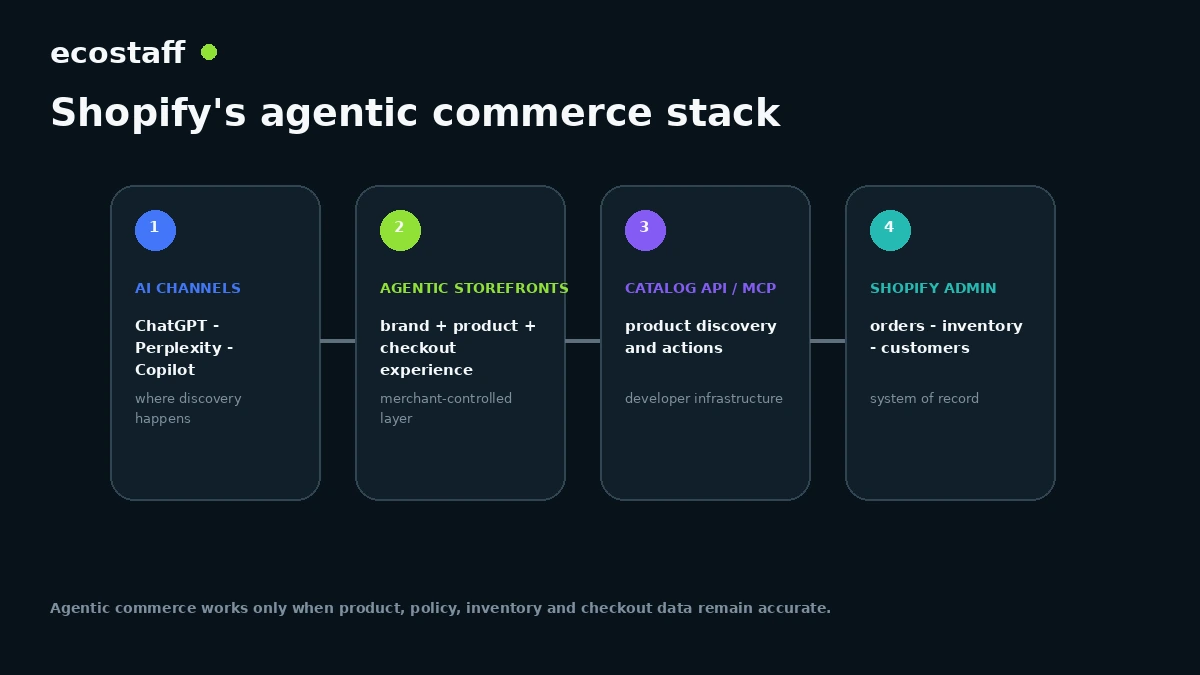
1. Agentic Storefronts move commerce into AI conversations
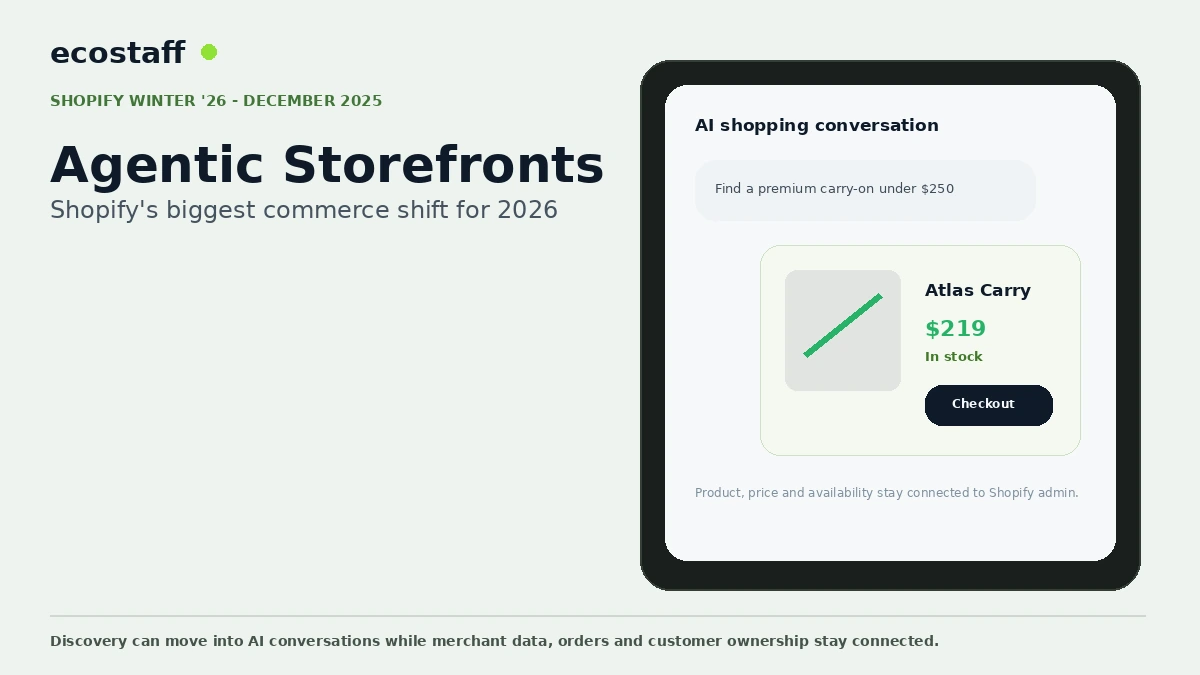
Shopify introduced Agentic Storefronts so merchants can make products discoverable on AI platforms such as ChatGPT, Perplexity and Microsoft Copilot, with additional channels planned. Shopify said merchants can choose whether customers complete purchases inside the AI experience or on the online store.
The important merchant promise is continuity: product details, pricing and availability can remain current, while orders flow into Shopify admin and the customer remains part of the merchant relationship.
2. Catalog quality becomes a distribution requirement
Agentic storefronts depend on accurate product data. A merchant with duplicate variants, stale inventory, inconsistent product titles or unclear policies may create poor experiences across every AI channel at once.
- Standardize product identifiers and variant names.
- Keep availability and price synchronized.
- Maintain strong product imagery.
- Document shipping, returns and warranty clearly.
- Resolve catalog duplicates before adding new distribution channels.
- Assign ownership for product-data quality.
3. Sidekick becomes more proactive
Shopify described Sidekick as evolving from a reactive assistant into a collaborator that can anticipate needs, surface suggestions and take action with merchant oversight. Sidekick Pulse can provide personalized recommendations based on store data and market trends.
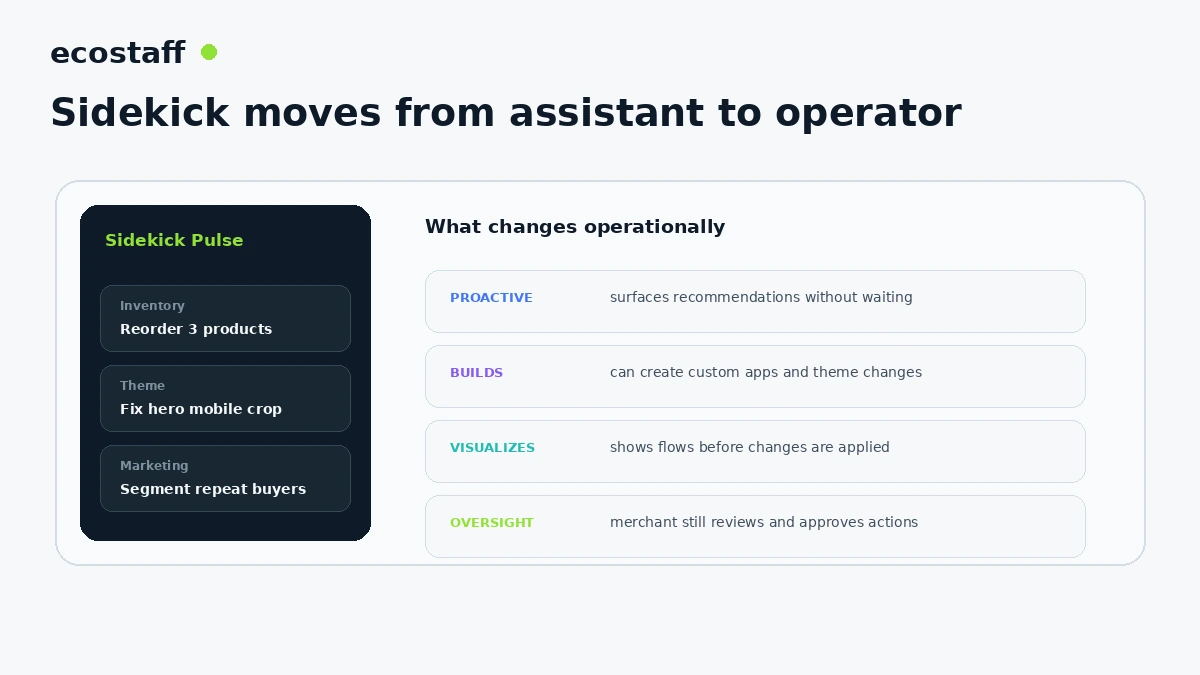
The operational opportunity is significant, but merchants should create approval boundaries. Inventory changes, theme edits and app generation have different risk levels. Low-risk suggestions can move faster than checkout, tax or pricing changes.
4. Sidekick can build custom apps
Shopify highlighted custom app generation through Sidekick. This can reduce the cost of building narrow internal tools, but generated software still needs code ownership, permissions, testing and a maintenance plan.
AI-generated code is still production code. Store the source, review permissions, test the output and document who owns the app after it launches.
5. Agentic developer tools expand
Winter ’26 expanded the developer platform for agentic commerce, including Catalog access, Checkout MCP previews for partners and Checkout Kit options. Shopify’s direction is to let external AI experiences discover products and complete commerce actions through standardized infrastructure.
For agencies and app developers, this creates a new architecture layer. For merchants, the procurement question becomes whether a proposed AI experience uses supported Shopify infrastructure or creates another fragile custom integration.
6. Product variant limits increased
Winter ’26 highlighted support for products with up to 2,048 variants. This is useful for complex catalogs, but a technically higher limit does not mean presenting hundreds of options on one product page is good UX.
Before consolidating products, review search, feed behavior, merchandising, product-page interaction, inventory sync and whether customers can still understand the option structure.
7. Unlisted product status creates more catalog control
Shopify added an unlisted product status that can hide products from search results and collections while keeping them reachable through a direct URL. This can support private launches, service links or special access scenarios.
Use it intentionally. An unlisted URL can still be shared, so it should not be treated as an access-control or security mechanism.
8. Marketing and segmentation continued expanding
The Edition included customer-segmentation and messaging improvements, including product-category-based segments and more dynamic product content in merchant messaging tools. The opportunity is to reduce manual campaign building while keeping targeting logic understandable.
9. B2B and catalog pricing gained more flexibility
Winter ’26 included compare-at prices in catalogs and other B2B improvements. Merchants should review whether native pricing can replace CSV or API workarounds, while checking how the change interacts with ERP price lists and company-specific agreements.
10. Shopify Functions replaces Scripts in June 2026
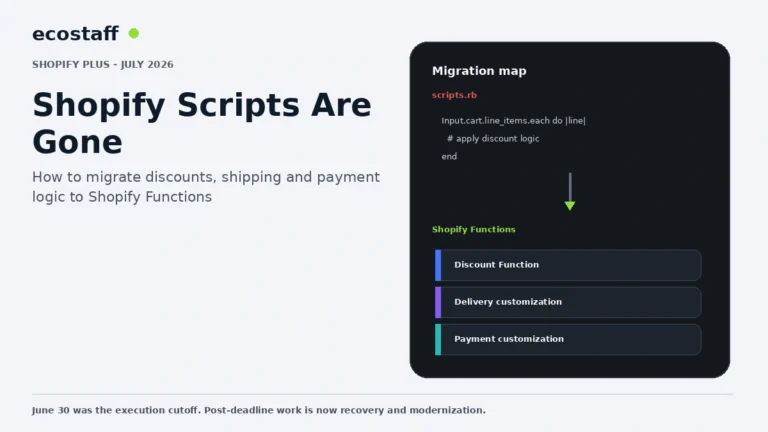
Shopify stated that Functions will replace Scripts in June 2026. For Plus merchants still relying on Shopify Scripts, Winter ’26 turned migration into a near-term planning task.
Inventory every Script, identify the business rule it implements and map it to Functions, native discount logic or another supported solution. Test discount stacking, shipping, payment customization and analytics before the deadline.
11. Rollout controls become more valuable in an AI-heavy platform
As more changes can be generated and applied quickly, controlled releases become more important. Shopify highlighted tooling such as Rollouts and SimGym in the Winter ’26 direction. The principle is broader than any one feature: faster change creation should be matched by stronger testing and rollout discipline.
12. Agentic commerce changes agency evaluation
Shopify agencies now need to understand more than Liquid and themes. Product data, Catalog APIs, MCP, checkout, AI interfaces, Functions, permissions and measurement can all become part of a modern Shopify architecture.
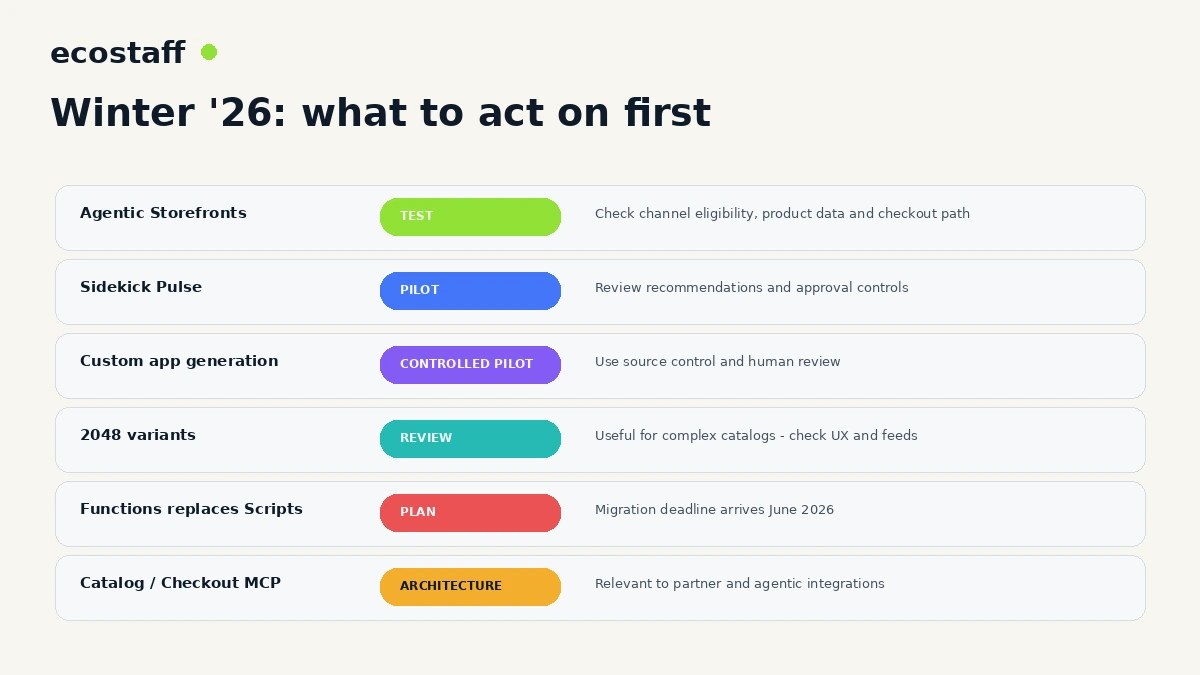
| Area | Recommended action | Why |
|---|---|---|
| Agentic Storefronts | Test | Validate product representation, channel eligibility and checkout path. |
| Sidekick Pulse | Pilot | Measure usefulness of proactive recommendations. |
| Custom app generation | Controlled pilot | Generated apps need source control, security and ownership. |
| 2,048 variants | Review | Useful for complex products but can create UX and feed complexity. |
| Functions migration | Plan now | Scripts replacement deadline is June 2026. |
| Catalog / Checkout MCP | Architecture review | Relevant to AI and partner integrations. |
A practical Winter ’26 roadmap
- Audit product-data quality and variant structure.
- Review current AI and marketplace distribution channels.
- Check Agentic Storefront eligibility and business fit.
- Pilot Sidekick on low-risk operational tasks.
- Create approval rules for AI-generated changes.
- Inventory Shopify Scripts and begin Functions migration.
- Review custom apps for AI-generated or agentic opportunities.
- Map Catalog, checkout and customer-data integration boundaries.
- Test analytics attribution for new AI channels.
- Measure conversion and customer ownership across in-chat and on-site purchase paths.
- Review security scopes for new developer tools.
- Document what will be adopted in Q1 and Q2 2026.
How to choose a Shopify partner for agentic commerce
Ask the agency to explain the whole data and transaction path. Which product system is authoritative? How does inventory stay current? Where does checkout occur? Which customer data is shared? How are permissions scoped? How will new AI-channel orders be measured?
Ecostaff lists Shopify-focused companies. For the previous platform release, see Shopify Summer ’25, which introduced much of the AI commerce foundation expanded in Winter ’26.
Create a product-data contract for agentic channels
Agentic Storefronts increase the cost of inconsistent product information because the same underlying data may be reused across several AI experiences. Merchants should define a small product-data contract that every channel can rely on: canonical product ID, title, variant structure, price, availability, images, shipping constraints, returns, warranty and market eligibility.
When one of those fields changes, the business should know which system updates it and how downstream channels receive the change. This is the same discipline used for marketplaces and product feeds, but agentic commerce makes the need more visible.
| Data field | Owner | Failure if inconsistent |
|---|---|---|
| Product / variant ID | PIM or Shopify admin owner | Duplicate or wrong product surfaced. |
| Price | Commerce / ERP | AI channel shows stale or invalid price. |
| Availability | Inventory system | Buyer is offered an unavailable item. |
| Images | Merchandising | Wrong variant or poor visual representation. |
| Returns / warranty | Operations / legal | AI gives misleading purchase guidance. |
| Market eligibility | International team | Product appears where it cannot be sold. |
Define approval tiers for Sidekick and generated apps
AI productivity improves when the team does not review every action with the same level of friction. Create tiers. Low-risk actions such as draft analysis or internal reporting can move quickly. Medium-risk theme or merchandising changes require preview and QA. High-risk changes involving checkout, pricing, tax, customer data or payments should require explicit human approval and a rollback path.
- Low risk: research, summaries, draft reports and internal recommendations.
- Medium risk: theme sections, content edits, merchandising rules and non-critical apps.
- High risk: checkout, discounts, tax, payments, customer data and inventory writes.
Frequently asked questions
Does Agentic Storefronts replace the Shopify online store?
No. Shopify positioned it as an additional selling surface. Merchants can choose whether a shopper checks out in the AI experience or on the online store.
Which AI platforms did Shopify name in December 2025?
Shopify’s announcement named ChatGPT, Perplexity and Microsoft Copilot, with additional channels described as coming later.
Can Sidekick make store changes automatically?
Shopify described Sidekick as able to take more initiative and execute tasks with merchant oversight. Businesses should still define approval boundaries for high-risk changes.
When do Shopify Functions replace Scripts?
Shopify’s Winter ’26 Edition says Functions replace Scripts in June 2026. Merchants with Scripts should treat migration as a planned 2026 project.
Sources and further reading
- Shopify – Winter ’26 Edition
- Shopify – Winter ’26 merchant overview
- Shopify – Winter ’26 developer overview
- Shopify – Introducing Agentic Storefronts
- Shopify – Winter ’26 product direction
Conclusion
Shopify Winter ’26 marked a shift from AI as a merchant assistant toward AI as a commerce distribution layer. Agentic Storefronts, Catalog infrastructure, MCP and a more capable Sidekick all move the platform in the same direction.
For merchants, the durable work is data quality, permission design, checkout reliability and controlled change management. Agentic commerce expands where buying can happen, but the quality of the underlying commerce system still determines whether the experience works.