

Quick answer: which technical SEO mistakes still hurt eCommerce stores?
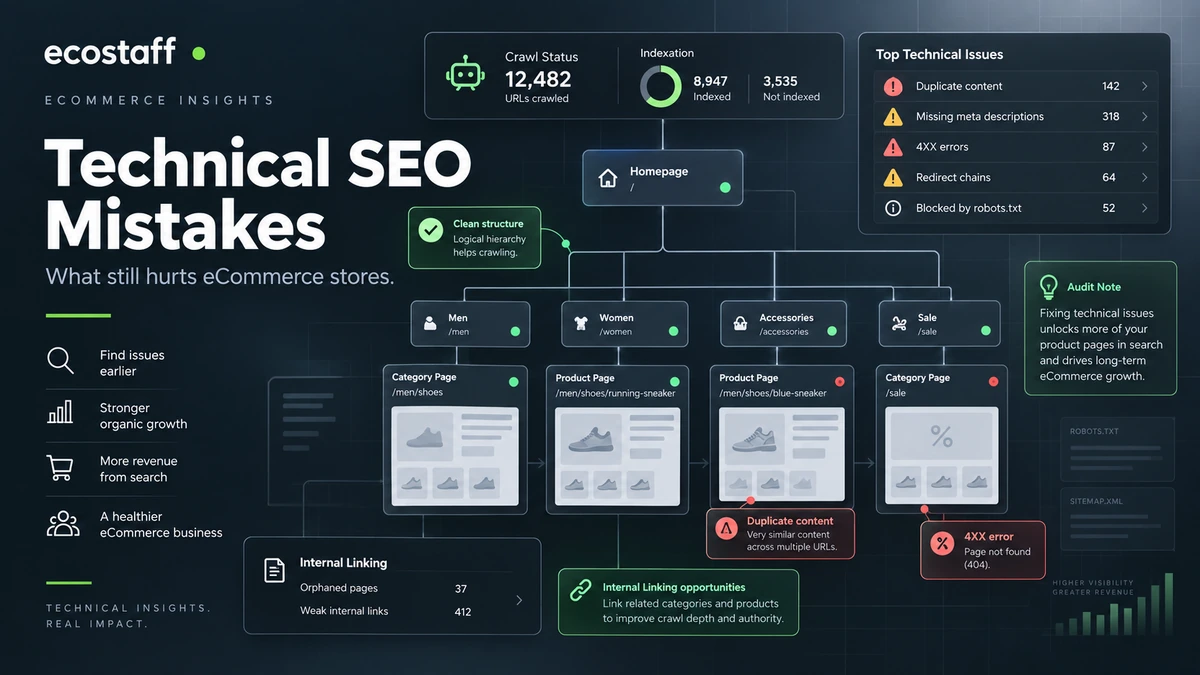
The most damaging technical SEO problems are usually structural: duplicate URL systems, uncontrolled faceted navigation, inconsistent canonicals, orphaned products, broken pagination, JavaScript-only discovery, soft 404s, stale sitemaps and indexation rules that do not match the site’s real priorities.
eCommerce sites create many valid URL variants for filters, sorting, products, variants and tracking. The goal is not to eliminate every duplicate-looking URL. The goal is to make crawling and canonicalization intentional so Google can discover important products without wasting resources on endless low-value combinations.
Technical SEO on a store is a systems problem. A single product may appear through category paths, filters, search, variants, tracking parameters and campaign URLs. A small template mistake can therefore multiply across thousands of URLs.
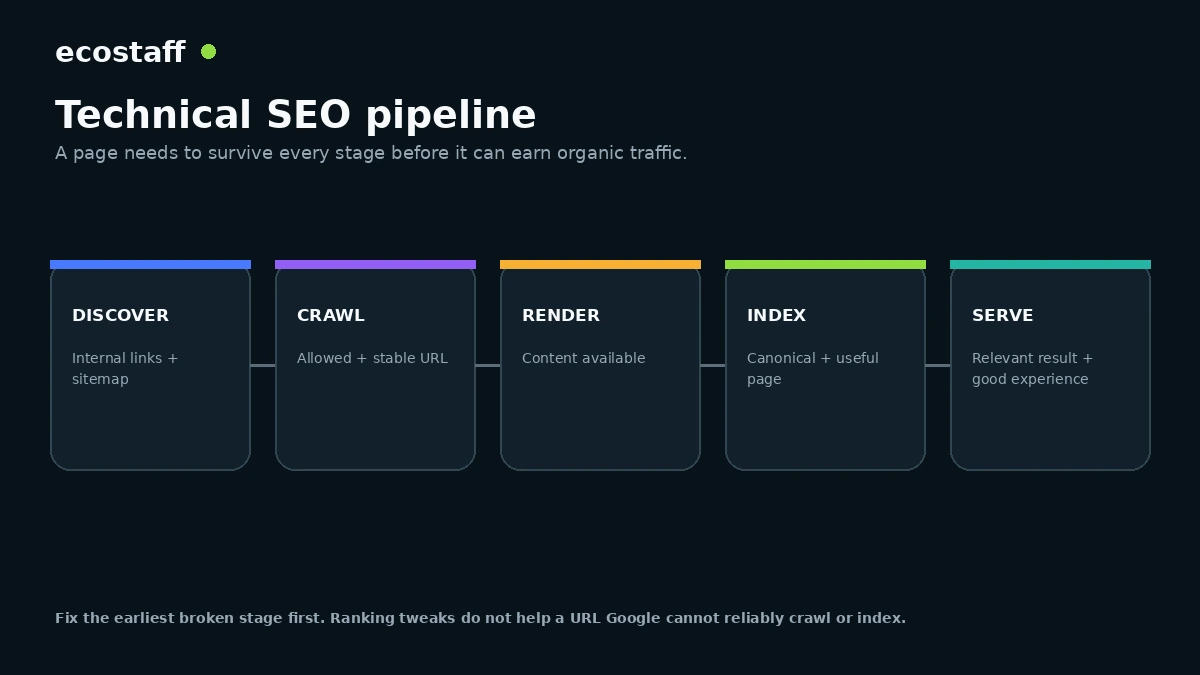
The most useful audit starts with a simple pipeline: can Google discover the URL, crawl it, render the useful content, select the intended canonical and serve it as a relevant result? Fix the earliest broken stage before optimizing titles or content length.
15 technical SEO mistakes to audit
1. Faceted navigation creates uncontrolled crawl spaces
Filters are useful for shoppers but can create a near-infinite number of URL combinations. Google published detailed faceted-navigation guidance in December 2024, recommending that sites either block faceted URLs they do not need indexed or make crawlable filter systems technically consistent when those URLs are valuable.
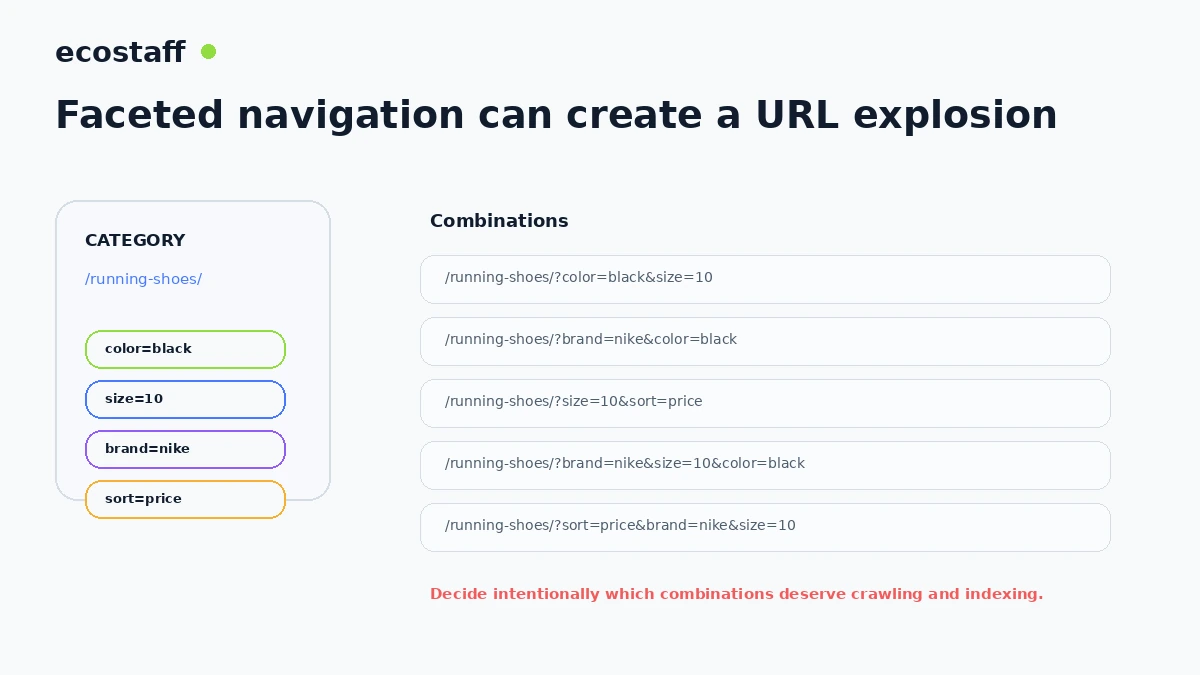
Do not let every combination of color, size, brand, price and sort order become an indexable landing page. Create a rule set: which facets have stable demand and distinct inventory, which should be crawlable but noindexed, and which should be blocked from crawling altogether.
2. Canonical signals disagree
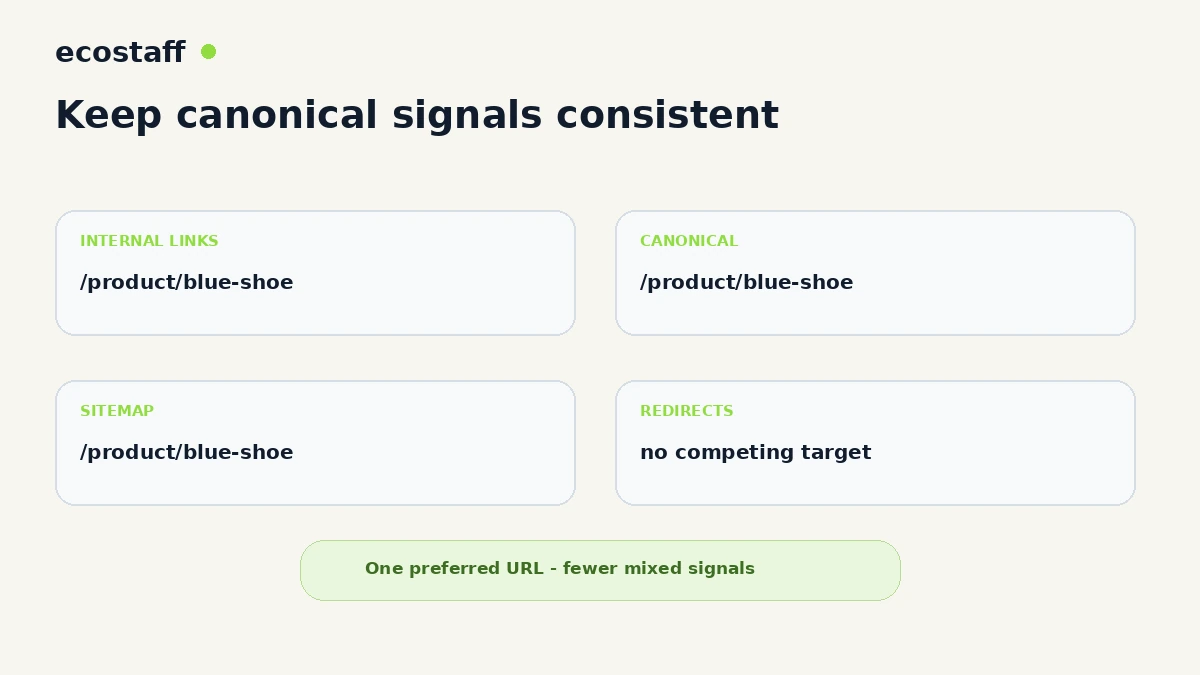
A common store problem is telling Google four different things: internal links point to one URL, the canonical points to another, the sitemap lists a third and redirects send to a fourth. Canonicalization works best when important signals agree.
3. Pagination is hidden behind buttons or JavaScript
Load More and infinite scroll can be good user experiences, but crawlers do not interact with interfaces like humans. Google recommends crawlable links and unique URLs for paginated pages so products deeper in a category can still be discovered.
If a product can only be reached by clicking a JavaScript button that creates no crawlable URL, discovery may depend entirely on the sitemap or Merchant Center. Important catalog pages should have robust link paths.
4. Internal search and category navigation do not expose important products
Google generally does not submit searches into a site’s search box to find products. Category navigation and internal links therefore matter. If important products are only discoverable through search, filters or personalized modules, add crawlable category or editorial links and include valid product URLs in sitemaps.
5. Empty categories and discontinued products return misleading 200 pages
Empty categories, removed products and invalid filter combinations should have deliberate behavior. An empty page that returns HTTP 200 with generic template content can become a soft 404. For permanently removed products without a useful replacement, a 404 or 410 can be appropriate. If there is a clear equivalent, redirect deliberately rather than sending everything to the homepage.
6. Sitemaps contain URLs the site does not want indexed
A sitemap is a list of preferred URLs for discovery and canonicalization signals. Do not fill it with redirected, noindexed, duplicate or parameterized URLs. Generate sitemaps from the same canonical source of truth used by the application.
7. Product variants are inconsistent
Variants create legitimate complexity. Some stores use one canonical product page for all colors and sizes; others expose variant URLs. Whatever model you choose, internal links, canonicals, structured data and Merchant Center data should describe the relationship consistently.
8. Sorting and tracking parameters leak into internal links
Temporary parameters such as session IDs, campaign tags and user-relative settings create duplicate crawl paths when they appear in internal links. Keep navigation links clean and persistent. Tracking belongs at acquisition boundaries, not in the permanent site architecture.
9. JavaScript hides critical content or navigation
Google can render JavaScript, but technical SEO should not depend on complex client-side behavior when simple crawlable HTML links and server-rendered content are available. Ensure important product names, prices, availability and links exist in indexable content.
10. Structured data disagrees with visible commerce facts
Product markup is useful only when it matches the visible product page. Price, availability, review values and variants should be kept in sync. Invalid or misleading markup can make debugging difficult and can remove eligibility for rich results.
11. Canonicalizing paginated pages to page one
Google’s ecommerce pagination guidance says paginated pages should have unique URLs and generally self-canonicalize rather than all pointing to page one. A blanket canonical to the first page can reduce the ability to discover products deeper in a category.
12. Mobile templates have different crawl paths or missing content
Google uses mobile-first crawling. If mobile navigation hides categories, product links or content that exists only on desktop, the mobile version can become the limiting version for discovery and indexing.
13. Orphaned high-value pages
A page can be in the sitemap and still be weakly connected to the site. Internal links communicate importance and help users navigate. Link strategic products, categories and guides from relevant hubs rather than relying only on XML discovery.
14. Migration redirects are treated as cleanup after launch
Redirect mapping belongs before a replatform or URL change. Preserve valuable paths, update internal links to final destinations and avoid chains. A migration is much easier to validate when old-to-new mapping is explicit.
15. Crawl controls are used as substitutes for architecture
robots.txt, noindex and canonicals solve different problems. robots.txt controls crawling, noindex controls indexability when the page can be crawled, and canonical signals express a preferred duplicate. Using one as a substitute for another often creates unexpected results.
| Problem | Primary control | Typical mistake |
|---|---|---|
| Duplicate equivalent URLs | Canonical + consistent internal links | Blocking the duplicate in robots.txt before Google can see its canonical |
| Low-value filter combinations | Robots or noindex depending crawl strategy | Allowing millions of combinations to be crawled by default |
| Removed page | 404/410 or relevant redirect | Redirecting every missing product to the homepage |
| Paginated category | Unique crawlable URLs + self canonicals | Canonicalizing every page to page 1 |
| Important orphan page | Internal links + sitemap | Assuming the sitemap alone proves importance |
A practical technical SEO audit order
- Confirm HTTP status and indexability for key templates.
- Review robots.txt, noindex and canonical rules.
- Sample faceted, sorting, tracking and pagination URLs.
- Compare internal links, canonical URLs and sitemap URLs.
- Check category-to-product crawl paths.
- Audit orphaned products and important landing pages.
- Validate mobile navigation and content parity.
- Review Product structured data against visible facts.
- Check redirects, chains and discontinued-product rules.
- Use Search Console indexation and crawl reports to validate the system after changes.
How technical SEO supports AI-era search
AI search features still depend on pages being discoverable and indexable. Technical SEO does not become less important when interfaces become more generative. It becomes the prerequisite that lets strong product data, images and editorial content enter the search ecosystem.
For the content side of the equation, see Google August 2024 Core Update and eCommerce SEO in 2025 after AI Overviews.
When should a store involve a specialist?
Large catalogs with multiple filters, markets, migrations or custom storefronts benefit from technical SEO specialists who can work with developers. Ask for URL rules, crawl samples, implementation specifications and validation plans rather than a spreadsheet of warnings with no architecture context.
Ecostaff lets teams compare eCommerce service providers and evaluate partners using the agency selection framework.
Frequently asked questions
Should every faceted URL be blocked?
No. Some filter combinations can be useful landing pages when they have stable demand, distinct inventory and sufficient value. The point is to make the choice intentionally.
Is duplicate content a spam penalty?
Normal duplicate URLs are common on eCommerce sites. Canonicalization helps Google choose a representative version. The bigger problem is uncontrolled crawl space and inconsistent signals.
Do XML sitemaps replace internal links?
No. Sitemaps help discovery, but internal links also communicate site structure and relative importance and help users navigate.
Sources and further reading
- Google Search Central – Faceted navigation best practices
- Google Search Central – Ecommerce URL structure
- Google Search Central – Ecommerce site structure and navigation
- Google Search Central – Pagination and incremental loading
- Google Search Central – Canonicalization
Conclusion
Technical SEO mistakes hurt eCommerce stores because they scale. A single bad rule can create thousands of duplicate URLs, hide important products or send mixed canonical signals across the catalog.
Build clear URL rules, keep signals consistent and validate the crawl path from category to product. Once discovery and indexation are reliable, content and merchandising improvements have a much better chance to create organic growth.