

Quick answer: what did Google’s March 2024 core update change?
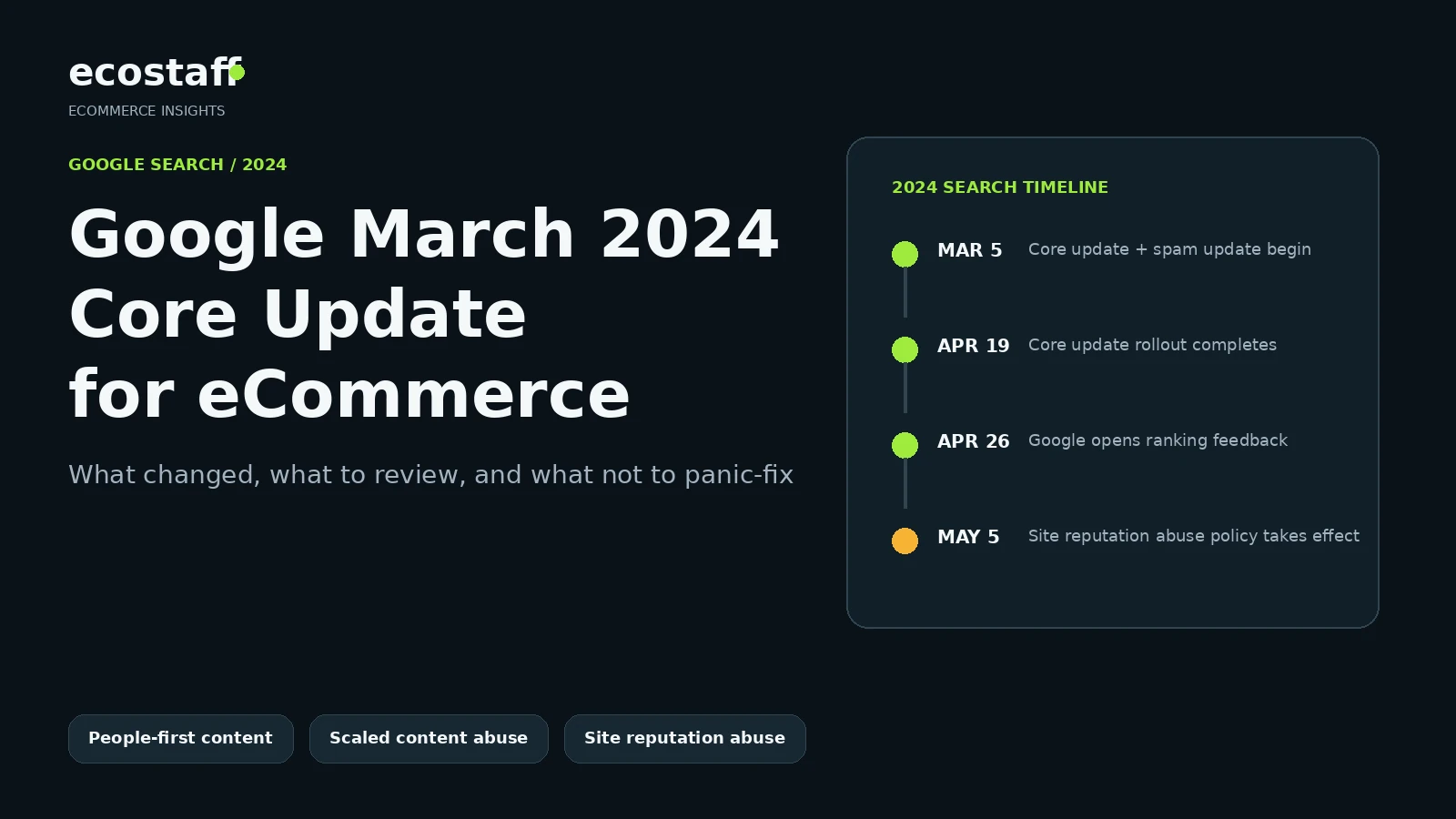
Google’s March 2024 core update was a broader and more complex ranking update than a typical core update. It began on March 5, 2024, ran for 45 days and completed on April 19. Google said the update changed multiple core systems and evolved how Search identifies helpful content, while a separate March spam update and new spam policies targeted expired domain abuse, scaled content abuse and site reputation abuse.
For eCommerce teams, the practical response is not to rewrite every product or category page. Start by identifying where visibility changed, separate category, product, editorial and programmatic page types, and then assess whether affected pages provide original value, clear intent match, reliable information and a strong user experience. Technical SEO still matters, but a core update is not a single technical bug with a universal fix.
Google Search updates can create a difficult situation for eCommerce teams. Revenue depends on many page types at once: category pages capture broad commercial demand, product pages compete for specific purchase intent, buying guides support discovery, and filters or location pages may generate hundreds or thousands of additional URLs.
When rankings move during a major update, it is tempting to change titles, add more copy, remove content or commission a complete redesign immediately. That can make diagnosis harder. The better approach is to understand what Google actually announced, isolate the affected parts of the site and improve the underlying quality issues that are visible across multiple pages.
What happened in the March 2024 Google updates?
Google announced the March 2024 core update and new spam policies on March 5, 2024. Google described the core update as more complex than its usual core updates because it involved changes to multiple core systems. The company also said this marked an evolution in how its ranking systems identify helpful content.
The Google Search Status Dashboard records the March 2024 core update as a 45-day rollout beginning March 5, which places completion on April 19. The separate March 2024 spam update lasted just under 15 days.
| Change | Start | What Google said | Practical implication |
|---|---|---|---|
| March 2024 core update | March 5 | Changes to multiple core ranking systems and helpfulness assessment | Expect broader ranking movement and diagnose by page type and query set |
| March 2024 spam update | March 5 | Spam-fighting systems updated alongside new policies | Review scaled, low-value and manipulative publishing patterns |
| Site reputation abuse policy | Effective May 5 | Targets third-party content published with little first-party oversight to exploit host ranking signals | Audit partner, coupon, white-label and sponsored sections for real editorial involvement |
Why this update matters specifically for eCommerce
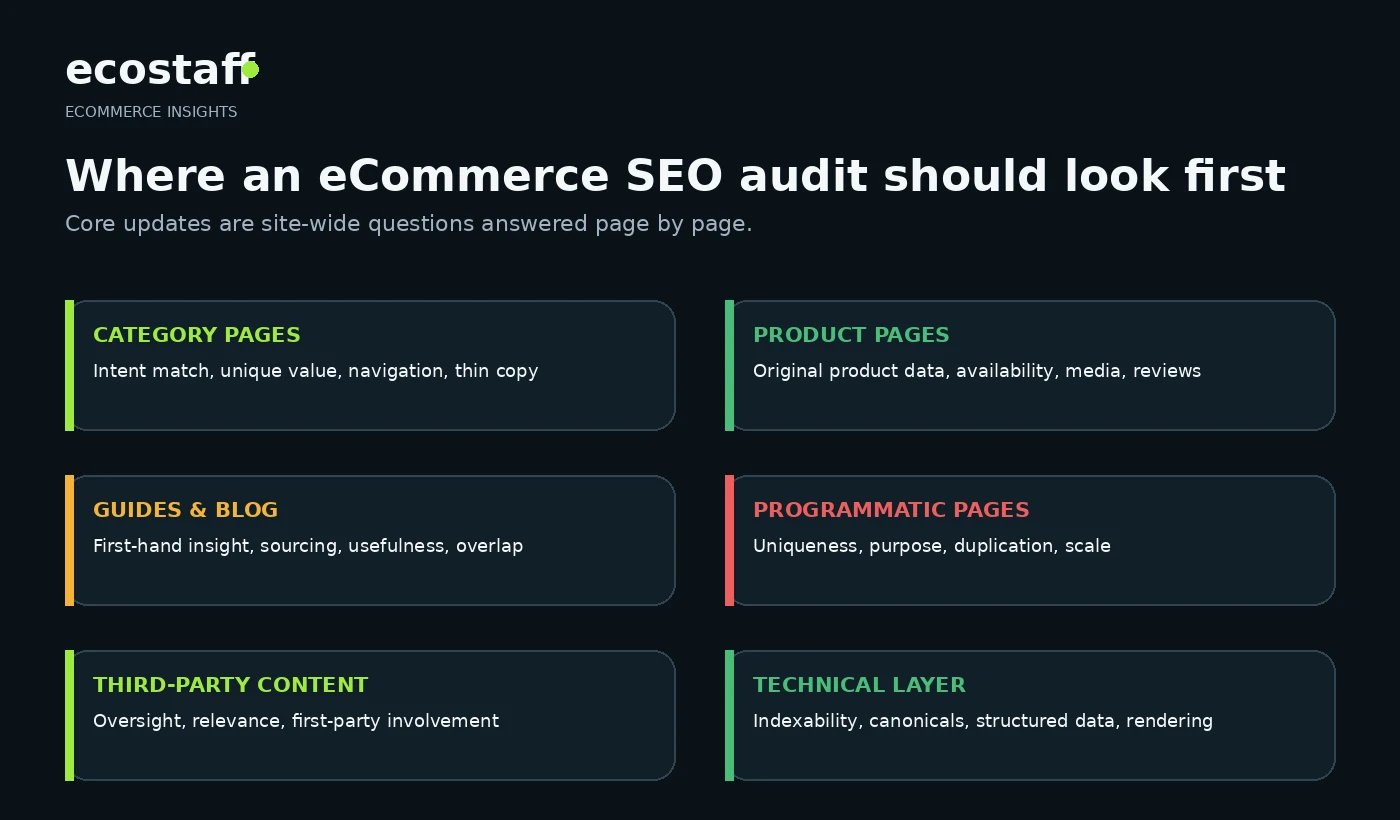
eCommerce sites are unusually exposed to quality and duplication problems because they combine large catalogs, repeated templates, faceted navigation, manufacturer data, user-generated content, third-party apps and editorial content on one domain. A strong store may contain tens of thousands of URLs even when the merchandising team actively manages only a fraction of them.
Category pages can become thin variations of the same template
A category page is valuable when it helps a shopper make a choice. Useful category content can include a clear product set, meaningful filters, relevant subcategories, concise buying guidance, comparison context and merchandising that matches the query. Adding 800 words of generic SEO copy below every grid does not automatically make the page more useful.
During an audit, compare categories that gained and lost visibility. Look for differences in product availability, intent fit, internal links, indexability, uniqueness and whether the page genuinely answers a shopping need.
Product pages often depend on duplicated supplier data
Many stores use manufacturer descriptions, shared specifications and the same product imagery as dozens of competitors. That information may be necessary, but it does not create much differentiation by itself. Strong product pages can add original photography, fit or compatibility guidance, real availability, delivery details, returns information, FAQs, comparison context and verified customer feedback.
The goal is not to make every product description long. The goal is to provide the information a buyer needs that is not already obvious from the product title and supplier feed.
Programmatic SEO can cross the line from scale to low value
Large eCommerce sites often create landing pages from combinations of brand, category, use case, location, attribute or compatibility. Programmatic publishing is not inherently a problem. The risk appears when many pages exist mainly to capture keyword variants and provide little unique value to the visitor.
Google’s March announcement made the principle explicit: scaled content abuse can involve automation, human production or a combination of both. The issue is the purpose and value of the output, not simply whether AI or a script was used.
The three new spam policies eCommerce teams should understand
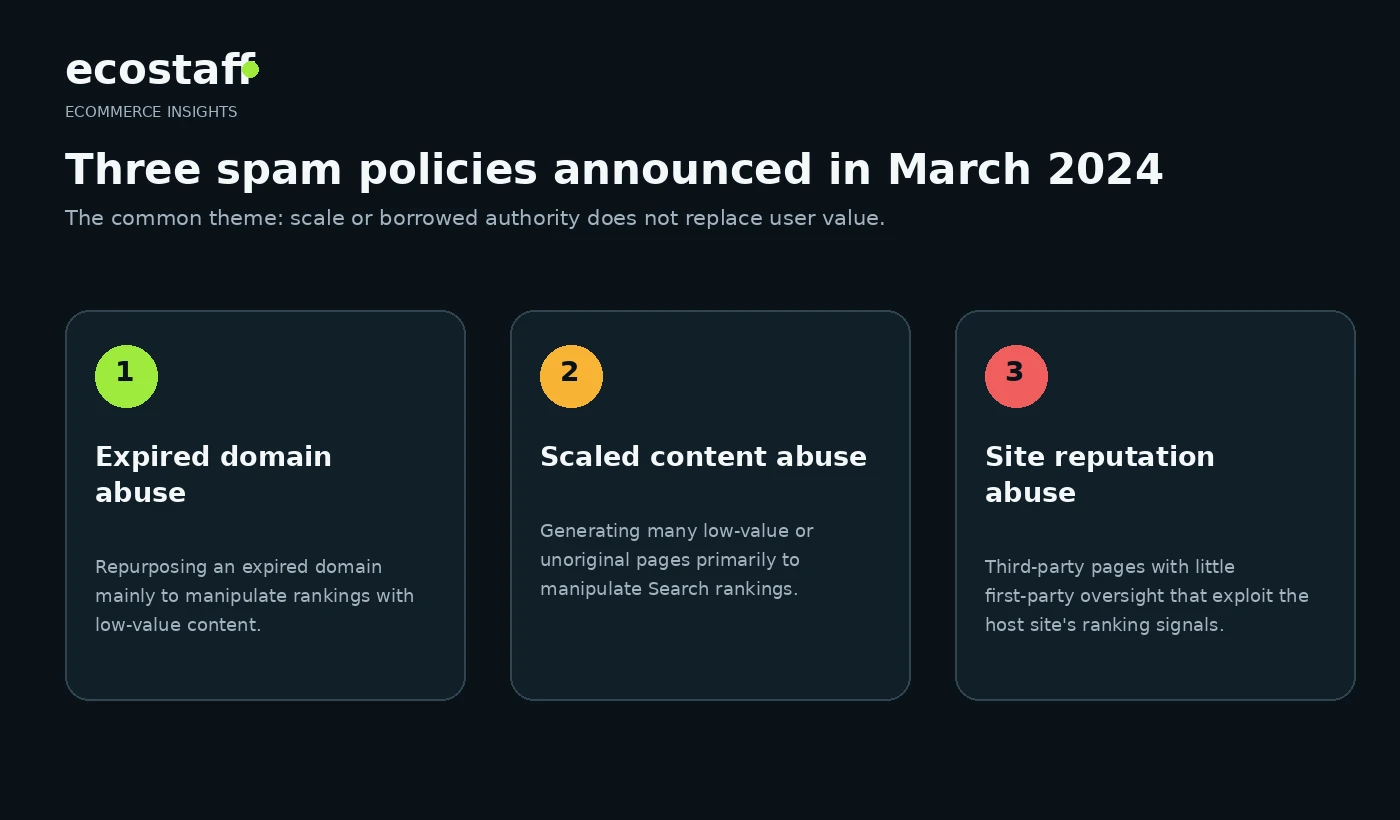
1. Expired domain abuse
Google defined expired domain abuse as purchasing and repurposing an expired domain primarily to manipulate Search rankings with content that provides little or no user value. Buying an old domain is not automatically a violation. The issue is using its previous reputation as a shortcut for low-value ranking content.
2. Scaled content abuse
Scaled content abuse is especially relevant to eCommerce, marketplaces and directory businesses. Google described it as generating many pages primarily to manipulate Search rankings rather than help users, regardless of whether the pages are produced by AI, scripts, outsourced writers or internal teams.
That means a 50,000-page catalog is not automatically problematic, and a 50-page blog is not automatically safe. The meaningful questions are whether each indexed page serves a clear audience need, contains enough distinct value to justify its existence and is maintained with real editorial or operational oversight.
3. Site reputation abuse
Site reputation abuse targets third-party pages published with little or no first-party oversight where the main purpose is to benefit from the host site’s ranking signals. Google gave site owners until May 5, 2024 to prepare for the policy to take effect.
For an eCommerce business, the review should include white-label coupon sections, partner content, marketplace microsites, sponsored editorial hubs and any large third-party content area that exists mainly because the main domain has authority. Third-party content itself is not prohibited. What matters is meaningful first-party involvement, relevance and user value.
How to tell whether a traffic drop is actually related to the update
A ranking drop during a core update does not prove causation. eCommerce traffic can also move because of seasonality, promotions, stock availability, technical releases, competitor changes, SERP features or demand shifts.
Wait until the rollout is complete
Because the March 2024 rollout lasted 45 days, daily comparisons during the rollout can be misleading. Capture the dates, avoid large reactive changes unless there is a clear technical problem, and compare stable periods before and after the update.
Segment Search Console data before drawing conclusions
Do not begin with total organic traffic. Segment performance by page type, query intent, device and search appearance. A store can lose generic informational queries while commercial category pages stay stable, or lose a specific product family while the rest of the catalog grows.
- Compare category pages separately from product pages.
- Separate branded and non-branded queries.
- Check mobile and desktop independently.
- Review countries or markets separately for international stores.
- Check whether affected products went out of stock or changed price.
- Separate Search traffic from Discover, Images and other surfaces when relevant.
Look for patterns, not isolated keyword movements
One ranking change is noise. Twenty category pages losing similar queries is a pattern. If the same template, content type or business process appears across the losing group, you have a stronger hypothesis to test.
A practical eCommerce quality audit after a core update
| Audit area | Questions to ask | Common eCommerce weakness |
|---|---|---|
| Search intent | Does the page solve the query better than a generic listing? | Landing page exists only because a keyword exists |
| Original value | What does this page add beyond supplier feeds or competitors? | Copied descriptions and commodity imagery |
| Trust | Can users verify business, policies, authorship and claims? | Missing ownership, sourcing or review context |
| Page experience | Can shoppers use search, filters, variants and checkout smoothly? | Slow or intrusive interaction layer |
| Internal architecture | Can important pages be reached and understood through internal links? | Orphan pages and crawl-heavy faceted URLs |
| Indexation | Should every generated URL really be indexed? | Near-duplicate filter, sort and search pages |
| Freshness | Is the information still accurate and maintained? | Expired offers, dead products and outdated guides |
| Third-party content | Is the business actively involved in production and quality control? | White-label sections built mainly for SEO reach |
What not to do after a core update
Do not rewrite every page at once
If you change titles, copy, templates, internal links and navigation across the whole site simultaneously, you remove your ability to learn which change helped or hurt. Prioritize a meaningful segment, document the hypothesis and measure the result.
Do not add text merely to make pages longer
Google does not publish a preferred word count for ranking. For eCommerce, concise decision support can be more valuable than a long generic introduction. Add information because shoppers need it, not because a template says every category needs 1,000 words.
Do not delete useful pages because traffic dropped
A page can lose ranking even if it still serves customers, supports navigation or converts paid and direct traffic. Evaluate business value alongside organic performance before consolidating or removing URLs.
Do not treat AI as the problem by itself
Google’s March policy focused on scaled low-value content, not on banning generative AI. Automation can assist research, formatting or production, but the final page still needs a useful purpose, factual quality, originality and real oversight. Mass production without added value is the risk.
The useful question after a core update is not “What SEO trick stopped working?” It is “Which repeatable parts of our site are less useful, less original or less trustworthy than the alternatives a shopper can choose?”
How technical SEO fits into the March 2024 review
Core updates are not technical penalties, but technical quality still affects whether Google can crawl, understand and present an eCommerce site. A content review should therefore run alongside a focused technical check.
- Confirm important categories and products are indexable and canonicalized correctly.
- Check faceted navigation, internal search and sorting URLs for crawl/index bloat.
- Verify internal linking to priority categories and products.
- Audit redirects and discontinued-product handling.
- Validate Product, Offer, Breadcrumb and organization structured data where applicable.
- Check mobile rendering and JavaScript-dependent content.
- Review Core Web Vitals and interaction responsiveness, especially on templates that lost traffic.
For storefront responsiveness specifically, see Ecostaff’s Interaction to Next Paint guide for eCommerce. INP became a Core Web Vital during the same period in March 2024, but it should be treated as one part of the wider page experience rather than a universal explanation for ranking changes. Platform context also matters: teams reviewing a Shopify storefront can compare Shopify specialists, while sites with deeper speed or interaction issues can review performance optimization companies.
A five-step recovery and improvement workflow
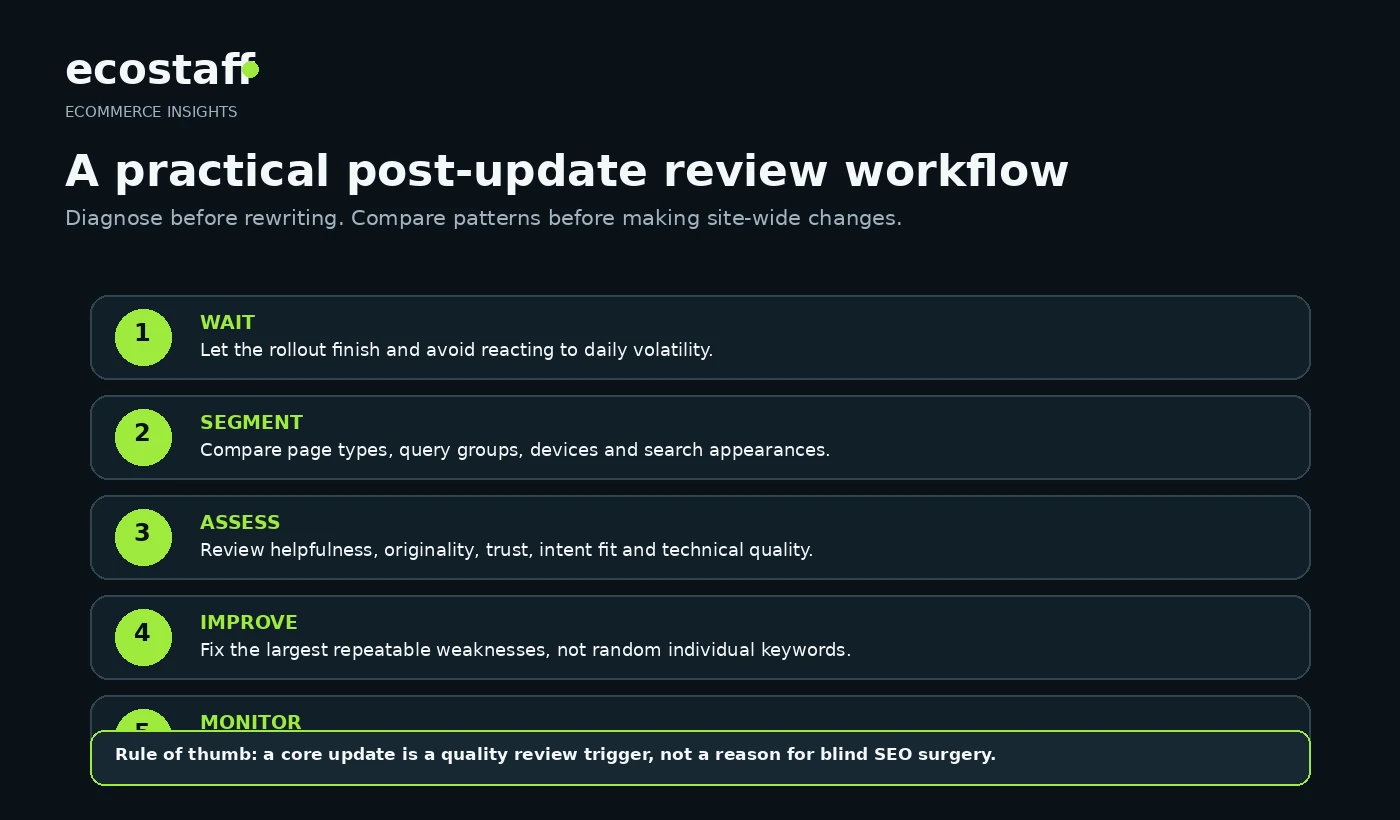
Step 1. Establish the affected segment
Document the pages, queries and markets where the change is material. Include revenue or conversion contribution so SEO priorities reflect business impact rather than traffic alone.
Step 2. Compare winners and losers
Within your own site, compare pages that improved with pages that declined. Then inspect the current search results manually. Look for differences in format, intent, depth, freshness, product selection, trust signals and unique information.
Step 3. Prioritize repeatable causes
A template-level issue affecting 300 categories should normally be prioritized before a wording issue on one article. Rank opportunities by traffic, revenue, number of affected URLs, implementation effort and confidence in the diagnosis.
Step 4. Improve a controlled set
Choose a representative group and make meaningful improvements: better merchandising, stronger original copy, clearer comparison information, improved internal links, better review context, cleaner indexation or more useful product data. Avoid cosmetic edits that do not change the shopper’s experience.
Step 5. Monitor the same segments over time
Recovery from a core update is not necessarily immediate. Keep a change log, monitor Search Console and analytics, and separate improvements that affect conversion or engagement from changes in organic visibility. A better page can create business value before rankings fully respond.
When should an eCommerce business involve an SEO agency?
An internal team can handle many post-update reviews when analytics, Search Console, engineering and content ownership are already coordinated. External support becomes more useful when the decline spans many templates, international markets, migrations or large programmatic page sets, or when internal teams cannot agree whether the cause is technical, content-related or competitive.
Before hiring an agency, ask for a diagnosis framework rather than a promise to “recover rankings.” A credible team should explain how it will segment the loss, distinguish technical issues from quality issues, prioritize changes and measure business impact. Ecostaff’s guide to choosing an eCommerce agency provides a broader evaluation framework, and the Ecostaff company directory can be used to compare providers by platform, service and other public profile data.
A practical checklist for eCommerce teams
- Record the March 5 to April 19 core update window in your SEO change log.
- Wait for stable post-rollout data before making a large diagnosis.
- Compare category, product, editorial and programmatic pages separately.
- Identify the pages and queries with the largest business impact.
- Check product availability, pricing and seasonality before assuming an algorithmic cause.
- Review originality and decision value on category and product templates.
- Audit scaled landing pages for purpose, uniqueness and indexation.
- Review third-party sections for genuine first-party oversight.
- Check canonicalization, faceted navigation, internal links and structured data.
- Review mobile usability and Core Web Vitals on affected templates.
- Prioritize repeatable improvements instead of isolated keyword edits.
- Document every material change and monitor the same segments over time.
Frequently asked questions about the March 2024 core update
Was the March 2024 update a penalty?
No. A core update changes how Google’s ranking systems assess and order results. A site can lose positions without receiving a manual action or violating a spam policy. Spam-policy violations and manual actions are separate issues.
Did Google ban AI-generated content?
No. Google’s scaled content abuse policy focuses on large amounts of low-value or unoriginal content created primarily to manipulate rankings. Google explicitly framed the policy around purpose and value rather than whether the content was created by automation, humans or both.
Should eCommerce sites remove programmatic SEO pages?
Not automatically. Keep pages that serve a distinct search or shopping need and provide enough unique value to justify indexation. Consolidate, noindex or remove low-value combinations that exist mainly to capture keyword permutations.
How long should a business wait before evaluating the update?
The March 2024 core update completed on April 19 after a 45-day rollout. A useful analysis should compare stable periods before and after the rollout rather than reacting to day-to-day movement during the update.
Sources and further reading
- Google Search Central – March 2024 core update and new spam policies, March 5, 2024.
- Google Search Status Dashboard – ranking update history.
- Google Search Central – spam policies.
- Google Search Central – creating helpful, reliable, people-first content.
- Google Search Central – core updates guidance.
Conclusion
The March 2024 core update matters to eCommerce because it reinforces a direction that affects every large catalog: useful pages need more than indexable templates and keyword coverage. Category pages should help shoppers choose, product pages should add value beyond supplier data, programmatic pages should justify their existence, and third-party content should have real first-party involvement.
The right response is a disciplined review rather than a panic rewrite. Segment the change, identify repeatable weaknesses, improve the pages that matter most and measure both search visibility and commercial outcomes. That process is slower than chasing a single ranking factor, but it produces a stronger eCommerce site regardless of the next algorithm update.