

Quick answer: what should eCommerce teams review in Shopify Winter ’25?
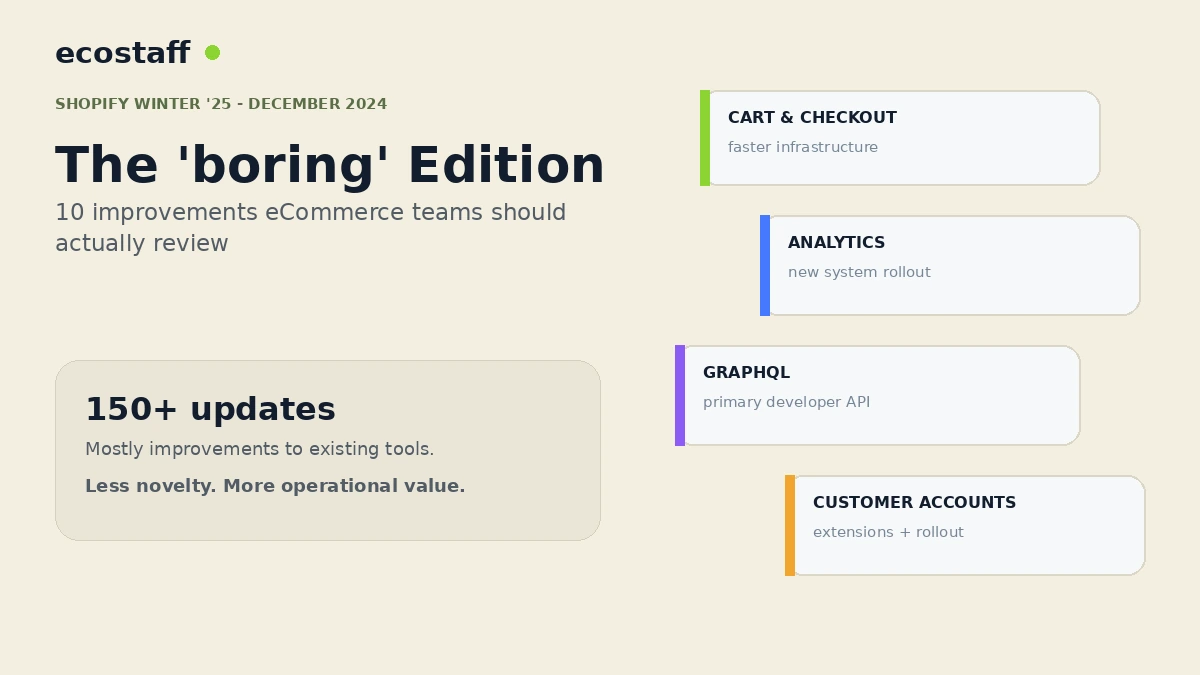
Shopify released Winter ’25 on December 11, 2024 with more than 150 updates focused largely on improving existing systems rather than launching a new platform category. Shopify highlighted faster cart and checkout infrastructure, wider Checkout Blocks availability, ongoing rollout of new analytics and Sidekick, improvements to B2B and bundles, customer-account extensions and a stronger developer shift toward GraphQL.
For most merchants, the useful response was not to activate every improvement. The right review was to identify which updates reduced an existing operational, performance or development constraint and which changes created migration work – especially REST-to-GraphQL dependencies.
Shopify called Winter ’25 the Boring Edition because the release emphasized refinement. That framing is useful for product teams: mature ecommerce platforms often create more value by removing friction from everyday workflows than by adding another headline product.
Winter ’25 is therefore a good example of how merchants should review platform releases. Separate improvements you can benefit from automatically, features worth testing and architecture changes that require a plan.
1. Cart infrastructure became faster
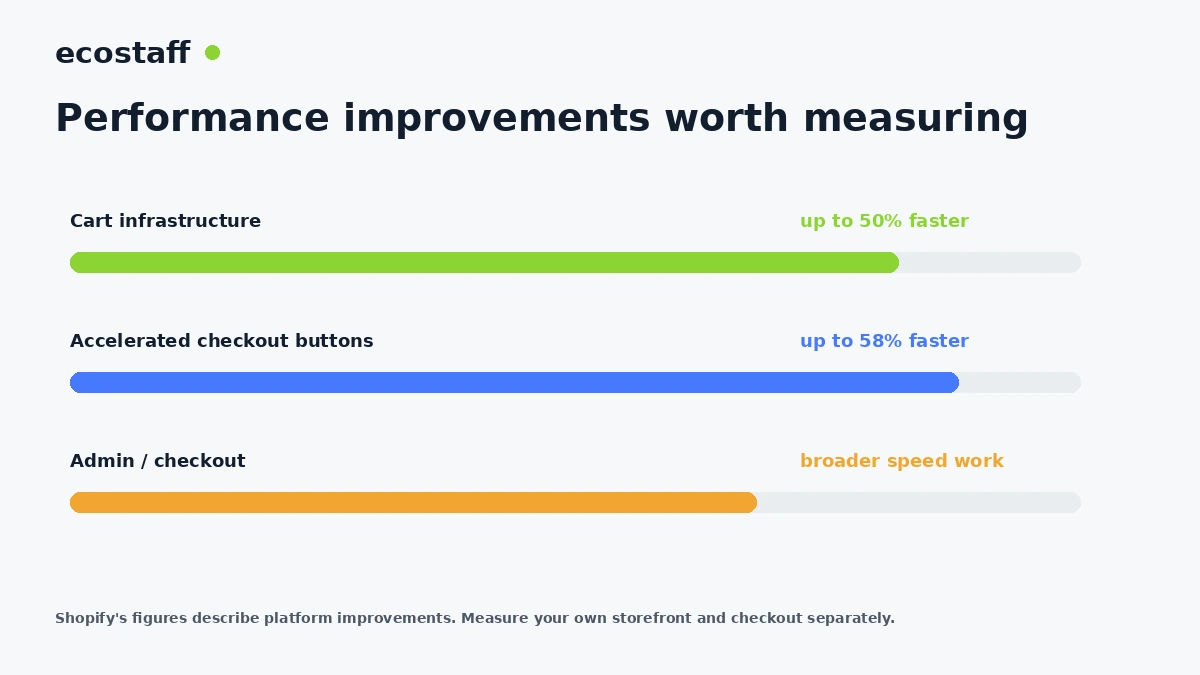
Shopify said cart infrastructure had been optimized to boost load speeds by up to 50%. That is a platform-level improvement, but merchants should still measure their own theme, cart drawer, apps and third-party scripts because custom code can dominate the actual user experience.
2. Accelerated checkout buttons improved
Shopify’s developer update said accelerated checkout buttons could load up to 58% faster and support more modern workflows such as Functions and bundles through portable wallets.
For merchants, the practical test is whether the relevant product and cart templates show the expected payment methods quickly and whether bundle, discount and app logic behaves correctly.
3. Checkout Blocks expanded
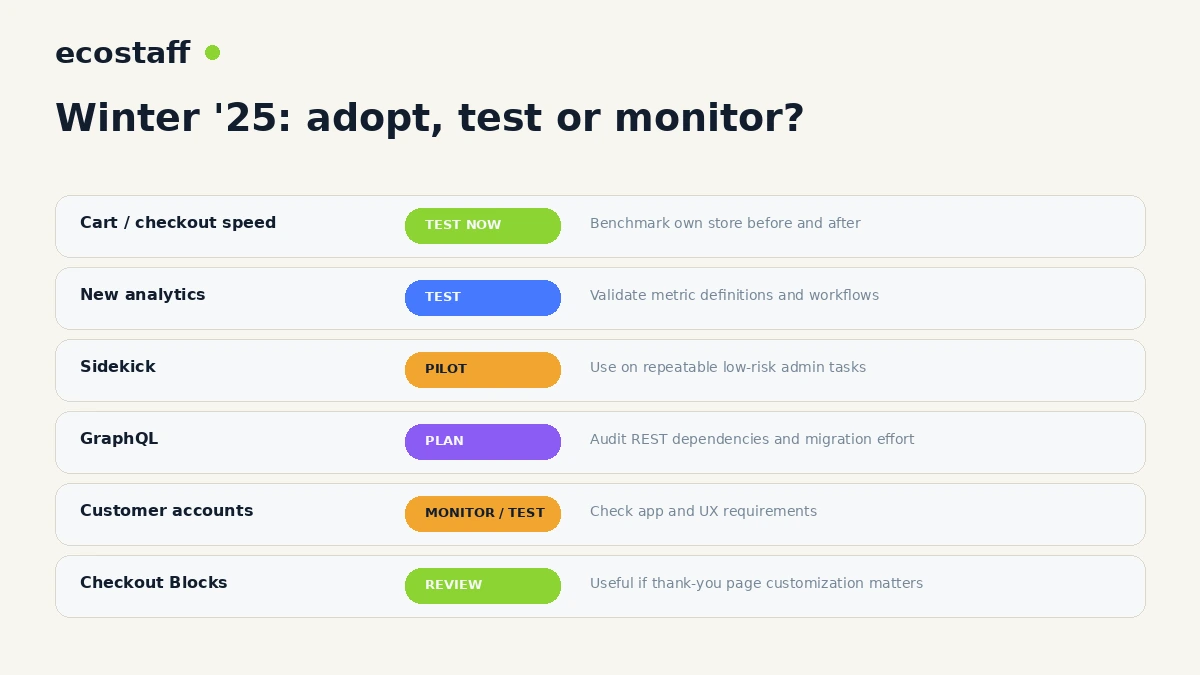
Shopify highlighted Checkout Blocks availability across plans for customizing thank-you experiences. That can reduce the need for custom development for certain post-purchase messaging and configuration tasks.
4. New analytics continued rolling out
The new analytics system announced earlier in 2024 continued to roll out. Merchants moving from old reports should check metric definitions, attribution logic and recurring finance or marketing workflows before replacing their existing reporting process.
5. Sidekick became a more practical admin assistant
Sidekick was part of Shopify’s continuing AI rollout. The useful adoption pattern is controlled: start with repetitive, low-risk tasks where an operator can review the output instead of delegating high-impact business decisions without oversight.
6. Customer accounts kept becoming extensible
Shopify continued expanding the modern customer-account system and extensions. Stores with loyalty, returns, subscriptions, B2B or account-specific workflows should review whether their current app stack supports the new account architecture.
7. B2B and bundle workflows improved
Winter ’25 included improvements that brought bundles and checkout customization into more B2B and draft-order scenarios. For wholesale merchants, this reduces gaps between online B2B workflows and the rest of Shopify’s commerce model.
8. Search & Discovery gained more control over combined listings
Shopify Search & Discovery could give merchants more control over whether parent or child products appear in search and recommendations. That is especially relevant to catalogs using combined listings or complex variant merchandising.
9. The developer direction shifted further toward GraphQL
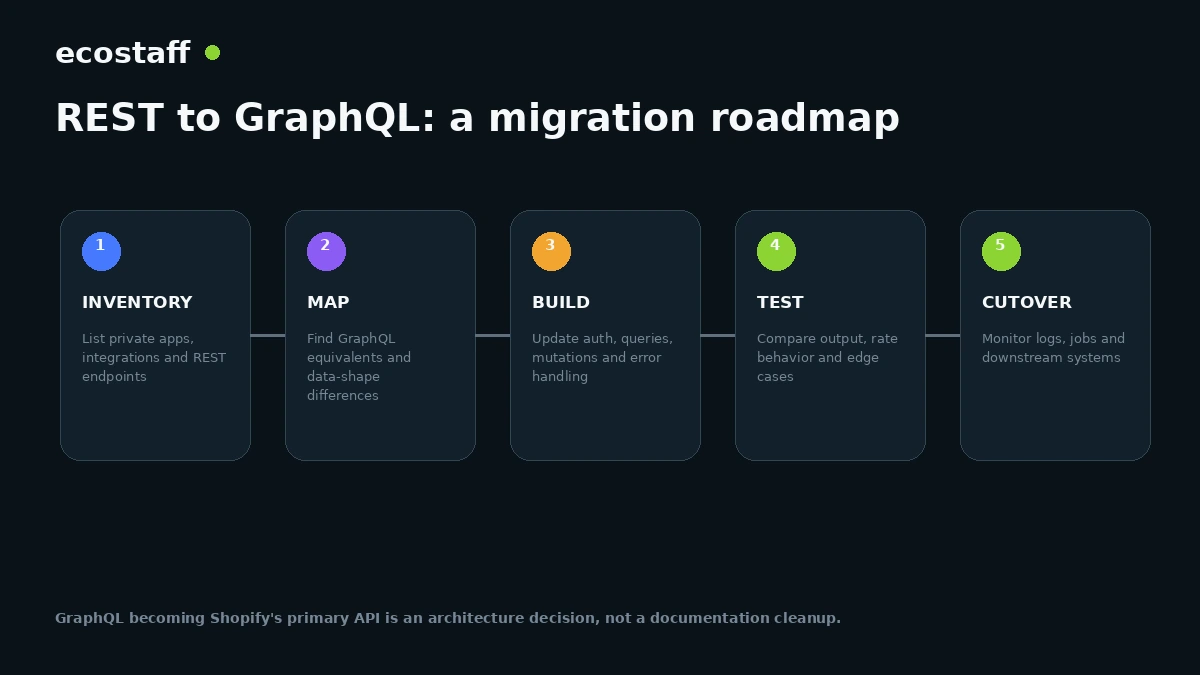
Shopify stated that GraphQL was now the primary API for interfacing with Shopify and improved documentation for moving from REST to GraphQL. This matters for merchants with private apps, middleware, ERP connectors or long-lived custom integrations.
The migration should start with an inventory of REST endpoints and downstream dependencies. Do not treat it as a syntax translation exercise: pagination, rate behavior, data shapes, mutations and error handling can differ.
10. The boring theme itself is a useful product lesson
A mature commerce stack is often improved by faster workflows, fewer incompatibilities, better consistency and lower operational friction. Product teams should resist the idea that every platform review needs a transformational project.
Sometimes the best release outcome is simply removing a workaround, retiring an app, simplifying a report or improving checkout speed without changing the customer journey.
How should a merchant prioritize Winter ’25?
| Area | Action | Reason |
|---|---|---|
| Cart and checkout performance | Measure | Platform improvements are useful, but custom theme and app overhead still matters. |
| New analytics | Test | Validate reporting definitions before replacing operational dashboards. |
| Sidekick | Pilot | Best suited to repeatable tasks with human review. |
| GraphQL | Plan | Custom integrations may require structured migration work. |
| Customer accounts | Review | Important for loyalty, returns, subscription and B2B workflows. |
| Checkout Blocks | Evaluate | May replace custom or app-based post-purchase configuration. |
A practical Winter ’25 review workflow
- List current Shopify pain points and workarounds.
- Check whether Winter ’25 directly improves one of them.
- Confirm plan and rollout availability.
- Separate automatic platform improvements from merchant configuration and developer work.
- Measure baseline performance before changing the stack.
- Pilot analytics or AI changes with a small group.
- Inventory REST dependencies and prioritize GraphQL migration risk.
- Review whether new native capabilities allow an app or custom workaround to be retired.
- Document what was adopted, deferred or rejected.
What should Shopify agencies be able to explain?
An agency should be able to distinguish platform-level improvements from store-specific work. For example, Shopify making carts faster does not automatically mean the merchant’s cart drawer is optimized. GraphQL becoming the primary API does not mean every integration must be rebuilt immediately without a dependency plan.
Ecostaff lists Shopify-focused companies. The Summer ’24 review provides the previous Edition context, and the Checkout Extensibility guide covers one of 2024’s most important Shopify Plus migrations.
Frequently asked questions
Why did Shopify call Winter ’25 boring?
The Edition intentionally emphasized improvements to existing products, performance and consistency rather than a collection of brand-new product categories.
Did Winter ’25 require every merchant to migrate APIs immediately?
No. The GraphQL direction is important for developers and merchants with custom integrations, but migration priority depends on the specific REST dependencies and Shopify’s API timelines.
Are Shopify’s published speed improvements the same as my store’s performance?
No. Shopify’s figures describe platform improvements. Theme code, apps, scripts, merchandising and customer devices still affect the real experience. Measure your own store.
Should we replace apps whenever Shopify adds a native feature?
Not automatically. Compare functional fit, migration effort, support, data ownership and long-term cost. Native can reduce complexity, but only when it actually meets the business requirement.
Sources and further reading
- Shopify – Winter ’25 Edition
- Shopify News – The Boring Edition: Everything improved
- Shopify News – Winter ’25 developer improvements
- Shopify Changelog – Winter ’25 Edition is here
Conclusion
Winter ’25 was a release about operational maturity. Faster cart and checkout systems, better analytics, more extensibility and a stronger GraphQL direction can all matter, but they create different kinds of work.
The right merchant response is selective: measure automatic improvements, pilot workflow changes and plan architecture migrations. Boring improvements can create substantial value when they remove recurring friction from a live commerce operation.