

Quick answer: what mattered most in Shopify Summer ’24?
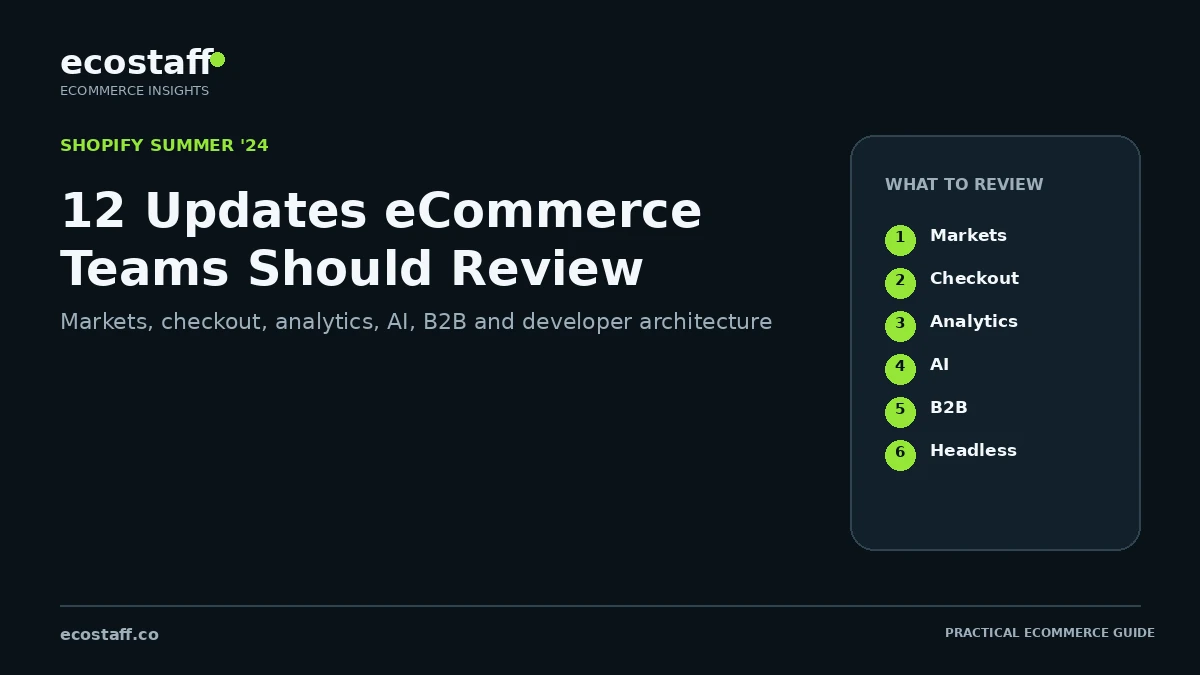
Shopify released its Summer ’24 Edition on June 24, 2024 with more than 150 updates. The release focused on unifying commerce across markets, B2B, retail and online selling, while also expanding analytics, AI, checkout, developer tooling and international growth capabilities.
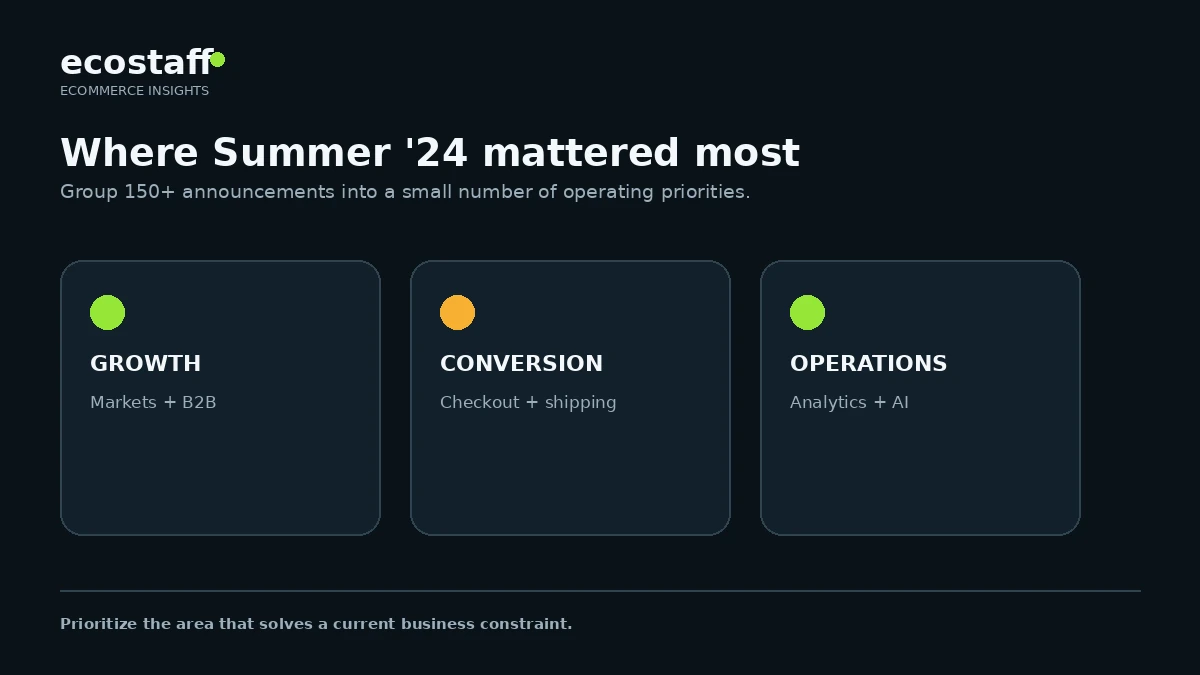
For most eCommerce teams, the useful task was not to activate 150 features. It was to identify which updates changed an existing constraint: market expansion, checkout complexity, analytics, B2B operations, product discovery, content workflows or developer architecture.
Shopify Editions are intentionally broad. The release format combines major strategic changes with smaller merchant conveniences, which makes it easy for teams to either overreact or ignore the release entirely. Summer ’24 was especially important because many updates were about consolidation: bringing markets, analytics and workflows into more unified systems.
This guide focuses on the changes an eCommerce operator, product owner or technical lead should have reviewed in 2024, and separates high-impact architecture decisions from optional productivity improvements.
1. Markets became a broader growth command center
Shopify described the reimagined Markets as a central command center for expansion across international selling, B2B and in-person retail. The strategic shift was important: instead of treating each growth mode as a separate administration problem, Shopify was moving toward one place to configure buyer experiences by market.
For merchants already operating multiple stores, countries or B2B catalogs, this was worth reviewing because consolidation can change both architecture and operating cost. Teams should compare what is centralized, what remains market-specific and how apps or ERP integrations behave under the new structure.
2. Split shipping made complex fulfillment clearer at checkout
Summer ’24 introduced more visible support for split shipping in checkout. Customers could receive clearer information when an order required multiple shipments and, depending on configuration, choose between delivery options.
This matters for merchants with multi-location inventory, preorder items, mixed fulfillment models or large catalogs. Shipping clarity is not merely a logistics feature: unexpected delivery splits can affect trust, support volume and checkout conversion.
3. Shopify continued expanding AI in the admin
Shopify highlighted Sidekick and additional AI-assisted media and inbox capabilities. For eCommerce teams, the value of these tools depends on workflow fit. AI can accelerate repetitive tasks, but the merchant still needs clear product data, brand rules and approval processes.
The right test is not whether AI can generate content. It is whether it reduces time-to-publish without creating factual, legal or brand-quality problems.
4. Analytics received a major redesign
Shopify announced all-new analytics in Summer ’24. A more flexible reporting layer matters because many merchants previously moved quickly from Shopify reports into spreadsheets or external BI tools.
Before changing a reporting workflow, teams should compare metric definitions, attribution assumptions and historical consistency. A new dashboard is useful only if finance, marketing and operations understand what the numbers mean.
5. Checkout continued moving toward extensibility
The Summer release arrived shortly before the August 13, 2024 checkout.liquid deadline for Shopify Plus in-checkout pages. That made Checkout Extensibility more than a developer topic. Merchants still using legacy checkout code needed to prioritize migration and testing.
If your store relied on checkout.liquid at the time, the detailed Checkout Extensibility migration guide should be treated as a separate implementation checklist.
6. B2B capabilities kept becoming more native
Shopify had been steadily expanding B2B on Shopify, and Summer ’24 continued that direction inside the broader Markets experience. The opportunity for merchants was to reduce custom B2B logic where native company, catalog, pricing or market features could now handle the requirement.
The risk is assuming native automatically means sufficient. Complex B2B programs may still need ERP integration, account workflows, quoting, tax logic or custom permissions. A fit-gap analysis is more useful than a feature checklist.
7. International expansion became more integrated
Markets was also a signal that cross-border selling was becoming part of Shopify’s core operating model rather than a separate project. Currency, domains, localization, duties, catalog differences and regional merchandising all affect the actual expansion architecture.
Before consolidating multiple stores into one international setup, compare SEO requirements, legal entities, fulfillment, tax, content ownership, analytics and local app dependencies. Platform consolidation can reduce complexity in one area while increasing it in another.
8. Developer tooling continued supporting headless builds
Shopify’s developer update highlighted ongoing investment in Hydrogen, Oxygen, Storefront API and visual development. The integration of Utopia into Hydrogen was one example of Shopify trying to make headless development more accessible and collaborative.
This does not mean every merchant should go headless. A headless architecture should solve a real experience, integration or organizational problem. Otherwise, the merchant may trade theme constraints for a larger engineering surface.
9. Product and merchandising workflows kept getting richer
Across Editions, Shopify continued reducing the number of cases where merchants need custom code for merchandising and catalog operations. Teams with large catalogs should review new native options before commissioning another app or custom workflow.
A simple rule is useful: if a recurring process is now native and meets the business requirement, compare the long-term cost and maintainability of the native option against the existing custom solution.
10. Store performance remained a platform-level priority
Winter ’24 had already introduced Shopify’s new web performance dashboard based on Core Web Vitals and real-user data. Summer ’24 continued the broader direction of tighter platform performance and developer tooling.
For teams working on responsiveness, the INP for eCommerce guide explains why a storefront can load quickly and still feel slow when shoppers interact with filters, variants or cart controls.
11. Merchant productivity features added up
Not every Edition update deserves a project. Smaller admin, content, AI, search and workflow improvements can still create meaningful time savings when used repeatedly. Product teams should maintain a lightweight release-review process so these gains are not lost.
A 10-minute workflow improvement used by 20 people every week may be more valuable than a large feature that nobody adopts.
12. The platform was becoming more unified, but architecture still matters
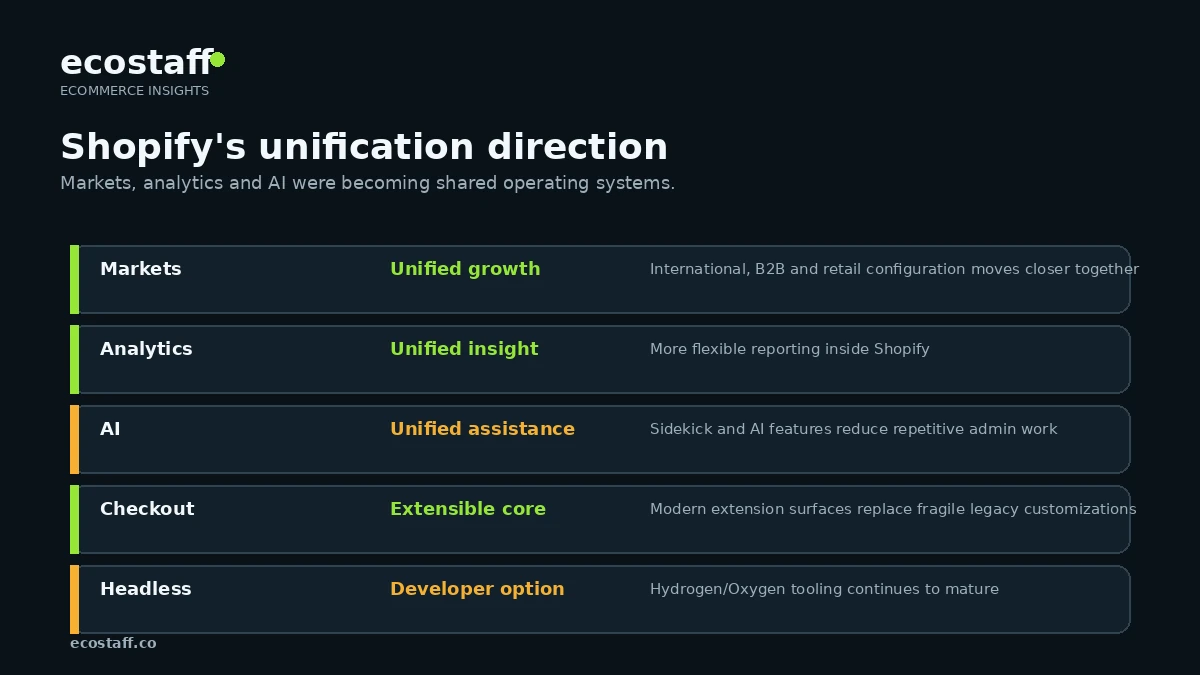
The Summer ’24 theme was unification. That can reduce operational fragmentation, but it does not eliminate architecture decisions. Merchants still need to decide when to use native features, apps, custom development or external systems.
| Update area | Potential business value | Main question to ask |
|---|---|---|
| Markets | Simpler multi-market operations | Can we consolidate workflows without losing required regional control? |
| Split shipping | Clearer delivery expectations | Does it improve checkout clarity for our fulfillment model? |
| Analytics | Faster reporting and exploration | Do definitions and historical comparisons remain trustworthy? |
| AI / Sidekick | Lower operational effort | Which tasks can be accelerated without reducing quality or control? |
| Checkout Extensibility | More upgrade-safe checkout customization | Have all legacy dependencies been migrated and tested? |
| B2B | More native wholesale capabilities | Which custom processes can safely move to Shopify? |
| Headless tooling | More flexible storefront development | Do we have a business case strong enough to justify the engineering surface? |
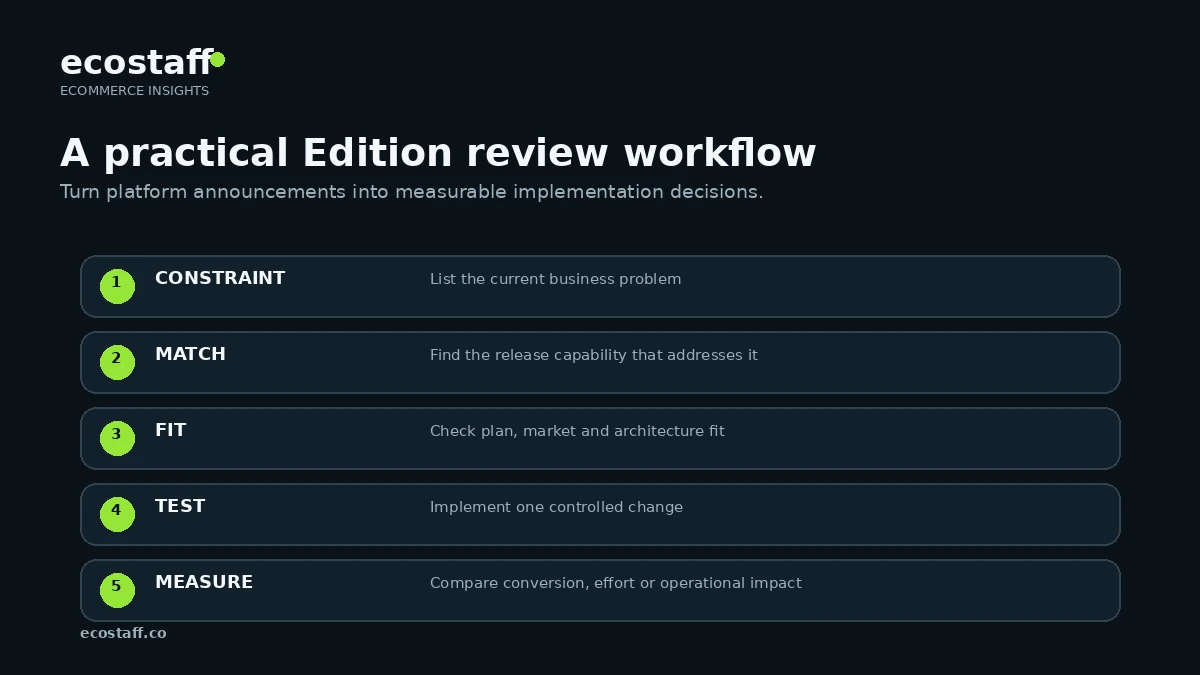
A practical Summer ’24 review process
- List the three biggest commercial or operational constraints in the store.
- Map Summer ’24 updates only to those constraints first.
- Check plan, market and rollout availability before planning implementation.
- Identify dependencies on apps, custom code, ERP, analytics or checkout.
- Estimate migration and QA effort, not only feature value.
- Test one change in a controlled environment.
- Measure the effect on conversion, operations, support load or development effort.
- Document what was adopted, rejected or deferred.
When should a merchant involve a Shopify agency?
An agency is useful when an Edition update changes architecture rather than configuration: multi-market consolidation, B2B integration, checkout migration, custom apps, headless storefronts or complex analytics. Routine admin improvements usually do not need external support.
Ecostaff organizes Shopify-focused companies by public expertise and company data. When evaluating a partner, use the agency-selection framework to compare process, evidence and delivery risk.
Frequently asked questions
Did merchants need to adopt every Summer ’24 update?
No. Shopify Editions are broad product announcements, not mandatory migration lists. Some changes required action because of separate deadlines or deprecations, while many others were optional capabilities.
Was Summer ’24 only relevant to Shopify Plus?
No. The release covered capabilities across Shopify, although some features were plan-specific, market-specific or rolling out gradually. Availability should always be checked before implementation.
Did Summer ’24 make headless the default choice?
No. Shopify continued investing in headless tooling, but standard theme architecture remains appropriate for many stores. Headless should be selected for a clear business or technical reason.
What was the first thing a merchant should review?
Start with current constraints. If checkout migration, international complexity or reporting quality was already a problem, prioritize the relevant Summer ’24 area before exploring lower-impact productivity features.
Sources and further reading
- Shopify – Summer ’24 Edition highlights
- Shopify Editions – Summer 2024
- Shopify – Developer updates in Summer ’24
Conclusion
Shopify Summer ’24 was notable less because of one headline feature and more because of the platform’s direction toward unified commerce. Markets, analytics, B2B, checkout, AI and developer tooling were increasingly designed to work as connected systems.
The practical response for an eCommerce team is selective adoption. Review the release against real business constraints, test the architecture implications and implement only the changes that create measurable value.